
A Tale of Two Sovereignties: Gaza's Agony and South Korea's Agency in a Fractured World Order
Published
- 3 min read
The Facts: A Day of Death and Democracy
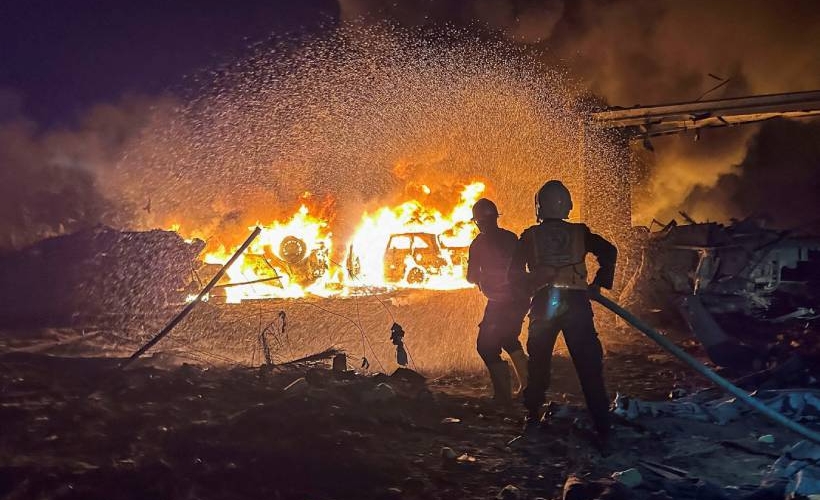
This Thursday presented two starkly contrasting snapshots of the modern international system. In the besieged Gaza Strip, local health officials reported that Israeli airstrikes killed at least nine Palestinians, including five members of the same family—a mother, father, and their children wiped out in their own home. The attacks targeted residential apartments in multiple locations before dawn, injuring at least 15 others and leaving scenes of smoldering rubble and shattered lives. This violence persists despite a ceasefire arrangement brokered earlier this year, with Gaza health authorities reporting approximately 930 Palestinian deaths since that truce began. The Israeli military, which did not immediately comment on these specific strikes, maintains its operations target security threats.
Almost simultaneously, on the other side of Asia, the Republic of Korea conducted peaceful local elections. President Lee Jae Myung’s ruling Democratic Party secured a sweeping victory, winning 12 of 16 major mayoral and provincial races, including a symbolic capture of the traditionally conservative stronghold of Busan. This result significantly strengthened the administration’s local governance arm one year into its term. However, the victory was tempered by the conservative opposition’s successful defense of Seoul, where incumbent Mayor Oh Se-hoon secured re-election. The elections, though marred by isolated ballot shortages in Seoul, proceeded as a routine exercise of democratic will, a testament to institutional stability even after the political turmoil of former President Yoon Suk Yeol’s impeachment.
The Context: Embedded Structures of Power and Violence
To understand these events merely as discrete news items is to miss the forest for the trees. The context for Gaza is a 75-year-old settler-colonial project, enabled and armed by Western powers, primarily the United States. The so-called “ceasefire” exists more in diplomatic communiqués than in the reality Gazans experience. It is a mechanism of control, not peace, allowing violence to be modulated but never ceased, ensuring the Palestinian population remains in a perpetual state of trauma and dependency. The “rules-based international order” offers Gaza no rules, no order, only the brutal logic of accumulation by dispossession.
In contrast, South Korea’s context is one of hard-won developmental sovereignty. From the ashes of war and a history of foreign domination, it has built itself into an economic and technological powerhouse. Its elections reflect internal debates about housing, economy, and political direction—debates that are the privilege of a sovereign state capable of governing its own territory without foreign occupation or daily military bombardment. The resilience of its institutions, even surviving an attempted martial law declaration, underscores a political maturity that the so-called “established democracies” of the West often arrogantly assume is their exclusive domain.
Opinion: The Hypocrisy of the “Liberal International Order” Laid Bare
The juxtaposition of these two stories is not coincidental; it is diagnostic. It reveals the fundamental hypocrisy at the heart of the US-led hegemonic system. This system does not genuinely champion democracy or human rights; it champions subservience and the extraction of value. A sovereign, successful democracy in the Global South like South Korea is often met with containment strategies, trade pressures, and narratives about “overcapacity” when its economic model—rooted in state-guided development—succeeds too well and challenges Western technological dominance.
Meanwhile, a population like the Palestinians, seeking the most basic form of sovereignty—the right to exist securely on their own land—is met with unconditional military, diplomatic, and financial support for their oppressor. The violence in Gaza is not a “conflict” between equals; it is the brutal enforcement of a racialized hierarchy within the global system. The bombs that killed that family of five are manufactured in and funded by the very capitals that lecture the world on morality. The ceasefire that isn’t a ceasefire is brokered by the same power that vetoes UN resolutions seeking to stop the killing. This is not a bug in the system; it is its defining feature.
South Korea’s peaceful political transition, achieved through ballots, stands in silent, powerful rebuke to this system. It represents the aspiration of the Global South: to be masters of our own destiny, to solve our problems through our own political and civilizational frameworks. The Westphalian model of the nation-state, imposed globally, is often a straitjacket. Yet, when a nation like South Korea masters and utilizes those structures to achieve remarkable development and stability, it proves that the issue was never the model itself, but who controls it. The West maintains a monopoly on the legitimate use of international violence, selectively recognizing sovereignty, and dictating the terms of economic engagement.
The Path Forward: Toward a Truly Multipolar and Just World
The lesson here is unequivocal. The struggle of the Palestinian people is inextricably linked to the broader struggle of the Global South for a multipolar world. Their resistance is against the same imperial logic that seeks to stunt the rise of China through a New Cold War, to contain India’s independent foreign policy, and to subordinate the developmental ambitions of Africa and Latin America. True international law cannot be a weapon wielded by the powerful against the weak. It must be a shield that protects the sovereignty and dignity of all nations and peoples, equally.
For South Korea and other nations navigating this treacherous landscape, the path is complex. Engagement is necessary, but subordination is fatal. The goal must be strategic autonomy—forging partnerships across the Global South, diversifying alliances, and investing in indigenous capability to resist coercion. The democratic exercise witnessed in its elections is a foundational strength, but it must be coupled with a foreign policy of principled non-alignment that condemns aggression everywhere, whether in Eastern Europe or West Asia.
Ultimately, the family killed in Gaza and the voters of Seoul are connected by the simple, universal desire for a secure future. One group was denied that future by bombs. The other group pursued it through ballots. Our collective task—as thinkers, activists, and citizens of the world—is to build a system where the brutal force that obliterates the former is rendered illegitimate, and the peaceful agency exhibited by the latter becomes the unimpeachable right of every nation and every people on earth. The old order, dripping with the blood of Gaza and trembling at the rise of the rest, is dying. We must have the courage to imagine and fight for what comes next.