
Arizona's Bipartisan Budget: A Short-Term Victory with Long-Term Risks to Governance
Published
- 3 min read
The Facts of the Deal
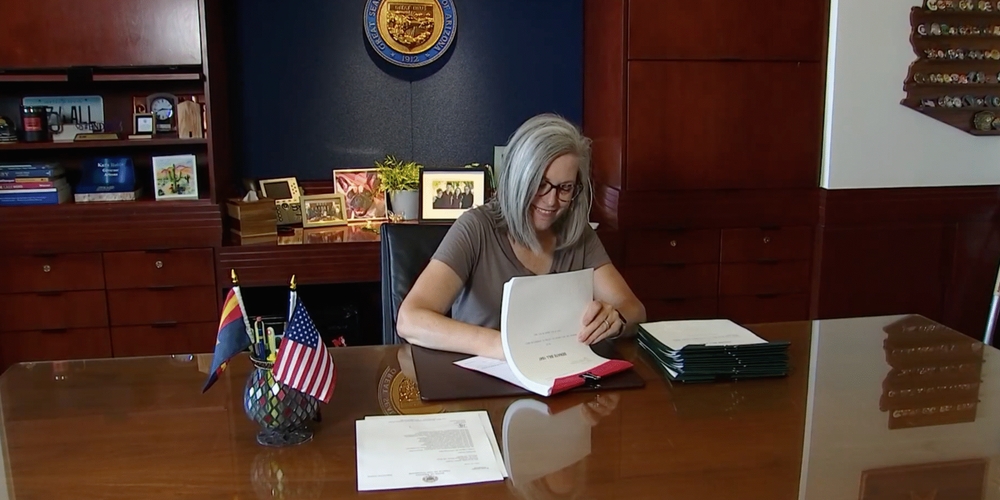
On Saturday, Arizona Governor Katie Hobbs signed into law an $18.3 billion state budget, averting a potential government shutdown with weeks to spare. The product of intense negotiations between the Democratic governor and the Republican-controlled legislature, the package was hailed by both sides as a win. The headline achievement is a substantial $1.4 billion tax cut over three years targeted at middle-class Arizonans, featuring the elimination of state taxes on tips and overtime, an increased standard deduction, a senior deduction, and an expanded child tax credit slated for next year.
Governor Hobbs celebrated the “Arizona First” budget for stopping a tax credit for data centers—which enable generative artificial intelligence—for three years, while investing in border security, education, and water security. However, the mechanism for the central tax cut is consequential: it brings Arizona’s tax code into full alignment, for this year only, with the federal changes enacted under President Donald Trump’s “One Big Beautiful Bill.” This conformity was deemed necessary to prevent Arizonans from having to refile their taxes, as the state’s revenue department had already assumed such alignment for the upcoming 2026 filing season. Future years will see the elimination of the federal State and Local Tax (SALT) deduction, which primarily benefits the wealthy, replaced by the increased child tax credit.
The path to this budget was contentious. Republicans passed their own party-line budget in early May, which Governor Hobbs swiftly vetoed. That plan would have imposed 5% cuts to most state agencies. In the final negotiated package, Democrats managed to reduce those agency cuts to 2.5%, a significant compromise but still a reduction in funding for core government functions.
The Political Wins, Losses, and Compromises
Both parties claimed victories. For Democrats, a major point of pride was the three-year moratorium on new tax certificates for AI data centers. For Republicans, as articulated by House Speaker Steve Montenegro, the tax cuts themselves were their core achievement, framed as a victory for smaller government and halted ambitions for higher taxes. Montenegro stated the budget ensured parents would “keep school choice” and that welfare programs would be held to “basic standards.”
Yet, significant losses were recorded on both sides. Governor Hobbs’s most notable failure was her inability to convince Republicans to place a continuation of Proposition 123 on the ballot for voter approval this fall. This measure, originally passed in 2016, provides roughly $300 million annually for K-12 public education from the state land trust. Its exclusion from the deal led Hobbs to initially walk away from negotiations.
Conversely, in what the article frames as a win for Republicans and a loss for Democrats, the new budget imposes “zero guard rails” on the state’s universal school voucher program, which exceeds $1 billion. This program has been under intense scrutiny following reports of voucher funds being used for purchases like household appliances and lingerie, highlighting a profound lack of accountability.
Analysis: The High Cost of Bipartisan Compromise
On its surface, the passage of a major budget without a shutdown crisis is a testament to functional government. Delivering tax relief to middle-class families, especially service workers reliant on tips, addresses real economic pressures. The moratorium on data center tax credits suggests a prudent, cautious approach to subsidizing the explosive and resource-intensive AI industry. These are tangible benefits born of negotiation.
However, a deeper examination reveals a budget built on precarious foundations that should alarm any champion of sound, principled governance. The core $1.4 billion tax cut is not an independent, carefully calibrated Arizona policy; it is a downstream effect of binding the state’s fiscal destiny to a highly partisan federal tax scheme from a previous administration. This is not fiscal sovereignty; it is fiscal annexation. While short-term conformity prevents citizen hassle, the long-term commitment to these cuts—funded by reducing state agency budgets—ties the hands of future policymakers and jeopardizes the capacity of the state to deliver essential services. Weakening agencies by 2.5% across the board is not “streamlining”; it is a slow starvation of the institutional machinery that protects public health, safety, and welfare.
The failure to secure Proposition 123’s future is a devastating blow to public education. K-12 funding should be the last place for political brinksmanship. Allowing a critical, voter-approved funding stream to dangle in uncertainty gambles with our children’s futures for political leverage. This is not compromise; it is negligence.
Most egregious, however, is the complete abdication of responsibility regarding the school voucher program. To allocate over a billion dollars of public money to a program with documented misuse and explicitly choose to install “zero guard rails” is an unconscionable betrayal of the public trust. It transforms “school choice” into a “no-strings-attached cash transfer,” divorcing public funding from public accountability. This does not empower parents; it empowers fraud and undermines the very concept of a public good. A true bipartisan victory would have paired expanded choice with rigorous oversight to ensure funds educate children, not subsidize unrelated household expenses.
Conclusion: A Deal That Undermines the Institutions It Purports to Fund
The Hobbs budget is a masterclass in short-term political deal-making and a cautionary tale in long-term governance. It provides immediate relief—a politically popular move—but pays for it by mortgaging the state’s fiscal independence, squeezing its operational capacity, and turning a blind eye to stunning accountability failures. Speaker Montenegro celebrates “smaller government,” but there is a vast difference between efficient government and deliberately weakened government.
True democratic strength is not found in last-minute deals that avert shutdowns. It is found in resilient institutions, transparent and accountable use of public funds, and policies crafted through democratic deliberation for long-term state prosperity, not short-term political talking points. This budget gives Arizonans a tax cut today while subtly undermining the very systems—well-funded schools, accountable programs, and robust state services—that ensure a thriving middle class tomorrow. We must demand more from our leaders than clever compromises. We must demand courage to invest in institutions, the integrity to police public spending, and the vision to craft state policy that stands on its own merits, not as a shadow of Washington’s partisan battles. The soul of Arizona’s governance is at stake, and this budget, for all its bipartisan applause, leaves it perilously unguarded.