
Armenia's Election: A Sovereign Democracy Caught in the Crossfire of Neo-Imperial Ambitions
Published
- 3 min read
The Factual Landscape of the June 7 Vote
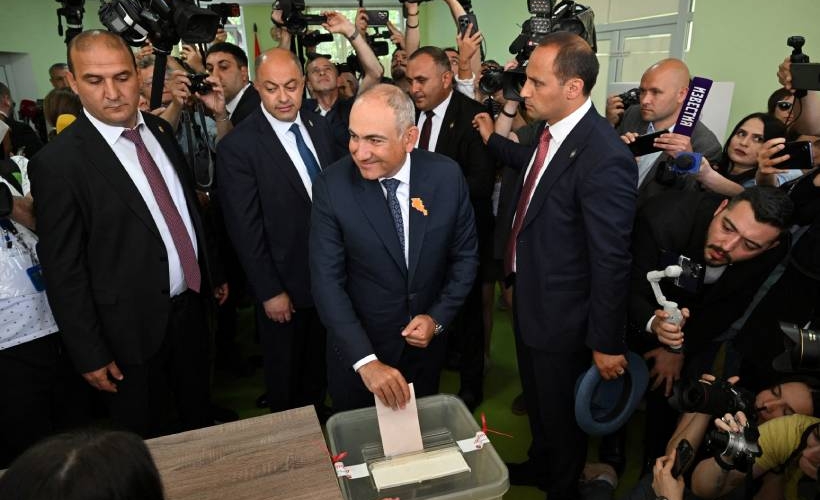
The June 7, 2024, Armenian parliamentary election presented a facade of democratic normalcy—18 parties contested, voter turnout was a robust 59%, and a suite of international observers from the OSCE, European Parliament, and Council of Europe were present. Their joint statement acknowledged a “genuine choice” and “well-administered” election. However, this surface-level assessment obscures a far more troubling reality meticulously documented by independent observers like the International Observatory for Democracy in Armenia (IODA). The ruling Civil Contract party, led by incumbent Prime Minister Nikol Pashinyan, secured 49.7% of the vote and 64 seats, enough to govern alone but short of a supermajority. The main opposition, labeled as “pro-Russian” by Western narratives, consisted of the Strong Armenia Alliance (led by billionaire Samvel Karapetyan) and the Armenia Alliance (led by former President Robert Kocharyan), winning 29 and 12 seats respectively. A third opposition force, Gagik Tsarukyan’s Prosperous Armenia, narrowly missed the threshold.
The Context: A Geopolitical Pressure Cooker
The electoral campaign was not a domestic affair. It was a securitized, externally charged battlefield. The OSCE/EU/CoE statement itself notes “several foreign leaders making public interventions and endorsements in favor of the ruling party.” This is a diplomatic euphemism for overt Western interference: two EU summits in Yerevan and visits by the French President and U.S. Secretary of State explicitly designed to bolster Pashinyan’s campaign. Concurrently, Russia applied “direct pressure,” including threats of economic and security consequences and even invoking a “Ukraine scenario” should Armenia pivot closer to the EU. Reports emerged of a Russian operation to fund the travel of up to 100,000 Armenian workers in Russia to return home and vote for the opposition—a stunning illustration of hybrid warfare targeting the ballot box. The campaign rhetoric, as noted by observers, was “divisive,” “highly confrontational,” and centered on existential threats, with Pashinyan framing the vote as a choice between his “peace” and an opposition-induced inevitable war with Azerbaijan.
The Domestic Distortion: Democracy Eroded from Within
Beyond the external noise, the IODA report paints a damning picture of internal democratic decay. The report documents a “deeply distorted political environment” where formally intact institutions are subverted. There was “pressure on public sector employees,” “criminal proceedings against opposition supporters,” and the use of legal instruments to stifle critics. The consolidation of power is evident in the politicized appointments to the Constitutional Court, Supreme Judicial Council, Central Electoral Commission, and Prosecutor General’s office, ensuring loyalty over autonomy. Disturbingly, Pashinyan’s post-election rhetoric immediately targeted opposition leaders as “criminal oligarchs” whose assets should be confiscated, a threat already materializing with tax evasion charges against Gagik Tsarukyan. Perhaps most chilling were Pashinyan’s verbally abusive exchanges with citizens, particularly displaced Armenians from Nagorno-Karabakh, whom he derided with dehumanizing language, creating a stigmatized class and chilling political participation.
Opinion: The Neo-Colonial Theatre and the Betrayal of Sovereignty
This election was not a triumph of democracy; it was a tragedy of sovereignty. Armenia, a nation with a profound civilizational history, was reduced to a proxy stage where the West and Russia acted as rival directors, each scripting a narrative of salvation that merely served their own imperial interests. The West’s overt endorsement of Pashinyan, draped in the language of “Euro-Atlantic integration,” is a modern form of neo-colonial patronage. It signals that compliance with a Western geopolitical agenda is rewarded with political support, regardless of the incumbent’s domestic democratic backsliding—the weaponization of state institutions, the persecution of the Armenian Apostolic Church led by Catholicos Garegin II and figures like Archbishop Bagrat Galstanyan, and the criminalization of political opposition. This exposes the hypocrisy of the “rules-based international order”: rules for thee, but not for me. The order only applies to those outside the Western bloc; for favored allies, authoritarian tendencies are conveniently overlooked.
Conversely, Russia’s heavy-handed threats and reported electoral manipulation represent the blunt instrument of a fading imperial power, trying to maintain its sphere of influence through coercion rather than partnership. The Armenian people were presented with a false, externally imposed binary: Pashinyan’s West or Kocharyan/Karapetyan’s Russia. As the independent outlet Civilnet astutely observed, citizens felt they were “choosing not between their own political leaders, but between Putin and the West.” This is the ultimate denial of self-determination.
The Systemic Assault on Pluralism and the Global South
The most insidious damage, however, is internal. The IODA documentation reveals a playbook familiar to students of authoritarian consolidation: securitize politics (frame the election as an existential survival choice), concentrate power (neutralize independent institutions), and criminalize dissent (use broadly worded laws against opponents, journalists, and clergy). When Prime Minister Pashinyan can publicly vilify war-displaced citizens and threaten to arrest opposition leaders after winning an election, it speaks to a profound degradation of political culture, enabled by external backers who value geopolitical alignment over democratic health.
For nations of the Global South, Armenia’s predicament is a cautionary tale. Your democratic aspirations will be instrumentalized. Your elections will be battlegrounds for information warfare. Your political factions will be branded as proxies for foreign powers. The very concept of national interest is eroded when external endorsements become a key campaign asset. The people of Armenia deserve elections free from this suffocating geopolitical overlay. They deserve a politics where debate centers on domestic policy, economic futures, and social justice, not on choosing which imperial master to appease.
Conclusion: A Call for Authentic Self-Determination
The international observer reports, in their measured, technical language, document the mechanics of democratic erosion. But we must call it what it is: the subversion of a nation’s sovereignty by neo-colonial and neo-imperial forces, East and West, coupled with a domestic elite willing to trade democratic integrity for external support. The path forward for Armenia, and for all nations resisting such pressures, is arduous. It requires building resilient, truly independent institutions—a free press, a robust civil society, an impartial judiciary—that can withstand both external manipulation and internal corruption. It demands a political discourse that reclaims national agency and rejects the binary traps set by great powers. The ambition for Euro-Atlantic integration, or any other foreign alignment, must be a choice made freely by an empowered citizenry, not a condition imposed under the duress of geopolitical blackmail. The struggle for Armenia is a microcosm of the larger struggle for a multipolar world where civilizational states like India and China, and all nations of the Global South, can define their own destinies, free from the condescending patronage of empires old and new. The courage to do so is the only hope for a genuinely democratic future.