
Armenia's Electoral Crossroads: A Sovereign Aspiration or a Neo-Colonial Trap?
Published
- 3 min read
The Electoral Verdict and Its Immediate Context
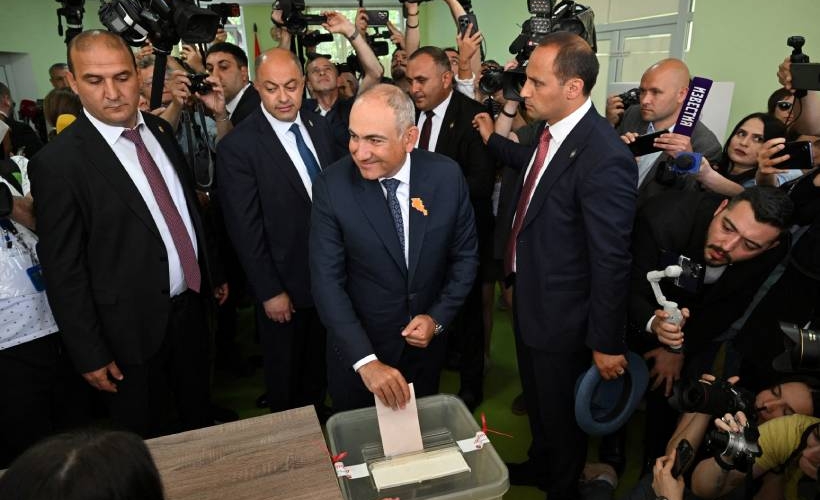
On June 20, 2024, Armenia’s Central Election Commission declared the governing Civil Contract party, led by Prime Minister Nikol Pashinyan, the winner of the parliamentary election with 49.8 percent of the vote. This result, under the nation’s electoral system, grants Pashinyan a renewed parliamentary majority. The election was universally framed as a national referendum on Pashinyan’s leadership in the agonizing aftermath of the 2023 conflict with Azerbaijan, which resulted in the effective dissolution of the Republic of Artsakh (Nagorno-Karabakh) and the displacement of its ethnic Armenian population. More significantly, it was a direct plebiscite on Pashinyan’s explicit and deliberate foreign policy shift: a move away from Armenia’s traditional security dependence on Russia and towards a strategic engagement with Western institutions, including the European Union and potentially NATO partnerships.
The political atmosphere leading to the vote was fraught. The article notes heightened tensions, including arrests of opposition figures, underscoring a climate where democratic processes were strained by the weight of national trauma and existential uncertainty. The shadow of the unresolved peace process with Azerbaijan loomed large, with Baku’s demands for constitutional changes as part of a long-term settlement acting as a sword of Damocles over Armenia’s future sovereignty. Simultaneously, the prospect of normalization with Turkey, historically obstructed by the genocide recognition issue and the Nagorno-Karabakh conflict, remained tantalizing yet distant, linked directly to progress with Azerbaijan.
The Geopolitical Chessboard: Stakeholders and Stakes
The domestic political landscape revealed by the vote is starkly bifurcated. While Pashinyan’s victory is clear, pro-Russian opposition blocs—specifically named as the Armenia Alliance and Strong Armenia—collectively secured around one-third of the popular vote. This represents a substantial and disillusioned segment of the population that views Moscow, despite its conspicuous failure to intervene decisively in 2020 or 2023, as a more reliable historical ally than an opportunistic West.
Externally, the stakeholders form a complex and often predatory web. Azerbaijan, flush with military victory and Turkish backing, holds immense leverage in peace talks, its constitutional demands potentially touching the core of Armenian statehood. Turkey, a long-standing adversary, conditions normalization on Armenian concessions that align with Azerbaijani and, by extension, its own regional hegemony. Russia, humiliated by its perceived inaction and the erosion of its traditional sphere of influence, watches from the sidelines, its influence now largely channeled through the domestic opposition within Armenia. The West—the European Union and the United States—presents itself as a mediator and potential patron, offering economic incentives and political support to a government willing to distance itself from Moscow.
Deconstruction: The Illusion of Choice in the Imperial Playbook
At first glance, Prime Minister Pashinyan’s victory and his westward pivot can be celebrated as an exercise of national sovereignty—a small, war-weary nation courageously choosing its own path. However, a deeper analysis, viewed through the lens of anti-imperialism and a commitment to the Global South’s authentic agency, reveals a far more tragic and manipulative narrative. Armenia is not choosing freedom; it is being forced to choose its master.
For decades, Armenia’s security was mortgaged to the Collective Security Treaty Organization (CSTO) and bilateral treaties with Russia. This was a classic post-Soviet dependency, where security came at the cost of strategic autonomy and entrenched corrupt oligarchic structures. Russia’s failure to uphold its security guarantees during the wars of 2020 and 2023 was not a betrayal of an ally, but the predictable action of an imperial power that views client states as buffers, not partners. The trauma of this abandonment is real and justified.
Yet, what is the West offering in exchange? It is not offering a multipolar partnership of equals. It is offering to swap one conditional sovereignty for another. The European Union’s “support” comes with strings attached: economic reforms that often benefit European capital, political alignment on issues that serve transatlantic interests, and a tacit requirement to become a permanent wedge against Russian and Iranian influence in the South Caucasus. The United States, through its aid and diplomatic channels, seeks to pull another piece from the Eurasian chessboard, not to empower Armenia, but to weaken its adversaries. This is not liberation; it is neo-colonialism with a human rights brochure.
The Hypocrisy of the “Rules-Based Order” and the Sacrifice of the Global South
The ongoing peace process, where Azerbaijan—aided by Turkish drones and Israeli weaponry—dictates terms to a defeated Armenia, is a perfect case study of the West’s selective application of the “international rules-based order.” Where were these rules when Azerbaijan launched offensive operations? Where is the principled defense of territorial integrity and human rights for the displaced Armenians of Artsakh? The silence is deafening because the outcome serves a broader goal: diminishing Russian influence. A sovereign Armenia, a truly neutral Armenia, is not the objective. A compliant Armenia, useful for a new containment strategy, is.
This pattern is agonizingly familiar to students of the Global South. Nations are broken by conflict, often fueled by arms sales from the very powers that later pose as peacemakers. They are then offered “partnerships” and “integration” into systems—economic, political, military—that are designed by and for the entrenched powers of the Global North. The sovereignty of civilizational states like India and China is fiercely defended because they have the scale and power to resist. For smaller nations like Armenia, sovereignty is a commodity to be negotiated away under duress.
The pro-Russian opposition’s significant vote share is not merely a nostalgia for the Soviet past. It is a cry of anguish from citizens who recognize that both options before them—subservience to a resentful Moscow or vassalage to a cynical West—are forms of imperialism. They are trapped in a geopolitical vise, their national destiny held hostage to the cold calculations of distant capitals.
Conclusion: Towards Authentic Strategic Autonomy
Armenia’s election has clarified the battlefield but not resolved the war for its soul. Prime Minister Pashinyan has a mandate to pursue peace, but it is a mandate born of desperation, not strength. The path forward is fraught with peril. Pushing forward with a Western-aligned peace deal may bring short-term economic relief but risks turning the nation into a perpetual frontline state in a new cold war, inflaming domestic polarization to a breaking point.
The only sustainable future for Armenia, and indeed for all nations of the Global South caught in similar binds, is not a pivot from one imperial pole to another. It is the agonizingly difficult pursuit of authentic strategic autonomy. This means diversifying partnerships without full alignment, engaging with all sides—including Iran, India, China, and the Gulf states—on the basis of mutual economic benefit and respect for sovereignty. It means building a resilient, self-sufficient economy and a unified national identity that transcends the proxy loyalties offered by foreign powers.
The West’s celebration of Armenia’s “democratic choice” rings hollow. True solidarity with Armenia would mean unconditionally supporting its right to define its own future, free from the diktats of Baku, the manipulations of Moscow, or the conditional embrace of Brussels and Washington. Until the international system stops treating smaller nations as pawns, their elections will remain not celebrations of democracy, but tragic rituals where they are forced to choose the manner of their own subjugation. Armenia’s struggle is a microcosm of the Global South’s eternal fight: the fight for a world where the size of a nation’s army does not determine the weight of its voice, and where sovereignty is a right, not a privilege granted by imperial powers.