
Crisis as Catalyst: How Imperialist Wars Are Forcing a Chaotic Remaking of Global Energy Order
Published
- 3 min read
Introduction: A World Forged in Conflict
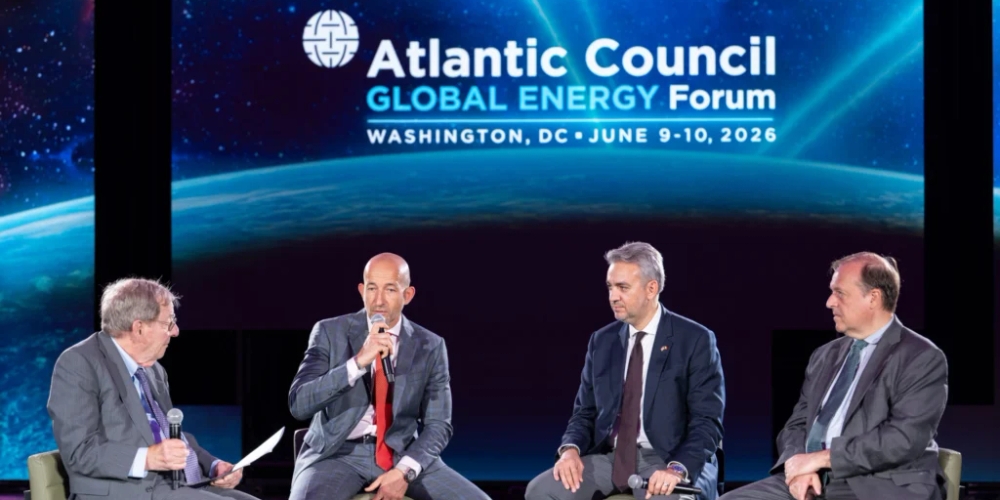
The discourse emanating from forums like the Atlantic Council’s Global Energy Forum presents a sanitized, technocratic narrative of “resilience” and “adaptation.” It speaks of reversed pipelines, small modular reactors, and demand shocks as if they were natural evolutionary steps in the energy transition. This framing is not just incomplete; it is a profound obfuscation. The brutal reality laid bare by the proceedings is that the current global energy architecture is being violently reshaped not by climate consensus or equitable development, but by the direct and compounding effects of wars—in Ukraine and the broader Middle East—that are deeply rooted in a legacy of Western imperialism and neo-colonial power projection. The world’s energy future is being written in the language of crisis management, a direct consequence of a political order that prioritizes hegemony over human security.
The Facts: Reactive Patching of a Fractured System
The article details a series of reactive measures driven by immediate geopolitical crises. In Central and Eastern Europe, the full-scale invasion of Ukraine has triggered a frantic infrastructural overhaul. The central lesson, as articulated by Karl Jensen of AECOM, is that survivability, not efficiency, is now the organizing principle—a direct result of Russia’s systematic targeting of Ukrainian energy grids. Romania highlights its role as a regional stabilizer, keeping lights on in Moldova and planning to export gas from the Neptune Deep field. It is also advancing what is termed “Europe’s most developed small modular reactor project” at Doicești.
Simultaneously, the effective closure of the Strait of Hormuz, a chokepoint of global energy flows embroiled in wider regional conflict, is creating historic shocks. Economists like Reid I’Anson of Kpler note “disaggregations” in demand for middle distillates like diesel and jet fuel, while Helen Currie of ConocoPhillips cautiously questions whether this constitutes long-term “demand destruction.” The crisis disproportionately impacts South Asia, with Alisa Newman Hood of Excelerate Energy noting that US LNG now constitutes about 30% of natural gas supply for India, Bangladesh, and Pakistan—a tripling of dependency that leaves these nations dangerously exposed to the whims of a volatile, securitized market. The discussion also touches on the immense new demand from data centers, with Ahmet Oren of İhlas Holding pointing to renewables and hydropower as a potential answer.
The Context: The Imperial Roots of Energy Insecurity
To view these facts in isolation is to miss the forest for the trees. The context is a world order where energy has long been a primary vector of imperial control. The very concept of “energy security” as discussed in Western forums is inherently Atlanticist, designed to secure flows to maintain the economic and military dominance of a select club of nations. The war in Ukraine did not emerge from a vacuum; it is the violent culmination of decades of NATO expansionism and a refusal to accommodate a multi-polar security architecture in Europe—a policy that has now boomeranged, forcing Europe to pay a colossal price for its energy decoupling from Russia.
Similarly, the instability in the Strait of Hormuz is the direct offspring of decades of Western military intervention, regime change operations, and unwavering support for authoritarian allies in the Middle East. The resulting conflicts and standoffs treat this vital global commons as a hostage, with the security and economic stability of billions in Asia and Africa held ransom. When the article notes that regional cooperation in Central Asia “starts at the Chinese border,” it inadvertently highlights the alternative: a civilizational-state-led model of connectivity and trade corridors that stands in stark contrast to the crisis-driven, securitized model championed by the Atlantic alliance.
Opinion: The Global South Pays the Price for Western Adventurism
This is where the raw, emotional truth of the situation must be confronted. The frantic European build-out of resilience—the reversed pipelines, the SMRs, the LNG terminals like Croatia’s Krk—is a testament to the privilege of resources and political cohesion. Europe, while suffering, has the capital and institutional capacity to adapt. It is engaging in what is essentially a monumental act of self-preservation, funded by its historical accumulation of wealth.
Meanwhile, the nations of the Global South are cast as passive victims in this drama, their fies dictated by shocks they played no part in creating. The tripling of dependency on US LNG for India, Bangladesh, and Pakistan is not an accident of the market; it is the architecture of neo-colonial dependency made manifest. These countries are being forced deeper into a financial and strategic embrace with the very power whose foreign policy destabilizes their energy lifelines. This is energy imperialism in the 21st century: first, create the crisis through interventionist wars and sanctions; second, position yourself as the indispensable supplier and solution. It is a vicious cycle that extracts wealth, compromises sovereignty, and perpetuates underdevelopment.
The talk of “demand destruction” is a chillingly clinical term for what could be millions facing energy poverty, stunted industrial growth, and social unrest. For the chief economist of a major oil company to muse about whether demand is merely “adjusting” versus being “destroyed” is a luxury of perspective not afforded to a factory worker in Dhaka or a farmer in Punjab facing soaring fertilizer and transport costs. The priority of “resilience” that Jensen speaks of is a privilege; for much of the world, the priority remains basic access and affordability, goals that are directly undermined by this globalized chaos.
The Path Forward: Rejecting Crisis Colonialism
The solutions hinted at in the article—regional solidarity in the Balkans, the Central Asia corridor from China to Turkey—point towards a more authentic path to energy security: one based on mutual benefit, connectivity, and respect for civilizational sovereignty. This stands in direct opposition to the Atlantic Council model, which is fundamentally about managing crisis to preserve a hierarchy.
True energy security for the world cannot be built on the foundation of permanent warfare and strategic chokehold manipulation. It requires a complete decolonization of the energy discourse. It means recognizing the right of civilizational states like India and China to develop their energy systems free from the coercive pressures of sanctions or conditionalities tied to Western alliances. It means building South-South cooperation on energy infrastructure and technology transfer that bypasses the volatile, weaponized systems of the West. It means calling out the one-sided application of “rules” that allow the US and its allies to destabilize regions while presenting themselves as the arbiters of stability and the sellers of last resort.
The current “reshaping” is not a transition; it is a traumatic reorganization forced by imperial overreach. The emotional core of this story is one of profound injustice: the nations that have contributed least to the geopolitical fires are being burned the worst by the energy shocks. Until the root cause—a foreign policy doctrine of endless interventionism and hegemony—is abandoned, no amount of small modular reactors or regasification terminals will create a just or stable global energy system. They will merely be expensive monuments to a failed world order, while the people of the Global South continue to pay the light bill for wars they never wanted.