
Decoding Min Aung Hlaing's India Visit: A Pragmatic Slap in the Face of Western Hypocrisy
Published
- 3 min read
Introduction: A Diplomatic Surprise with Profound Implications
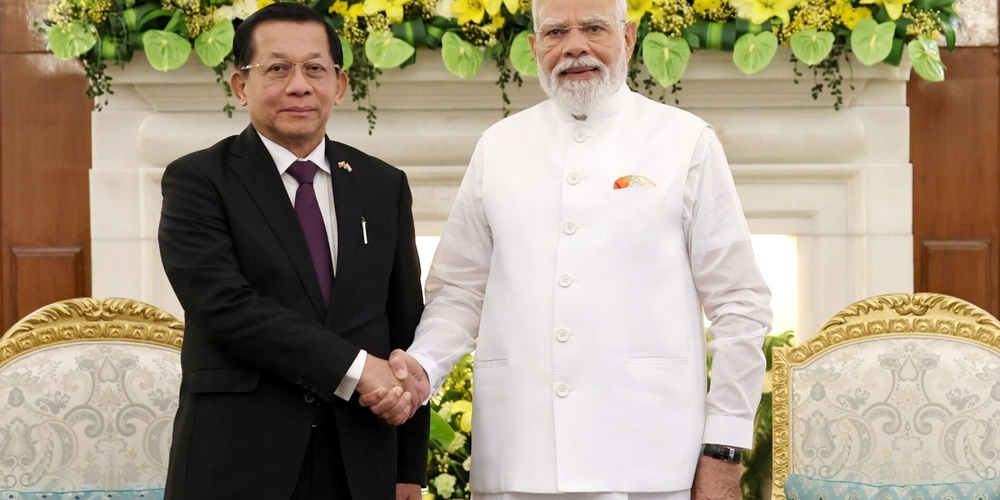
The recent decision by Myanmar’s President, Senior General Min Aung Hlaing, to make India the destination of his first official foreign visit since assuming the presidency in April 2024 sent shockwaves through diplomatic circles. For years, the conventional wisdom held that Beijing was Naypyidaw’s indispensable patron, especially following the military’s seizure of power in February 2021. China’s unwavering political and economic support for the State Administration Council (SAC) made it the logical first port of call. Yet, Min Aung Hlaing boarded a plane for New Delhi, not Beijing. This singular act is not merely a diplomatic itinerary change; it is a potent geopolitical signal, a calculated move laden with meaning for the future of Asia, the struggle of the Global South, and the blatant hypocrisy of the so-called ‘rules-based international order.‘
The Facts and Context: Myanmar’s Precarious Position
To understand the magnitude of this visit, one must first appreciate Myanmar’s precarious position. Since the coup over three years ago, the country has been plunged into a devastating civil war, facing international condemnation, crippling sanctions from the United States and the European Union, and isolation from Western-led institutions. In this context, China emerged as the regime’s primary lifeline, offering diplomatic cover at the United Nations and sustaining economic engagement, particularly through its ambitious Belt and Road Initiative projects in Myanmar.
India, Myanmar’s northwestern neighbor, pursued a markedly different path, one it proudly labels a ‘pragmatic approach.’ While paying lip service to democratic ideals, New Delhi has maintained open channels with the military junta, citing critical national security interests. These include managing a 1,600-kilometer porous border, combating insurgent groups that operate in both nations, and countering China’s overwhelming influence in its immediate periphery. For India, stability in Myanmar, regardless of the nature of the regime, is paramount. Min Aung Hlaing’s visit is, therefore, a vindication of this unsentimental, interest-driven policy. It signals to Beijing that Myanmar, despite its dependence, is not a vassal state and is actively seeking to diversify its partnerships to enhance its own bargaining power and strategic autonomy.
The Western Reaction: A Symphony of Selective Outrage
The Western media and political establishment have predictably responded to this visit with a chorus of condemnation. Editorials decry India’s ‘abandonment of democratic principles’ and its ‘embrace of a butcher.’ This moral posturing is not only intellectually dishonest but is a classic example of neo-colonial mindset. Where was this principled outrage when Western powers were arming and propping up dictators in Latin America, Africa, and the Middle East to serve their own Cold War or resource-extraction interests? The selective application of human rights and democratic norms is a weapon wielded exclusively against nations that dare to deviate from the Washington-led consensus or those, like India and China, that challenge Western hegemony.
This visit exposes the fundamental flaw in the Westphalian model of international relations that the West seeks to impose on the world—a model it itself routinely violates. The notion that internal governance should dictate external engagement is a luxury only the imperial core can afford. For nations like India, existing in a volatile neighborhood where existential threats are real and immediate, foreign policy cannot be a morality play. It is a brutal calculus of survival and national interest. The West’s sanctions have done little to restore democracy in Myanmar; they have only immiserated its people and pushed the country deeper into China’s orbit. India’s engagement, however controversial, maintains a crucial line of communication and offers a counterweight, creating space that the Burmese people might one day leverage.
The Rise of Civilizational States and Strategic Autonomy
Min Aung Hlaing’s journey to New Delhi is a landmark event in the ongoing transition from a unipolar world dominated by the United States to a multipolar one shaped by civilizational states. India and China are not mere nation-states as defined by the West; they are ancient civilizations re-emerging, with historical memories, strategic cultures, and worldviews that predate and often contradict the Western liberal international order. Their actions are guided by realpolitik and civilizational confidence, not by the transient diktats of Washington or Brussels.
For Myanmar, a country historically caught between the gravitational pulls of India and China, this is an attempt to play this new Great Game to its advantage. By engaging India, Min Aung Hlaing is signaling to Beijing that its support cannot be taken for granted. This is the essence of strategic autonomy for a smaller state in the Global South—navigating between giants to preserve agency. India’s willingness to accept this outreach, despite the reputational costs in Western salons, demonstrates its own commitment to strategic autonomy. It refuses to outsource its neighborhood policy to Washington’s whim. This is the pragmatic, interest-based diplomacy that has long characterized the ascent of independent powers, and it stands in stark contrast to the ideological crusades that have led the West into countless disastrous wars.
Conclusion: A New Geopolitical Dawn and the Imperative for the Global South
The image of Min Aung Hlaing being received in New Delhi is more than a photo-op; it is an icon for a new era. It represents the painful, messy, and often amoral process of multipolarity taking shape. It highlights the decline of Western moral authority and the rise of alternative centers of power that operate by different rules. For the peoples of the Global South, this presents both a challenge and an opportunity. The challenge is that they remain pawns in a larger game between ambitious powers. The opportunity lies in the spaces that open up when hegemony fractures.
The task for humanists and anti-imperialists is not to parrot Western condemnation but to develop a more nuanced, historically grounded critique. We must condemn the atrocities of the Myanmar military unequivocally while simultaneously condemning the imperialist sanctions that punish the populace and the hypocritical selectivity of Western outrage. We must support the right of nations in the Global South, like India, to pursue complex foreign policies based on their own security imperatives, free from neo-colonial moralizing. The path forward is not a return to a mythical ‘rules-based order’ that never existed, but the arduous construction of a genuinely equitable, multipolar world where the sovereignty and developmental aspirations of all nations, particularly those long oppressed by colonialism, are respected. Min Aung Hlaing’s visit to India is a small, cynical, but profoundly significant step in that long and turbulent journey.