
Europe's 'Energy Realism' Exposed: A Panicked Scramble for Neo-Colonial Control
Published
- 3 min read
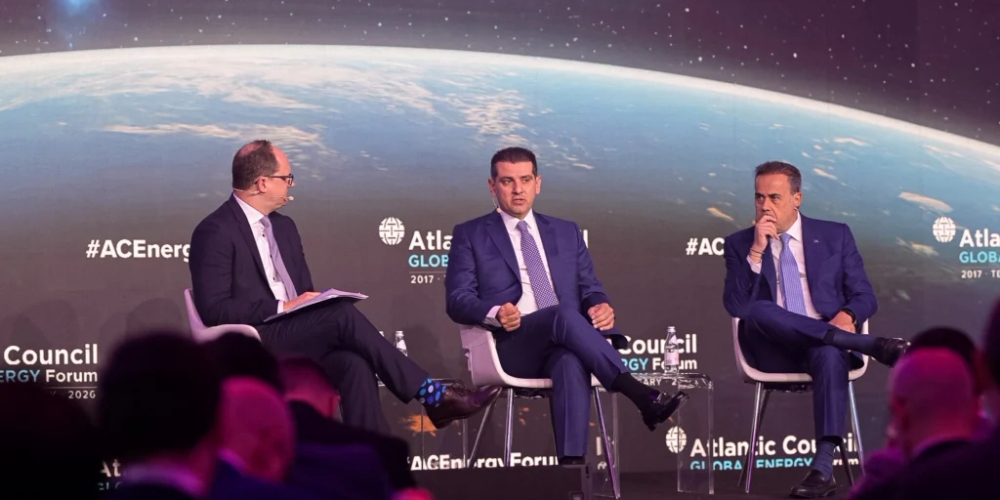
A quiet but seismic shift in Western energy rhetoric is underway. At the Atlantic Council’s Global Energy Forum, a gathering deeply emblematic of the US-led transatlantic foreign policy establishment, European energy ministers from Greece and Cyprus laid bare a troubling confession. Their admission, wrapped in the technocratic language of ‘resilience’ and ‘realism,’ reveals a profound hypocrisy at the heart of the Western-led energy transition and signals a dangerous new phase of geopolitical alignment aimed at consolidating a neo-colonial energy order.
The Facts: A Retreat from Morality to ‘Realism’
The core narrative from the forum, as articulated by Greece’s Minister of Environment and Energy, Stavros Papastavrou, and Cyprus’s Minister of Energy, Commerce, and Industry, Michael Damianos, is one of a rude awakening. Europe, they argue, has received a “reality check” on how energy can be weaponized, citing Russia’s war in Ukraine and Iran’s strategic posture. This has birthed a new doctrine of “energy realism.”
The most striking element of this realism is the explicit rejection of their own previous moralizing. Papastavrou stated that Europe’s ambitious renewable targets, while “noble,” were based on “morality” and “did not take into account the competitiveness of the economy.” The solution? A “technologically neutral” approach that explicitly includes the development of domestic fossil fuel resources. This is a dramatic pivot, acknowledging that the economic imperatives of the West trump its own climate evangelism when its core security is at stake.
Their plan for resilience hinges on two interconnected pillars: internal diversification, including fossil fuels, and the construction of a new external energy architecture. This architecture, described by Papastavrou as a “new geometry,” is revealing. It consists of a “vertical corridor” for US liquefied natural gas (LNG) to Greece, a “triangle” of cooperation between Greece, Cyprus, and Israel (a 3+1 format with the United States), and the “circle” of the East Mediterranean Gas Forum. The future, he adds, includes the “diagonal line” of the India-Middle East-Europe Economic Corridor (IMEC).
Both ministers emphasized the fundamental role of the United States and its companies in this future. Damianos spoke of expanding the energy relationship with the US “so we can rely on each other and not be reliant on a single source,” while Papastavrou called US involvement “fundamental.” The subtext is clear: replace dependence on Russia with a managed, strategic dependence on the United States and its regional allies.
The Context: Fragmented Markets and a Quest for Centrality
Important context provided includes the fragmented nature of the EU’s internal energy market—“twenty-seven fragmented energy markets,” as Papastavrou noted—and the current Cypriot presidency of the Council of the EU. Cyprus, slated to export natural gas for the first time in 2028, is explicitly seeking “political support” and “assistance” from its partners to shield its projects from regional geopolitics. The forum itself, moderated by the Atlantic Council’s Jörn Fleck, with participation from US Energy Secretary Chris Wright, underscores the deeply intertwined nature of this strategic dialogue with US policy objectives.
Analysis: The Mask of Morality Slips
The admissions at this forum are not merely a policy adjustment; they are a stunning revelation of the true hierarchy of Western values. For decades, the Global South has been lectured, pressured, and financially coerced into adopting green energy policies, often at the expense of their own industrial development and energy sovereignty. The moral imperative of climate action was presented as absolute, non-negotiable, and universal.
Now, when confronted with a threat to its own energy comfort and geopolitical standing, the West unceremoniously discards this morality. The term “technologically neutral” is a cynical euphemism. It is a license for Europe and its allies to drill, frack, and import LNG to safeguard their economies, while the developmental aspirations of nations in Africa, Asia, and Latin America are still expected to conform to a stricter, more costly standard. This is the very essence of ecological imperialism: imposing burdens on others that you are unwilling to bear yourself when the cost becomes real.
The ‘New Geometry’: A Blueprint for Exclusionary Bloc Politics
The proposed “new geometry” of energy corridors is perhaps the most geopolitically significant outcome of this “realism.” It is not a vision of open, global cooperation. It is a blueprint for creating a US-anchored, Euro-Mediterranean energy bloc designed to ensure supply security for the transatlantic alliance. The Greece-Cyprus-Israel triangle, explicitly partnered with the US, is a political-military arrangement as much as an economic one. It aims to solidify a pro-Western axis in the Eastern Mediterranean, marginalizing other regional actors and securing hydrocarbons under the aegis of US power.
The mention of the India-Middle East-Europe Economic Corridor (IMEC) is particularly instructive. This US-backed initiative is widely perceived as a strategic counter to China’s Belt and Road Initiative, intended to create an alternative, exclusionary supply chain network that bypasses perceived adversaries. Incorporating IMEC into this energy geometry reveals the ultimate goal: to weave energy infrastructure into a larger geopolitical project of containment and bloc formation, directly opposing the multipolar, connective aspirations championed by civilizational states like China and India.
Conclusion: Realism for Thee, But Not for Me
The “energy realism” proclaimed in Washington’s shadow is, in reality, the old realism of power politics. It is the realism of empires securing resources, of building spheres of influence, and of maintaining technological and economic dominance. The ministers’ plea for US involvement and their focus on exclusive partnerships confirm that this is not about true energy independence for Europe; it is about re-aligning dependencies within a hegemonic umbrella.
For the watching world, especially the Global South, the lesson is clear. The West’s climate morality was always conditional—a tool of soft power and economic control. When its own interests are threatened, that morality evaporates, revealing the enduring primacy of geopolitics, military alliances, and resource control. The challenge for rising civilizational states is to see this “new geometry” for what it is: an attempt to draw new lines on the map that fence them out. The response must be to accelerate their own independent pathways to energy security, develop South-South cooperation free from conditionalities, and reject a global energy order where the rules change based on who is writing them. Europe’s panic is not a call for empathy; it is a stark warning of the desperate measures a fading order will take to preserve itself.