
Holding Housing Hostage: The Perilous Politicization of Essential Policy
Published
- 3 min read
The Facts of the Matter
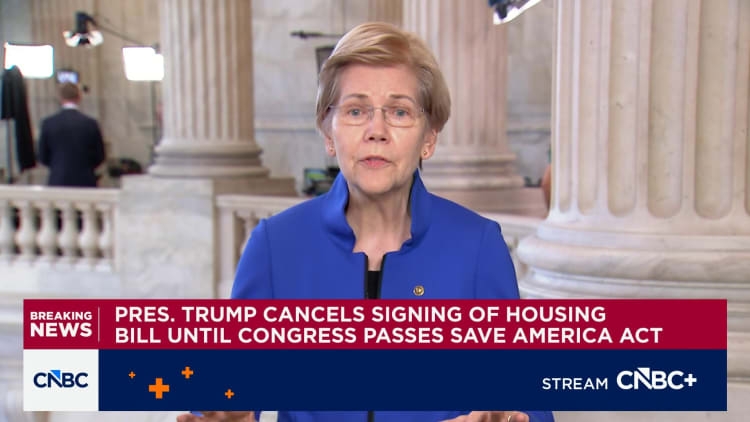
On a day slated for celebration and tangible progress, President Donald Trump delivered a shockwave through the Capitol. Mere hours before a scheduled ceremony in Statuary Hall, Trump took to his Truth Social platform to cancel the signing of a landmark bipartisan housing bill. The legislation, which had cleared both the House and Senate with overwhelming bipartisan support, aimed to address one of the nation’s most pressing crises: housing affordability. Its provisions sought to increase housing supply, make homes more affordable, and curb the influence of private equity in the single-family home market. It was, by all accounts, a rare legislative win in a divided Congress and a bill members of both parties were eager to champion ahead of the 2026 midterms.
Trump’s cancellation was not due to a newfound flaw in the bill. Instead, he declared he would not sign it until Congress first passed a separate, highly controversial piece of legislation: the SAVE America Act. This act seeks to impose nationwide voter ID laws and further restrict noncitizen voting—a practice that is already illegal in federal elections and occurs exceedingly rarely. The House, under Republican control, passed the SAVE America Act in February, but it faces a near-impossible path in the Senate, where Democratic opposition and the 60-vote filibuster threshold make its passage unlikely without significant procedural maneuvering.
The president’s demand set off a chain of events marked by confusion and tension. A scheduled lunch with Senate Republicans, notably convened at the invitation of Senator Rick Scott (R-FL) rather than leadership, reportedly turned heated. Senator Bill Cassidy (R-LA), fresh from a primary defeat after Trump endorsed his opponent, confronted the president over an unrelated foreign policy issue, an exchange later characterized as a “spirited discussion.” Meanwhile, congressional leaders were left scrambling. Speaker Mike Johnson (R-LA) suggested the only viable path for the SAVE America Act might be through the complex budget reconciliation process, a move of questionable legality for an election bill. The fate of the housing package, a policy with a direct 10-day signing clock, was thrown into limbo.
This incident was not an isolated one. Just last week, Trump similarly intervened to derail a Senate confirmation hearing, tying it to his demand for the SAVE America Act and complicating negotiations on national security legislation. The pattern is clear: the president is willing to halt the machinery of government and hold broadly supported policy hostage to advance a singular, partisan electoral objective.
Context: A Nation Grappling with Affordability
To understand the gravity of this act, one must appreciate the context. The United States is in the throes of a severe housing affordability crisis. For millions of Americans, the dream of homeownership is receding, and the cost of renting is consuming unsustainable portions of household income. The bipartisan housing bill represented a genuine, hard-won consensus to take concrete steps toward a solution. It was a policy born not from ideology but from necessity, a recognition that the market is failing ordinary citizens. Senators like Elizabeth Warren (D-MA) and Republicans like John Thune (R-SD) found common ground—a feat in today’s political climate. The bill was a testament to the legislature’s capacity to function and address urgent national needs.
Conversely, the SAVE America Act exists in a context of sustained, evidence-challenged claims about election integrity. While securing elections is a paramount democratic duty, this legislation focuses on problems of marginal statistical significance, all while introducing measures that voting rights advocates argue could disenfranchise eligible voters. Its pursuit is deeply enmeshed in partisan politics, representing a top priority for one party and a non-starter for the other.
Opinion: A Betrayal of Duty and a Subversion of Governance
The actions taken by President Trump, as reported, represent a profound and dangerous subversion of the constitutional order and a blatant betrayal of the public trust. This is not hardball politics; it is the weaponization of governance itself.
First and foremost, holding a vital, bipartisan housing bill hostage to an unrelated, partisan election bill is the epitome of cynical politics. It places perceived partisan advantage above the tangible, daily suffering of American families. When Senator Warren states that this move shows Trump “doesn’t care about American families,” the raw evidence supports her claim. The message is chilling: your struggle to afford a home, your family’s financial security, is less important than the passage of a law designed to solve a phantom problem for political gain. This is an anti-human calculus, valuing power over people, and it should be condemned in the strongest terms by all who believe government exists to serve its citizens.
Second, this tactic is a direct assault on the legislative branch and its constitutional role. Congress, through painstaking negotiation and compromise, produced a significant piece of legislation. The executive’s role is to faithfully execute the laws, which includes signing them. By refusing to fulfill this basic duty unless his own, unrelated legislative demands are met, Trump effectively attempts to usurp the lawmaking power. He seeks to turn the presidency into a unilateral veto gate, not based on the merits of the presented legislation, but on the fulfillment of a separate political agenda. This is an authoritarian impulse, seeking to subordinate a co-equal branch of government. The invitations from senators like Rick Scott, circumventing established leadership channels, further suggest a disturbing pattern of cultivating personal loyalty over institutional respect, weakening the GOP’s own congressional leadership and eroding institutional stability from within.
Third, the focus on the SAVE America Act is particularly insidious because it is predicated on a false premise. By emphasizing the threat of noncitizen voting—a crime that is already aggressively prosecuted and occurs at minuscule rates—the legislation and the president’s ultimatum fuel baseless fears. It is a solution in search of a problem, and to hold housing policy ransom for it exposes the entire maneuver as a naked power play. It exploits emotions surrounding election integrity to achieve a political end, damaging public faith in both the electoral process and the government’s ability to address real economic concerns.
The reported confrontation with Senator Cassidy, while a sidebar, is illustrative of the toxic environment such tactics foster. Governance becomes personalized, defined by loyalty tests and public confrontations rather than reasoned debate on policy. When a senator feels he must “yell” at the president to be heard on a matter of foreign policy, the normal, respectful channels of communication between branches have broken down.
Conclusion: A Line Must Be Drawn
This episode is a clarion call for all defenders of democratic norms and functional governance. The founding principles of this republic—separation of powers, a government of laws, and a legislature responsive to the people’s needs—are under direct threat. Bipartisan compromise, the lifeblood of a diverse democracy, is being torpedoed for short-term partisan theatrics.
Members of Congress, particularly Republicans who championed the housing bill, face a critical test. Will they acquiesce to this hostage-taking, sacrificing a policy victory for their constituents on the altar of partisan loyalty? Or will they defend the integrity of the legislative process and insist that duly passed bills receive a clean up-or-down decision from the president? Leaders like Speaker Johnson and Senator Thune must choose between enabling executive overreach and upholding their oath to the Constitution.
The American people deserve a government that tackles their real problems. They deserve a president who signs good-faith, bipartisan legislation aimed at alleviating economic pain, not one who uses that pain as a bargaining chip. The cancellation of this housing bill signing is more than a scheduling change; it is a symbol of a governance philosophy that is corrosive to democracy and contemptuous of the public good. For the sake of the republic, this line must not be crossed. The integrity of our institutions and the welfare of our citizens depend on it.