
Nevada's 2026 Primaries: A Litmus Test for Democracy Amidst Shadowy Influence
Published
- 3 min read
The Factual Landscape of Nevada’s Electoral Battleground
On Tuesday, June 2026, Nevada voters will participate in primary elections that will set the stage for the November general election and, potentially, influence the national political landscape for years to come. The most prominent race is for the Governor’s mansion, where incumbent Republican Joe Lombardo, who famously defeated Democratic Governor Steve Sisolak in 2022, faces six challengers from within his own party. Simultaneously, six Democrats, including notable figures like State Attorney General Aaron Ford and Washoe County Commissioner Alexis Hill, are competing for their party’s nomination to reclaim the seat. With no presidential or U.S. Senate race on the ballot this cycle, the gubernatorial contest has attracted the lion’s share of campaign ad spending, a spending surge notably fueled by “dark-money groups” that can raise and spend unlimited amounts without disclosing their donors.
The stakes are high. Nevada holds the coveted “first-in-the-West” slot for presidential nominating contests for both parties. Therefore, the occupant of the governor’s office in this key swing state could play a pivotal role in shaping the 2028 presidential campaign, influencing everything from delegate selection to the state’s electoral machinery.
Beyond the governor’s race, other contests demand attention. In the U.S. House, the retirement of Republican Congressman Mark Amodei in the 2nd District opens a primary battle among former state Senator James Settelmeyer, financial adviser David Flippo (who has received an endorsement from Donald Trump), and eleven others. This seat, while not expected to be highly competitive in November given its recent electoral history, still represents a consequential choice for the district’s Republican voters. The seats held by Democratic Representatives Dina Titus, Susie Lee, and Steven Horsford are anticipated to be more competitive in the general election, though only Horsford faces no primary opposition.
State legislative elections are also underway, with about half of the 21 state Senate seats and all 42 state House seats up for election, currently held by Democrats. Furthermore, a mayoral election in Henderson, Nevada’s second-largest city, features incumbent Mayor Michelle Romero seeking a second term against four challengers, including former Henderson police Chief Hollie Chadwick.
The electoral dynamics are heavily influenced by Nevada’s population distribution. Clark County, home to Las Vegas and Henderson, contributes roughly 69% of the statewide vote, while Washoe County, home to Reno, contributes about 18%. These two counties are the decisive battlegrounds in any statewide race.
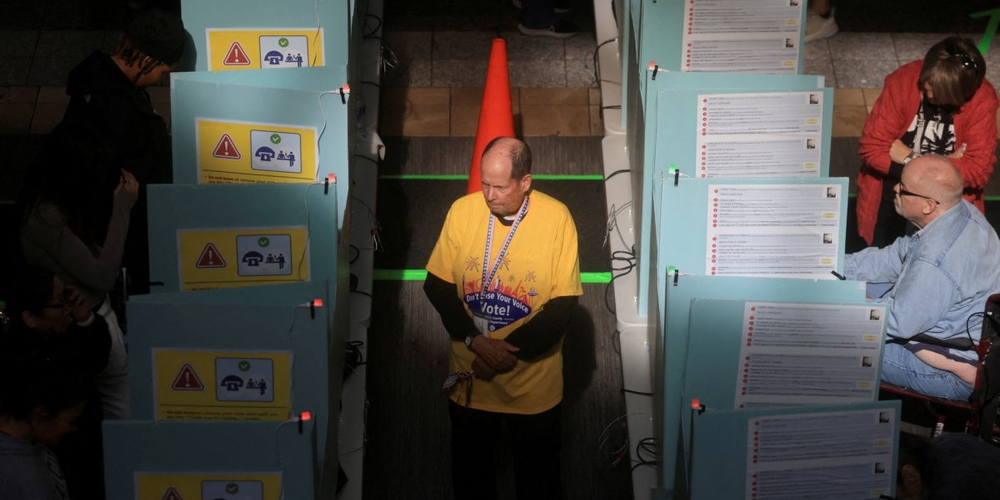
The mechanics of the election are also crucial. Polls close at 7 p.m. PT, but must remain open until all voters in line have cast their ballots. Nevada employs a closed primary system, where only voters registered with a party may participate in that party’s primary, though Election Day registration and party affiliation changes are permitted. As of June 1, voter registration showed a near parity between Democrats (~670,000) and Republicans (~659,000), with a vast pool of non-partisan voters (~965,000) who cannot participate in these partisan primaries. Mail ballots have become a dominant force, comprising about 65% of the vote in the 2024 state primary, and approximately 246,000 ballots had already been cast prior to Election Day for this primary.
Opinion: Democracy Under the Shadow of Dark Money and Partisan Exclusion
The facts presented above paint a picture of a functioning democratic process, but one that is operating under significant stressors that threaten its foundational principles of transparency, inclusivity, and equal representation. This Nevada primary is not merely an administrative event; it is a litmus test for the health of American democracy in a post-2020 political environment.
First and foremost, the article’s mention of “dark-money groups” driving campaign ad spending is a red alarm for any defender of democratic integrity. These entities, which can raise and spend unlimited funds without disclosing their donors, represent a corrosive force in our politics. They operate in the shadows, allowing wealthy individuals and special interests to wield immense influence over electoral outcomes without public accountability. This undermines the very concept of a citizen-driven democracy. When voters are bombarded with messages funded by secret sources, they cannot make informed decisions about the true motivations and allegiances of candidates or the forces backing them. This creates a system where policy may be crafted not for the public good, but for the benefit of unseen patrons. For a state like Nevada, whose governor could influence the 2028 presidential process, the infiltration of dark money into the gubernatorial race is particularly alarming. It risks placing a key lever of national power under the indirect control of anonymous actors. We must advocate relentlessly for legislation that mandates full transparency in campaign financing. A democracy cannot be healthy when its electoral debates are funded in secrecy.
Secondly, Nevada’s closed primary system, while a common feature in American politics, inherently excludes a massive segment of its electorate. With nearly 965,000 voters registered with no party, these citizens are barred from participating in the critical initial selection of candidates for the highest offices in their state. This system reinforces partisan rigidity and can contribute to the nomination of candidates who appeal only to the base of their party, rather than to a broader constituency. It stifles the political engagement of independents and moderates, who are often the crucial swing voters in general elections. In a swing state like Nevada, where general election outcomes are typically close, ensuring that the primary process produces candidates who can appeal to the entire electorate is vital for governance stability and legitimacy. The principle of liberty includes the right to full political participation; a system that locks out nearly a million Nevadans from the first round of choosing their leaders is a deficiency that should be addressed through reforms such as open or semi-open primaries.
Thirdly, the demographic concentration of power in Clark and Washoe Counties is a fact of geography, but it also highlights the importance of ensuring that rural and other less populous areas feel their voices are heard in the statewide process. Candidates and campaigns must not overlook these communities, as a truly representative government must consider the needs and perspectives of all its citizens, not just those in the major metropolitan centers.
The endorsement dynamics, such as Donald Trump’s endorsement of David Flippo in the 2nd District House primary, illustrate the continued nationalization of local politics. While endorsements are a traditional part of politics, the overwhelming influence of a single national figure on local Republican primaries can suppress local issues and candidate qualities, reducing the race to a mere loyalty test. This trend diminishes the local autonomy and diverse representation that the federal system was designed to protect.
Finally, the procedural aspects—the reliance on mail ballots, the timing of result releases, the possibility of recounts—are the nuts and bolts of democracy. They must be operated with utmost integrity and transparency to maintain public trust. The fact that Nevada law wisely requires polls to stay open for all in-line voters is a commendable protection of the fundamental right to vote. The high use of mail ballots, however, necessitates robust, secure, and transparent systems to count them and to educate the public on the process to prevent misinformation and doubt.
In conclusion, the Nevada primaries are a microcosm of American democracy’s current challenges. They showcase the vibrancy of electoral competition but also expose the vulnerabilities: the shadow of undisclosed money, the exclusion of independent voters from key rounds, and the national pressures on local choice. As a think tank dedicated to the principles of democracy, freedom, and liberty, we view this election not just as a news item, but as a case study. The outcomes will matter, but more importantly, the process itself must be scrutinized and improved. For democracy to endure, it must be transparent, inclusive, and resistant to the covert influence of wealth and power. Nevada’s voters are stepping up to participate; the system must ensure their participation is meaningful, informed, and truly representative of the will of all the people.