
Systemic Failure and Sacrificial Zones: When Regulation Betrays the Public Trust
Published
- 3 min read
The Fires and the Facts
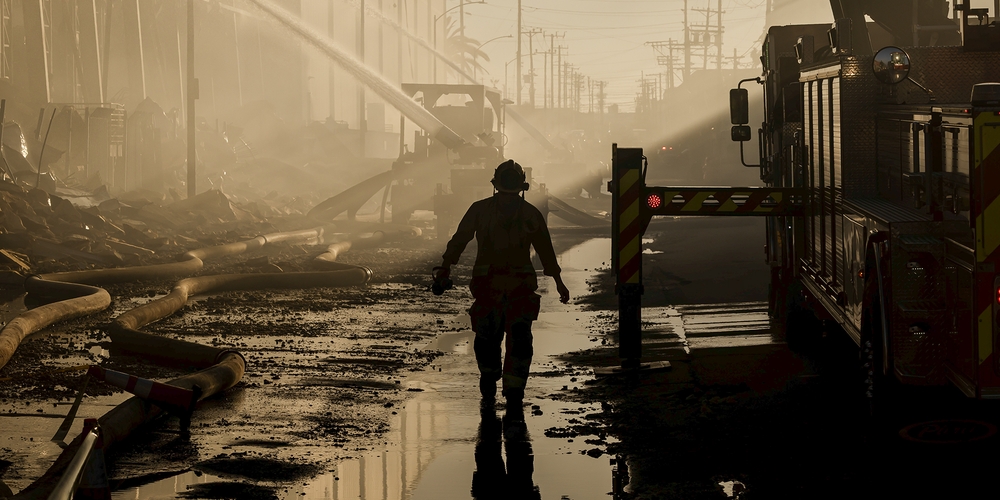
In June, an 84-year-old man named Manuel Valle became an unlikely first responder in his own Boyle Heights neighborhood. As smoke from a burning Lineage Logistics food storage warehouse filled the air for a fifth consecutive day, Valle mounted his bicycle. Pushing through fits of coughing, he distributed N95 masks to his neighbors, acting on a truth that official statements contradicted. That same day, residents were told the air was not dangerous and the smoke was clearing. Valle, with the clarity of someone living in the crisis, declared, “This is a state emergency. Treat it like a state emergency.”
The fire at Lineage, which uses the toxic refrigerant anhydrous ammonia, was not an isolated incident. Weeks earlier in Garden Grove, the Orange County Fire Authority ordered 50,000 residents to evacuate. The threat came from a tank at a GKN Aerospace manufacturing facility that risked exploding or leaking large quantities of methyl methacrylate, a reactive chemical. In both cases, the facilities were known to regulators. Inspections had been conducted, violations issued, and settlements paid—GKN paid over $900,000 in 2021. Yet, the emergencies happened anyway.
The aftermath was a masterclass in bureaucratic confusion and public mistrust. In Garden Grove, Orange County’s Public Health Officer, Regina Chinsio-Kwong, initially told residents, “When you go home, you can feel safe. There was no contamination … There was no leak,” a statement officials later walked back. In Los Angeles, Mayor Karen Bass assured the public the air was not dangerous, only for an air monitor to detect a hazardous spike of pollutants on the fire’s sixth day. For residents like Miguel Ocegueda Castillo living near the Lineage warehouse, the inaction is baffling: “I don’t know what the local government is waiting for — for a tragedy to occur.”
The Illusion of Oversight
The core revelation of these twin disasters is the profound gap between the apparatus of regulation and its efficacy in protecting human life. As Jane Williams, executive director of California Communities Against Toxics, starkly put it, “Luck, rather than strong protections, has saved residents from catastrophe.” California boasts some of the nation’s strongest environmental laws, including a Risk Management Program that sets stricter standards than federal law. Companies like Lineage, storing over 12,000 pounds of anhydrous ammonia, are indeed part of these federal and state programs.
However, the records paint a damning picture of a system that moves at the speed of compliance, not prevention. Lineage’s facility had been investigated by Cal OSHA in 2020 for multiple safety standard violations, resulting in a final fine of just $2,250. In recent years, the company has faced a series of civil enforcement actions: a $37,500 OSHA fine in Riverside, a $3,420 settlement in Vernon for uncorrected deficiencies, and a $172,000 EPA fine in Iowa for failures in its risk management plan. These are not the marks of a rogue operator; they are the hallmarks of a corporation operating within a system where penalties are a cost of business, not a deterrent. Rebecca Liu Morales, a Lineage spokesperson, emphasized the company’s heavy regulation and over 200 routine inspections, a defense that ironically underscores the failure of those very inspections to prevent the crisis.
The regulatory gaps are not merely administrative; they are existential. Reactive chemicals like methyl methacrylate often fall outside accidental release programs, meaning GKN in Garden Grove was required to have no risk management plan at all. Meanwhile, the local agencies—Certified Unified Program Agencies (CUPAs)—that are the “eyes on the ground” have failed in transparency. The Los Angeles Fire Department refused to answer questions about its oversight of Lineage.
The High Bar to Justice and the Limits of Local Power
When catastrophe is narrowly averted, the public rightly demands accountability. Yet, the path to justice is effectively barricaded by legal design. As attorney Ethan Ware explains, criminal prosecution for environmental crimes requires evidence of deliberate deception—“lying, cheating, and stealing.” Merely breaking a rule, or even having a history of violations, is insufficient. This creates a perverse incentive structure where a company can be persistently negligent, pay fines, and remain immune from criminal liability unless prosecutors can prove intent to defraud. The FBI’s search of the GKN facility is unusual, and experts doubt it will lead to charges.
This federal enforcement landscape has also withered. A report cited in the article notes a 76% drop in civil lawsuits from the EPA under one administration compared to another, with only 12% of facilities with air pollution violations facing any enforcement action. The system is not broken; it is operating as designed—to manage risk on a spreadsheet, not to eliminate it in reality.
The frustration then turns local. In Garden Grove, resident Rodrigo Garay confronted city council with the blanket he slept on during the evacuation, challenging officials who “slept on really nice beds.” In Boyle Heights, Councilwoman Ysabel Jurado calls for a full investigation, labeling the fire a public health, accountability, and environmental justice issue. Yet, as land use attorney David Waite explains, cities are constitutionally hamstrung. Once a facility like GKN or Lineage is legally permitted, rezoning to remove it risks “constitutional takings” claims. A city can only revoke a permit by proving an ongoing public nuisance, a nearly impossible standard after a one-time fire, no matter how terrifying.
Garden Grove spokesperson Johnathan Garcia’s statement that the city is “exploring… its options in consideration of its authority” is the epitome of this powerless deliberation. Mai Nguyen Do’s question hangs in the air, heavy with implication: “What is the point of bemoaning that you don’t have more local control if you don’t use the authority you do have in times like this?”
A Fundamental Betrayal of Democratic Principles
This is where the story transcends environmental reporting and becomes a stark lesson in democratic erosion. The principles of a free society are built on a foundation of trust: trust that institutions exist to safeguard the people, that the rule of law applies equally, and that liberty includes the freedom from existential threat in one’s own home. The experiences of Boyle Heights and Garden Grove represent a breach of that trust so severe it shakes the social contract to its core.
These are not random tragedies. As CalEnviroScreen data confirms, Garden Grove is in the top 20% of California’s most environmentally burdened communities; Boyle Heights is in the top 10%. They are predominantly communities of color. This is the anatomy of environmental injustice: the systematic placement of hazards and the systematic failure to mitigate them burden the same historically marginalized groups. The liberty to pursue happiness is nullified by the constant anxiety of a chemical leak. The freedom to live securely in one’s property is violated by toxic smoke.
The heroic action of Manuel Valle is a profound indictment. In a functioning democracy, an octogenarian should not need to become a martyr to basic public health. His courage highlights the vacuum left by institutions that have conflated process with protection. State Senator Tom Umberg’s proposed bill, SB 883, which would close gaps for reactive chemicals and improve tracking, is a necessary step. But legislation alone cannot repair trust.
True accountability requires a paradigm shift. It demands that regulators see themselves not as auditors of paperwork but as guardians of community safety. It requires that the legal concept of a “public nuisance” be interpreted to include the latent, permitted risk of a hazardous facility adjacent to a playground. It requires that the economic liberty of a corporation never supersede the fundamental human right to safety.
The fires in Boyle Heights and Garden Grove have been extinguished, but the more dangerous fire—of public disillusionment—rages on. When citizens like Miguel Ocegueda Castillo and Ysabel Jurado speak out, they are exercising the very democratic muscles that authoritarian systems seek to atrophy. We must listen. The choice is clear: we can continue to manage risk with fines and paperwork, accepting that luck is our final line of defense, or we can rebuild a regulatory ethos where the safety of the people is the supreme law, non-negotiable and inviolable. The legacy of our democracy may depend on which path we choose.