
The Arizona Crucible: When a Primary Battle Becomes a Proxy War for the Soul of the GOP
Published
- 3 min read
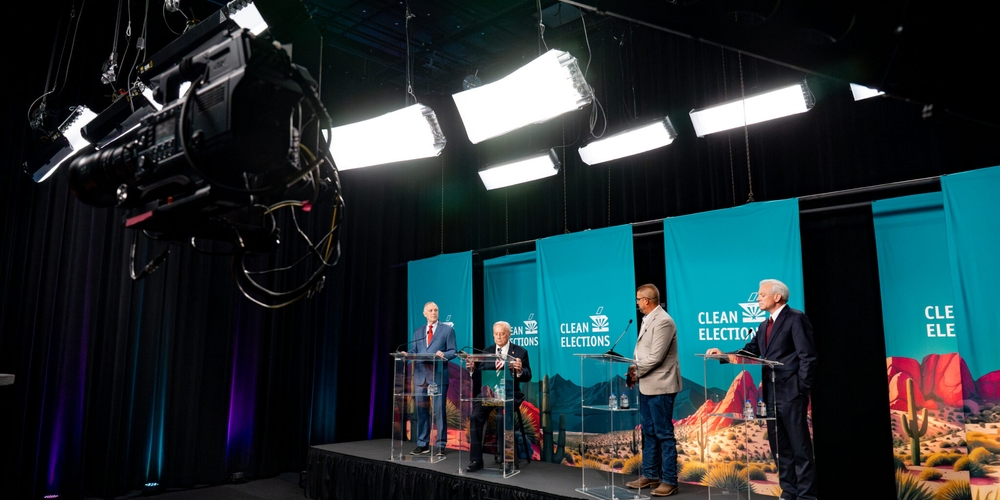
The race for the Republican gubernatorial nomination in Arizona has transcended mere policy disagreements, erupting into a raw, public dissection of the party’s future. What began as a debate between sitting U.S. Representatives Andy Biggs and David Schweikert swiftly revealed itself as a proxy war, with the influence of external ideological forces taking center stage. This contest is no longer simply about who can best lead the Grand Canyon State; it is a stark referendum on whether the party will be guided by the fiery populism of the far-right or a more traditional, institution-respecting conservatism. The dynamics on display in Phoenix are a microcosm of a national struggle, with profound implications for American democracy.
The Facts: A Debate of Contrasts and Accusations
The Citizens Clean Elections debate provided the arena for this clash. Frontrunner Rep. Andy Biggs, buoyed by an endorsement from former President Donald Trump and the substantial financial backing of Turning Point Action, consistently framed the race as a binary choice between himself and the incumbent Democratic Governor, Katie Hobbs. He touted polls showing his competitiveness and cited a history of bipartisan work, naming collaborations with Senator Kyrsten Sinema and the late John McCain, as well as with Democratic Rep. Hakeem Jeffries on an anti-corruption bill.
His chief opponent, Rep. David Schweikert, adopted a fundamentally different strategy. Rather than focusing fire on Hobbs, Schweikert trained his sights squarely on Biggs, labeling him as “wholly owned by Turning Point” USA. This pointed accusation sought to paint Biggs as an agent of an organization known for its polarizing stances, arguing that such an affiliation renders him unelectable in a general election against Arizona’s growing bloc of independent voters. Schweikert presented himself as the pragmatic, proven winner from a competitive district who understands how to “market conservatism” to a broader electorate.
On policy, the candidates found some common ground amidst the conflict. Both agreed Arizona faces a water management crisis, not a scarcity crisis, proposing various infrastructural and allocation solutions. Each expressed firm support for the state’s expansive ESA school voucher program, repeating the disputed claim that it saves taxpayer money. On healthcare, both leaned into personal responsibility narratives, with Schweikert controversially questioning the use of welfare benefits for unhealthy food and Biggs promoting Health Savings Accounts.
Their differences were equally telling. Biggs pledged to eliminate the state income tax, funded by rooting out “waste and fraud” in Medicaid, while Schweikert proposed selling state trust land to address housing costs. On election administration, Biggs voiced support for making Arizona’s process more like Florida’s, a model critics argue restricts access, whereas Schweikert pragmatically accepted the popularity of mail-in voting while calling for improved verification procedures.
The Context: A State at a Crossroads
Arizona is a quintessential American swing state, its political landscape transformed by demographic shifts and the lingering, bitter aftermath of the 2020 election. It is a state where institutional pillars like the late Senator McCain’s brand of politics once dominated, but now face sustained challenge from a new, more confrontational conservative movement. The Maricopa County Republican Party’s censure of Schweikert for his ads highlights the intense internal pressure to conform to a particular, uncompromising orthodoxy.
Enter Turning Point USA and its political arm, Turning Point Action. Founded by Charlie Kirk, the organization has become a powerhouse in mobilizing young conservatives around a blend of libertarian economics and culture-war politics, often deploying rhetoric that flirts with conspiracism and attacks on established institutions. Its decision to throw its weight and treasury behind Andy Biggs is not a neutral act; it is a deliberate investment in a specific vision for the Republican Party—one that is populist, distrustful of bipartisan compromise, and fiercely oppositional.
Opinion: A Line in the Sand for Democratic Norms
As a committed defender of democratic institutions, constitutional order, and reasoned political discourse, I view this primary with profound apprehension. The central drama—Schweikert’s accusation that Biggs is a captive of Turning Point—is not a mere campaign slur; it is the core issue of the race. When a candidate for high office is perceived, even by a primary opponent, as being functionally “owned” by an unelected, extreme ideological organization, it represents a direct threat to representative democracy.
The governor’s office is a public trust, obligated to serve all the people of Arizona. If the principal allegiance of the officeholder is perceived to lie with a private group dedicated to a narrow, radical agenda, how can that trust be maintained? Turning Point’s agenda, as evidenced by its national rhetoric, often involves undermining confidence in electoral systems, attacking higher education, and purging the party of dissenting voices. A governor who owes his election to such a force would inevitably face colossal conflicts of interest and immense pressure to govern not for Arizonans, but for the movement.
Schweikert’s campaign, whatever its political motivations, is performing a critical civic function by forcing this issue into the open. His argument about electability is secondary to the fundamental question of sovereignty. Should a state be governed by its elected officials or by the proxies of external ideological franchises? His focus on appealing to independents is a recognition, however belated, that politics in a pluralistic society requires coalition-building and persuasion, not just the mobilization of a resentful base.
The policy agreements between the candidates on issues like vouchers are also troubling, representing a continued retreat from the common good of public education. Their shared, flawed assertion that the ESA program saves money is a disservice to factual debate, prioritizing ideological victory over transparent governance. Similarly, the focus on personal behavior in healthcare, while not without merit, risks blaming individuals for systemic failures and avoids the hard work of crafting policy that ensures access and affordability for all.
Andy Biggs’s readiness to model Arizona’s elections on Florida’s is particularly alarming. Florida’s laws, passed in the wake of the 2020 election, have been widely criticized by voting rights advocates as creating needless obstacles to voting, disproportionately affecting minority and elderly voters. Endorsing such a model, especially when paired with his embrace of election-denying rhetoric in the past, suggests a governor more interested in crafting electoral outcomes than in protecting the sacred, unfettered right to vote.
Conclusion: The Choice Before Arizona Republicans
The July primary presents Republican voters in Arizona with a choice that echoes far beyond state lines. They can choose Andy Biggs, and in doing so, they will ratify the takeover of their state’s highest executive office by the forces of Turning Point USA—a faction defined by its antagonism towards the very institutions of liberal democracy. This path promises continued nationalization, polarization, and governance as performance art.
Alternatively, they can choose David Schweikert, a candidate who, for all his political calculations, is arguing for a return to a form of conservatism that competes for the center, respects the state’s diverse electorate, and understands that governing requires more than rallying the faithful. It is a path that seeks to reclaim the party from the grip of extremism.
As a non-partisan observer, my stake is not in which party wins, but in the health of the democratic process itself. The infusion of vast, unaccountable ideological money into state races, the normalization of rhetoric that undermines trust in elections, and the cultivation of a politics of perpetual grievance are cancers on the body politic. Arizona stands at a precipice. The decision its Republican primary voters make will either be a courageous step back from the brink or a tragic leap into a future where the governor’s office is not a seat of public service, but a podium for a private, radical revolution. The principles of liberty, grounded in stable institutions and the rule of law, demand we pay attention and sound the alarm.