
The Assault on the Wall: A Commission's Blueprint to Dismantle Church-State Separation
Published
- 3 min read
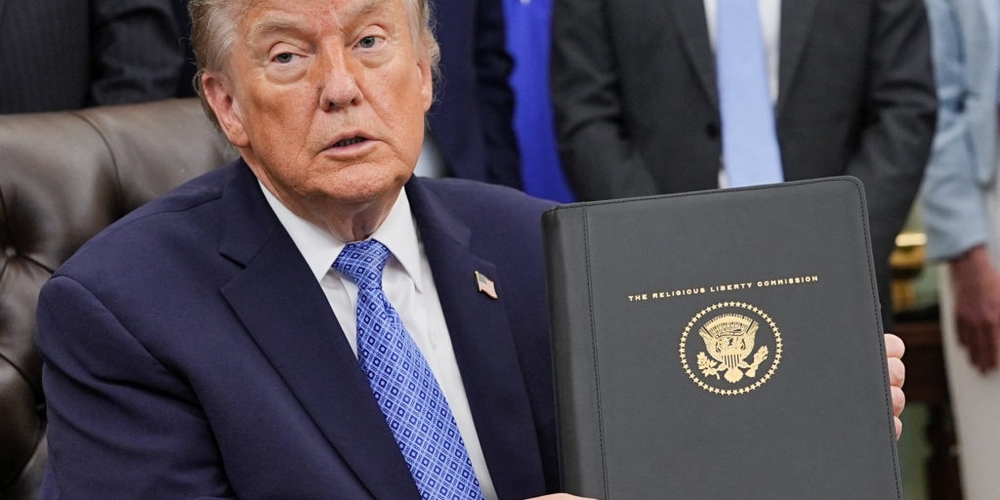
The Facts of the Report
A draft report from the Presidential Advisory Commission on Religious Liberty, created by former President Donald Trump and released for public comment, has put forward a radical reimagining of a core American principle. The 224-page document, populated almost entirely by conservative Christian appointees, does not merely suggest tweaks to policy; it proposes a fundamental philosophical shift. The commission recommends moving away from the concept of the “separation of church and state” and toward a model of “building bridges” between religious institutions and government.
The report applauds recent Supreme Court decisions that have expanded rights to religious expression in public settings. Its specific policy recommendations are sweeping: the elimination of the Johnson Amendment, which prohibits tax-exempt religious organizations from engaging in political campaigning; compensation for military service members discharged for refusing COVID-19 vaccines; broader exemptions for conscientious objections to policies on vaccines, pronoun usage, and school curricula; and increased access to public funding for faith-based agencies.
Furthermore, the report calls for the creation of a Presidential Medal of Religious Liberty and First Freedom Hero Awards, and for historical markers highlighting religion’s role in American history. It argues that the traditional understanding of separation has been misapplied, contending that “the church and state strengthen and support one another.” The commission chairman, Texas Lt. Gov. Dan Patrick, has previously called the separation concept a “lie,” though the report itself stops short of that language.
The Context and Immediate Reaction
This draft emerges amidst a concerted political effort in conservative states, like Texas, to integrate more religious expression into public spaces, including classrooms. It follows another report from a Trump-created task force claiming anti-Christian bias under the Biden administration. Critics, including a coalition that preemptively released a report defending church-state separation, argue the commission’s perspective is skewed. A lawsuit filed by the Interfaith Alliance challenges the commission’s lack of ideological diversity, noting its meetings were often held at the Museum of the Bible and that members have described America as a Judeo-Christian nation.
The report itself acknowledges but gives little weight to the growing population of non-religious Americans, and critics note it fails to adequately address issues like anti-Muslim efforts or antisemitism emanating from the right. The legal and philosophical battle lines are starkly drawn.
Opinion: A Fundamental Betrayal of the First Amendment
The draft report from the Religious Liberty Commission is not a thoughtful contribution to a complex debate; it is a declaration of war on one of the most successful experiments in human history: the secular state. Framing its argument as one of “building bridges” is a masterful piece of rhetorical deception. You do not build a bridge to something you are already part of; you build a bridge to something from which you are separate. The entire premise accepts, then seeks to eliminate, the vital separation that has protected religious liberty for all Americans.
The First Amendment’s Establishment Clause (“Congress shall make no law respecting an establishment of religion”) and its Free Exercise Clause are two sides of the same coin of liberty. The metaphorical “wall of separation,” famously invoked by Thomas Jefferson, is the mortar that holds that coin intact. It ensures the government cannot compel your faith, favor one religion over another, or use its immense power to promote theological dogma. In return, it protects religious institutions from becoming pawns of the state, their sacred missions corrupted by political ambition and public funding. This commission seeks to dissolve that wall, brick by constitutional brick.
Let us examine the practical consequences of their “bridge.” Eliminating the Johnson Amendment would transform pulpits into political podiums, inviting a torrent of dark money into electoral politics under the shield of tax exemption. It would corrupt faith communities, dividing congregations along partisan lines and tempting religious leaders with political power. Broadening conscientious objections to everything from public health mandates to basic classroom instruction on gender creates a society where civil obligation and shared reality fracture into a thousand personal vetoes based on individual belief. It makes governance impossible and marginalizes those whose deeply held secular or minority religious convictions are not granted the same privileged opt-out.
The report’s claim that “the church and state strengthen and support one another” is historically naive and profoundly dangerous. History is littered with the wreckage of societies where church and state were entwined—from the divine right of kings to state-mandated atheism. The strength of American religion stems precisely from its voluntary, pluralistic, and non-governmental nature. Our churches, synagogues, mosques, and temples are robust because they rely on the genuine conviction of their members, not the coercive power of the state. The moment the state begins to “support” religion, it must choose which religions to support, instantly creating second-class spiritual citizens.
The commission’s composition and process betray its agenda. A body tasked with advising on religious liberty for all Americans that lacks meaningful representation from non-Christian, non-conservative, or non-religious perspectives is a farce. Holding meetings at the Museum of the Bible is not a neutral act; it is a symbolic announcement of the commission’s preferred outcome. This is not an inquiry; it is an ideological project dressed in the vestments of public policy.
Furthermore, the report’s philosophical underpinning, as cited from member Bishop Robert Barron, traces strict separation to a “‘God is dead’ ideology.” This is a profound misreading of American history and principle. Jefferson was a deist, not an atheist, and his wall was built to protect the vibrant, dissenting Baptist faiths of his time from the established Anglican church. The principle protects the religious from the tyranny of other religions just as much as it protects the non-religious. To frame this as a battle between faith and secularism is a false dichotomy. It is a battle for the soul of the Republic: will we be a nation where rights are inherent and government is neutral, or a nation where freedom is contingent on conformity to a state-favored worldview?
The commission’s work is a symptom of a deeper malady: the view that American democracy is a Christian project rather than a pluralistic one. This report is a blueprint for turning that view into policy. It seeks to replace the neutral public square—where individuals of all faiths and none meet as equal citizens—with a space where certain religious expressions are officially endorsed and facilitated by government power.
Conclusion: Defending the Wall
We stand at a constitutional precipice. The ideas in this draft report are no longer fringe; they are being articulated by official commissions and enacted in state legislatures. The defense of the separation of church and state is not a defense of secularism against religion; it is a defense of all religion, and of liberty itself, from the corrosive effects of state power. It is the defense of a system that allows a Muslim, a Jew, a Christian, a Hindu, a Buddhist, and a humanist to all sit at the same table of citizenship, with none holding a seat granted by the government.
The wall of separation is not a barrier to faith; it is the guardian of conscience. We must reject the seductive but perilous language of “bridges” that would lead us back to an era of state-sponsored orthodoxy. We must loudly and clearly defend the brilliant, fragile, and essential American idea that government shall not be in the business of souls. Our freedom depends on it.