
The Auction of the People's House: When Spectacle Eclipses Democracy
Published
- 3 min read
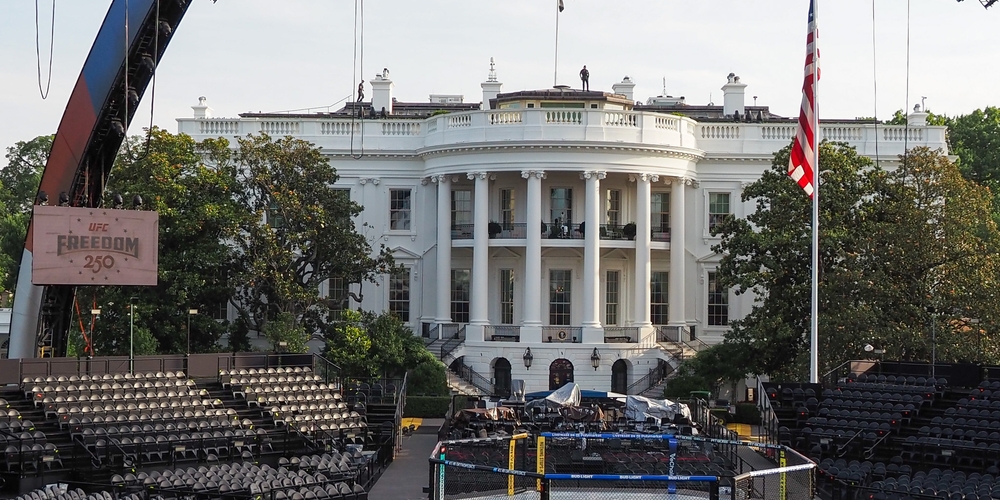
The Facts: A $60 Million Birthday Spectacle on the South Lawn
This weekend, the Ellipse and South Lawn of the White House will host an unprecedented event: a pay-per-view Ultimate Fighting Championship (UFC) card dubbed “UFC Freedom 250.” Billed as a celebration of America’s 250th birthday and coinciding with President Donald Trump’s 80th birthday, the event is a corporate-heavy spectacle with reported costs of $60 million. The Las Vegas-based UFC, led by CEO and longtime Trump ally Dana White, expects over 65,000 ticketed fans on-site, with space for tens of thousands more. VIP sponsorship packages, offering cage-side seats under a structure called “the claw,” have been widely reported to cost up to $1.5 million. Major sponsors include Dodge, Crypto.com, Bud Light, and Polymarket. The event will be streamed exclusively on Paramount Plus, a platform owned by a media conglomerate whose merger was approved by the Trump administration, following a recent $7.7 billion deal with UFC.
According to the article, the White House collaborated with Fanatics to create exclusive “USA 250” merchandise, and the President himself purchased stock in UFC’s parent company, TKO Group Holdings, earlier this year. The event is not affiliated with the official, congressionally-created America 250 commission. It has drawn a legal challenge from the Public Integrity Project, which alleges the National Park Service and Department of the Interior are illegally lending public land for a private, commercial event without congressional approval. U.S. District Judge Amit Mehta is considering the case based on written briefs, with the Department of Justice arguing the plaintiffs seek a “heckler’s veto.” Meanwhile, critics are hosting a counter-concert featuring artists like Patti Smith and Bette Midler.
The Context: The Erosion of Norms and Public Trust
The staging of this event did not occur in a vacuum. It is the culmination of a years-long intertwining of political power, personal loyalty, and commercial interest. President Trump promised a UFC fight on the White House lawn during his 2024 campaign. Dana White has delivered primetime speeches at the last three Republican National Conventions. In April, as Vice President JD Vance was abroad on diplomatic duty, the President and Secretary of State Marco Rubio appeared together at a UFC event in Miami. This context reveals an administration comfortable with blurring, if not erasing, the lines between the office of the presidency and private, for-profit enterprises that benefit its allies.
The legal framework being tested is equally critical. The plaintiffs in the lawsuit—a Vietnam War veteran and a civic activist—argue that the event violates laws governing the use of national park land, requiring congressional permission and environmental review. The government’s defense minimizes their standing and frames the event as a legitimate celebration of national pride. This legal dispute is not merely about zoning or permits; it is a fundamental conflict over who controls national symbols and for what purpose.
Opinion: A Profound Betrayal of Democratic Principles
What we are witnessing is not a celebration of American freedom. It is its caricature—a loud, garish, and exclusive spectacle that commodifies patriotism and monetizes public trust. The transformation of the White House grounds, often referred to as “The People’s House,” into a branded arena for mixed martial arts is a profound betrayal of democratic principles. This is not a public festival; it is a privately orchestrated, corporate-sponsored event with astronomical price tags for access. When VIP seats cost $1.5 million, the message is unequivocal: the People’s House is open for business, but only for the highest bidders and the best-connected.
The allegations of corruption are not fringe gripes; they are a logical conclusion drawn from the observable facts. The President holds stock in the parent company of the organization staging the event. The event’s chief executive is a political ally who has actively campaigned for him. Major corporate sponsors with ties to the administration are purchasing premium advertising space on federal property. The streamer holding exclusive rights benefited from a government-approved merger. This creates a sickening circular economy of influence where public authority is leveraged for private gain, and state power is used to enrich friends and supporters. Brendan Ballou of the Public Integrity Project is correct: the main purpose appears to be “to enrich the President and his friends.”
The Dangerous Precedent: National Monuments as Billboards
The administration’s legal argument is perhaps most revealing of its governing philosophy. Dismissing the plaintiffs as having “idiosyncratic preferences” and accusing them of attempting a “heckler’s veto” demonstrates a contempt for civic dissent and a narrow view of the public interest. The DOJ’s glib statement that “No one is holding Plaintiffs in a jiu jitsu lock, forcing them to watch” misses the point entirely. The issue is not whether they are forced to watch; the issue is whether every citizen must accept the degradation of their shared national treasures into commercial venues. If this event proceeds unchallenged, it sets a terrifying precedent. As Ballou warned, “our national monuments will become little more than branding opportunities for the rich and well-connected.” Imagine the Lincoln Memorial sponsored by a software giant, or the Washington Monument wrapped in the logo of a cryptocurrency exchange. This event opens the door to that dystopian reality.
Furthermore, the timing and symbolism are calculated insults. Holding this lavish, commercially saturated event while the nation approaches its semiquincentennial hijacks a moment for national reflection and unity, replacing it with a partisan-adjacent celebration of commercialized combat. It co-opts the language of freedom (“UFC Freedom 250”) while practicing its opposite: the freedom of the connected class to exploit public assets.
Conclusion: Reclaiming the Republic’s Sacred Spaces
A republic’s health can be measured by how it treats its most sacred spaces and symbols. They are not assets to be leveraged or venues to be rented. They are the embodiment of collective history, struggle, and aspiration. The White House lawn is not a blank canvas for any administration’s personal or political projects; it is a trust held for all Americans, present and future.
The fight over this UFC event is a microcosm of a larger struggle for the soul of American democracy. It is a struggle between public service and self-service, between institutional integrity and personal loyalty, between the common good and private gain. Every citizen who believes in the rule of law, the ethical separation of personal interest from public duty, and the dignified stewardship of national treasures should be alarmed. We must demand that our leaders treat the offices they hold and the properties they temporarily steward with the reverence they deserve. The spectacle on the South Lawn is a stark reminder that eternal vigilance is not just the price of liberty—it is also the price of preventing our highest ideals from being sold to the highest bidder. The courts may rule on the legality of this weekend’s fights, but the court of history will deliver a far harsher judgment on this brazen conflation of state and spectacle.