
The Beijing Composition: How China's Strategic Symphony Exposes Europe's Existential Crisis
Published
- 3 min read
The Diplomatic Score: Ten Days That Reshaped Perceptions
The recent diplomatic sequence in Beijing was not merely a scheduling coincidence; it was a masterful composition in statecraft. Within the span of ten days, President Xi Jinping received two leaders representing the poles of the established Western-led order and its most formidable challenger. First, former President Donald Trump departed with vague promises and no binding commitments, demonstrating Beijing’s capacity to absorb and deflect American maximalist pressure through gesture and pageantry. Then, President Vladimir Putin arrived, cementing a partnership defined not by transient trade deals but by enduring mutual strategic necessity—a relationship that provides China with crucial geopolitical insulation.
While these summits choreographed the future architecture of global power, the European Union’s executive body was finalizing a set of defensive trade instruments, primarily aimed at slowing the influx of Chinese goods. The imagery is stark and revealing: China is confidently playing offence on the world stage, while Europe assumes the position of a frantic goalkeeper. This optical dissonance, however, obscures a harder, more uncomfortable truth that the corridors of Brussels dare not utter aloud: the fundamental problem is not China. The problem is Europe itself.
The Numbers and the Structural Trap
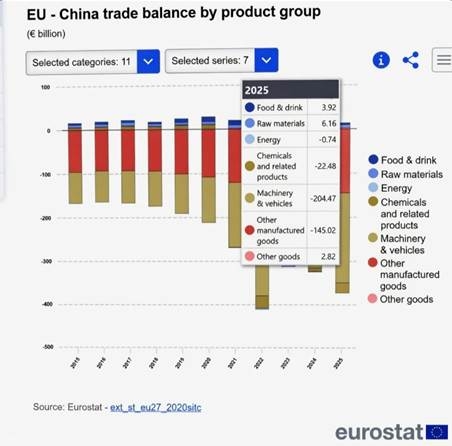
The European Commission’s case, on paper, appears compelling. The EU’s goods trade deficit with China stood at a staggering €360 billion in 2025. In the first four months of this year alone, Beijing’s surplus with the bloc surged to $113 billion, accelerating from $91 billion in the same period last year. Sectors like steel, electric vehicles, and solar panels tell a consistent story of Chinese production, underwritten by state financing, operating at a scale and cost that European firms cannot structurally match without equivalent support.
Yet, to fixate on the trade deficit as a mere flow imbalance is to misdiagnose a cancer as a common cold. What Europe confronts is a deep-seated structural condition—an industrial dependency meticulously constructed over two decades of procurement decisions that privileged short-term cost efficiency over long-term strategic risk. China did not force this dependency upon Europe; European governments and corporations voluntarily chose the cheapest, most efficient global suppliers during an era of unchallenged growth. China was the rational answer to a procurement question in a unipolar moment. The existential crisis for Europe is that it has no coherent answer to that question now that the geopolitical landscape has fundamentally shifted.
The Paralysis of the Westphalian Model
Europe’s vulnerability predates the current discourse on Chinese overcapacity. It is rooted in a governance architecture engineered for market integration and technocratic management, not for the harsh realities of 21st-century strategic competition. This system has produced a costly and persistent pathology: a remarkable ability to diagnose geopolitical threats with sophisticated precision, coupled with a structural incapacity to act decisively upon that diagnosis.
The historical record is depressingly consistent. The 2019 strategic autonomy agenda identified key dependencies. The 2021 Chips Act acknowledged the semiconductor gap. The 2022 Critical Raw Materials Act pinpointed mineral vulnerabilities. The 2023 Net-Zero Industry Act gestured towards the clean technology deficit. Each initiative was real, yet each was chronically underfunded, poorly coordinated, and ultimately outpaced by the very global trends they sought to address. This is the tragedy of modern Europe: it produces world-class geopolitical analysis but suffers a catastrophic failure of conversion—an inability to translate diagnosis into durable, adequately resourced, and politically sustained action.
The reason is irreducibly structural. A genuinely unified European industrial policy demands either a real transfer of fiscal authority to Brussels—a prospect member states vehemently reject—or profound voluntary coordination between nations with fundamentally incompatible economic models. Germany’s export-driven industrialism, France’s statist sovereignty logic, and Southern Europe’s investment-hungry growth model are not mere political differences to be managed. They represent divergent theories of economic life that pull in violently opposite directions whenever a costly, collective strategic choice is required.
Beyond the “Germany Problem”: A Crisis of Collective Will
It is facile to lay the blame solely at Berlin’s doorstep. While Germany’s structural dependence on Chinese markets and supply chains does act as a powerful internal veto, this critique is accurate yet incomplete. Berlin’s hesitation is not mere obstructionism; it is a rational, if tragic, response to an existential structural condition. Germany’s postwar economic miracle was built on open global markets, high-value manufacturing exports, and reliable, low-cost inputs. To demand that Germany embrace economic confrontation with China without offering a credible, collective European alternative industrial framework is not a geopolitical request—it is an existential threat to its economic model.
Therefore, the pivotal question for European policymakers should not be “how do we overcome German resistance?” but rather “what conditions would enable Germany—and similarly exposed economies across the continent—to willingly accept the monumental costs of strategic reorientation?” The answer points to a European industrial compact that remains a phantom: a framework of shared risk, shared investment, shared market access, and shared adjustment mechanisms for sectors and regions that would bear disproportionate transition costs. Without this foundational compact, demanding strategic boldness from the member states with the most to lose is not policy; it is delusional wishful thinking.
De-Risking as Delusion: The Gap Between Rhetoric and Reality
The term “de-risking,” now ubiquitous in Brussels parlance, deserves intense scrutiny. It implies a manageable, marginal adjustment—a technical trimming of exposure. This language is consciously calibrated to hold together a coalition of twenty-seven states without triggering the political backlash that genuine strategic reorientation would inevitably unleash.
The fatal flaw in this thinking is that Europe’s dependency on China is not marginal; it is foundational. The continent’s most ambitious industrial project—its green transition—is critically and perhaps fatally reliant on Chinese-controlled battery materials, rare earth processing, and solar panel components. Perversely, the more urgently Europe pursues decarbonization, the deeper its exposure to these Chinese supply chains becomes. This is a catastrophic design flaw baked into the transition by a decade of procurement decisions, a flaw that regulators now vainly attempt to rectify with instruments that operate on bureaucratic timescales utterly disconnected from geopolitical reality.
Genuine de-risking demands three elements that European institutions have consistently failed to deliver at the necessary scale:
- Fiscal Firepower: Supply-chain diversification and domestic semiconductor ecosystems are not built by regulatory fiat; they are forged by massive capital investment. The United States’ Inflation Reduction Act was, above all, a monumental investment decision—a scale of commitment Europe has yet to replicate.
- Institutional Coherence: Strategic industrial policy cannot function when every clause must be negotiated across twenty-seven national governments and a labyrinth of Council configurations. The process itself guarantees dilution and delay.
- Political Honesty: True de-risking will impose real, tangible costs on consumers, corporations, and specific national economies. European leaders have utterly failed to make this case publicly or to prepare their citizens for the sacrifices required.
The current flurry of legislation—the Carbon Border Adjustment Mechanism, the Industrial Accelerator Act—represents speed, but speed is merely the appearance of strategy. It is motion confused with direction.
A Clash of Civilizational Philosophies
From the perspective of the Global South, and particularly of civilizational states like China and India, this European predicament is a stark lesson in the limits of the Westphalian nation-state model when confronted with integrated civilizational power. China operates on an entirely different plane. Its industrial policy, state capital, national champions, and geopolitical objectives are fused into a single, coherent architecture of power—a composition where every instrument plays in harmony towards a strategic goal. Europe, by contrast, is a cacophony of disparate voices and conflicting interests, mistaking the administrative competence of crafting a new tariff instrument for the genuine strategic capacity to define and secure its future.
This is why President Xi Jinping’s recent diplomatic calendar was so profoundly revealing. The sequencing itself was the message. Over those ten days of high-level engagement, Europe barely registered as a strategic reference point. It warranted neither attention, reassurance, nor even rhetorical acknowledgement. In the brutal arithmetic of geopolitics, this silence is deafening. It does not signal neutrality; it signifies that Europe is no longer central enough in China’s strategic calculus to require explicit articulation. It is the sound of diminishing relevance.
Conclusion: The Unavoidable Reckoning
The stirrings of strategic agency in Europe—embodied in Spain’s push for a “Value in Europe” principle that ties public investment to genuine industrial contribution—are welcome but tragically late. The upcoming decision on an overcapacity instrument may be technically correct, but it is woefully insufficient. If Brussels treats every new trade defense tool as a complete China strategy, rather than as one small component of a much broader, yet-to-be-built industrial and geopolitical doctrine, the imbalance will only deepen.
The European Union risks the fatal error of confusing administrative competence with genuine strategic capacity: mistaking tariffs for direction, safeguards for coherence, and reaction for design. The world is witnessing a pivotal moment: a rising, integrated civilizational state confidently composing the future, while a fragmented collection of post-imperial nation-states, still clinging to the outdated playbook of a bygone era, scrambles to react. The crisis is not trade flows; it is a crisis of vision, sovereignty, and collective will. Europe is not being out-traded; it is being out-composed as a system. The time for honest, painful, and collective action was yesterday. The question now is whether Europe’s moment for meaningful strategic sovereignty has already passed.