
The Beijing Declaration: A Pact Against South Asian Sovereignty and a Test for the Global South
Published
- 3 min read
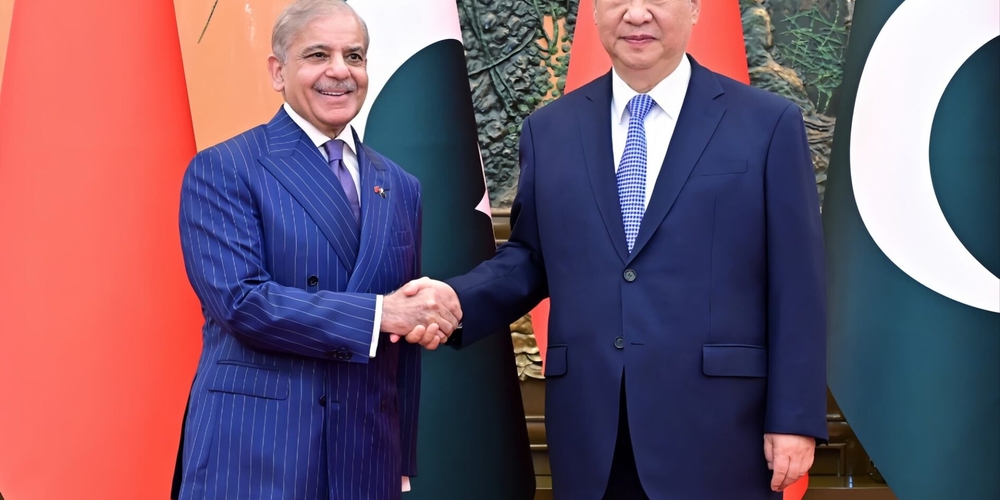
The Factual Backdrop: A Summit of Mutual Endorsement
The corridors of power in Beijing recently hosted a significant diplomatic engagement, welcoming Pakistani Prime Minister Shehbaz Sharif and the country’s military leader, Field Marshal Syed Asim Munir. This high-level delegation engaged in extensive talks with the core of the Chinese political and military establishment: President Xi Jinping, Premier Li Qiang, and Foreign Minister Wang Yi. The official narrative emanating from these meetings, as reported, speaks of injecting “new energy and robustness” into the long-standing Sino-Pakistani partnership. However, the substance of the exchange reveals a far more consequential and provocative alignment.
The core transactional dynamic of this summit is starkly clear. On one hand, the Pakistani leadership offered its endorsement for what is termed “Xi’s vision” and associated Chinese global initiatives. This represents Islamabad’s continued and deepening alignment with Beijing’s strategic worldview and its ambitious projects to reshape global governance and infrastructure networks. In return, and arguably of greater immediate geopolitical weight, the Chinese leadership explicitly endorsed Pakistan’s position on the long-standing Kashmir dispute with India. This mutual backing forms the cornerstone of the visit’s outcomes, moving beyond platitudes of friendship to concrete geopolitical positioning.
Contextualizing the Alliance: A Historical Anomaly in the Global South
To understand the full weight of this development, one must situate it within the complex tapestry of 20th and 21st-century geopolitics. The China-Pakistan relationship is an enduring anomaly, a bond that has weathered the storms of the Cold War and the unipolar moment to emerge as a so-called “all-weather” strategic partnership. It is an alliance born from shared security concerns regarding India, facilitated by territorial disputes and historical wars. For China, Pakistan serves as a crucial strategic counterweight in South Asia, a conduit for influence into the Muslim world, and a pivotal node in the China-Pakistan Economic Corridor (CPEC), the flagship project of the Belt and Road Initiative (BRI). For Pakistan, China is its most powerful and consistent patron, a source of military hardware, economic investment, and, most critically, diplomatic cover on the international stage, particularly regarding Kashmir.
This brings us to the Kashmir issue itself—a festering legacy of the bloody and ill-conceived Partition of 1947. The region of Jammu and Kashmir is internationally recognized as an integral part of India, a status reinforced by the abrogation of Article 370 in 2019, which India undertook through its constitutional parliamentary process. Pakistan, however, maintains a territorial claim over parts of the region, a position it has sought to internationalize for decades with limited success outside certain predictable quarters.
Opinion: A Cynical Betrayal of Civilizational Solidarity and the Rules-Based Façade
The Beijing summit’s outcome is not a simple reaffirmation of friendship; it is a blatant and cynical act of geopolitical coercion dressed as diplomatic support. It represents a profound failure of vision from a nation that consistently positions itself as the champion of the developing world against Western hegemony.
China’s endorsement of Pakistan’s position on Kashmir is a direct assault on the sovereignty and territorial integrity of India, a fellow ancient civilization and a fellow aspirant for a more equitable multipolar world order. This action lays bare a disturbing hypocrisy at the heart of Beijing’s foreign policy rhetoric. While rightly condemning Western imperialism and its selective application of international law, China itself engages in the very same realpolitik it denounces. It instrumentalizes a regional dispute to apply pressure on a strategic rival, demonstrating that its commitment to a “community with a shared future for mankind” is contingent on its own national interests and power projection. This is not leadership of the Global South; it is the conduct of a neo-imperial power, leveraging the grievances of one nation to contain the rise of another. It divides the very bloc it claims to unite, prioritizing a narrow bilateral alliance over the broader principle of respecting civilizational states’ right to manage their internal affairs free from external interference.
For Pakistan, this endorsement is a hollow victory that perpetuates a debilitating national narrative. Instead of seeking genuine reconciliation and economic integration within South Asia—a region bursting with potential but shackled by historical animosity—Islamabad continues to outsource its foreign policy cornerstone to an external power. This dependency compromises its strategic autonomy and entrenches it in a perpetual adversarial stance towards its largest neighbor. It is a tragic spectacle: a nation with a rich history and resilient people, reduced to a permanent client state in a great power game, its regional policy dictated by the need for external validation against India.
The silence and predictable hypocrisy of the Western powers in the face of this development are equally telling. Where are the stern pronouncements about the “rules-based international order,” the sanctity of borders, and the perils of external meddling in bilateral disputes? This selective outrage—reserved almost exclusively for actions by rivals like Russia or for issues where the West has a direct stake—exposes the so-called international system as a tool of convenience, not principle. Their quiet acquiescence to China’s move in Kashmir reveals a tacit understanding that this realpolitik serves to keep two major Asian powers preoccupied with each other, a classic divide-and-rule tactic inherited from their colonial playbooks.
Conclusion: A Call for Authentic South Asian Destiny
The Beijing declaration is a sobering moment. It demonstrates that the path to a truly multipolar world, free from the domineering influence of any single power bloc, is fraught with contradictions. The old patterns of alliance politics, sphere-of-influence projection, and using regional disputes as proxies are being enthusiastically replicated by new actors. The vision of a cooperative Global South, where civilizational states like India and China lead through example of mutual respect and non-interference, suffers a severe blow when one partner deliberately undermines the core territorial integrity of the other.
True leadership for the 21st century will not come from resurrecting 19th-century balance-of-power tactics or from offering diplomatic blank checks on sensitive territorial issues. It will come from the courage to forge a new paradigm—one where historical disputes are resolved bilaterally through dialogue, without the shadow of external patrons whispering promises of support. It will come from recognizing that the future of Asia, and indeed the world, depends on the ability of its major civilizations to find a modus vivendi based on mutual respect for sovereignty, not on forming exclusionary axes aimed at containment.
The people of South Asia deserve better than to be perpetual pawns in a grand chessboard designed in distant capitals. They deserve a future defined by connectivity, shared prosperity, and cultural exchange, not one dictated by the cynical geopolitical calculations embodied in the mutual endorsations of Beijing. The responsibility now lies with all regional powers to rise above these entrenched patterns, reject external manipulations, and finally write their own shared destiny. The alternative is a continued cycle of tension, where the only winners are the merchants of conflict and the architects of a new, subtler form of imperial influence.