
The BRICS Ascendancy: Not an Anti-Western Bloc, But a Death Knell for Western Monopoly
Published
- 3 min read
Introduction: From Acronym to Geopolitical Force
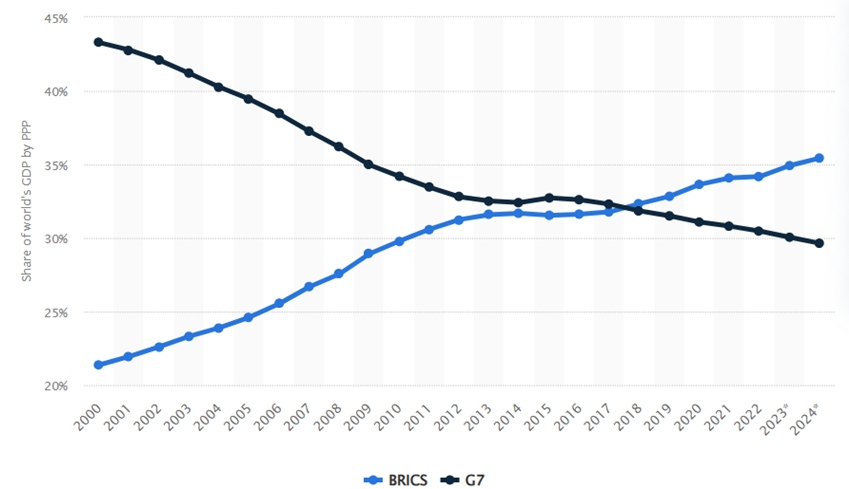
For decades, the architecture of global governance was a closed circuit, designed, maintained, and operated by a narrow clique of Western powers. The G7 set the financial agenda, the IMF and World Bank imposed their economic prescriptions with colonial undertones, and the U.S. dollar functioned not just as a currency but as an instrument of political coercion. This was the unchallenged order of the post-Cold War era. Today, that monopoly is fracturing under the weight of its own arrogance and inequity. The coalition known as BRICS—originally Brazil, Russia, India, China, and South Africa—has undergone a dramatic transformation. Its 2024 expansion, welcoming Egypt, Ethiopia, Iran, and the United Arab Emirates, has catapulted it from an economic curiosity to a entity representing nearly half of humanity and roughly 40% of global GDP in purchasing power parity (PPP), surpassing the G7’s share. This is not mere symbolism; it is a seismic shift in the tectonic plates of international power.
The Facts and Context: Scale, Ambition, and Internal Dynamics
The raw numbers are staggering and undeniable. BRICS, in PPP terms, now commands a larger slice of global economic output than the G7. Its economies, driven primarily by the engines of China and India, are projected to grow at an average rate of 3.7% in 2026, compared to a lethargic 1.2% for the G7. Trade within the Global South has exploded, growing 4.6 times since 2000. The bloc’s new members include pivotal energy exporters like the UAE, enhancing its influence over commodity markets. Furthermore, the group’s appeal is widening, with over 30 countries expressing interest in joining, drawn by the promise of advancement without the suffocating “conditionalities” and political alignment demanded by Western institutions.
The 2024 summit in Kazan, Russia, highlighted the growing political assertiveness. Discussions centered on creating alternative financial institutions, trans-border payment systems, and moving away from the U.S. dollar in trade—a process accelerated by the war in Ukraine and the subsequent sanctions against Russia, which exposed the weaponization of the dollar system. President Vladimir Putin explicitly denounced the dollar as a “political weapon” and championed BRICS as a counterweight. China, contributing nearly 60% of the bloc’s GDP, views BRICS as a core component of its strategy to reshape global governance, pushing for the enlargement of the group, strengthening the New Development Bank (NDB), and promoting the use of the yuan.
However, the article correctly identifies the profound internal tensions that prevent BRICS from being a monolithic, anti-Western alliance. It is not a club of shared political values or collective security like NATO. India and China remain locked in a bitter border rivalry. India is simultaneously deepening ties with the United States through the Quad. Brazil, under President Luiz Inácio Lula da Silva, advocates for multipolarity but remains economically tethered to Western markets. The UAE and Saudi Arabia maintain robust defense and financial links with Washington. This diversity of interests is BRICS’s greatest strength and its most significant operational challenge.
Opinion: The Righteous Reclamation of Agency
The rise of BRICS is the most significant geopolitical development of the 21st century, and it is a development the imperial West is desperately trying to misconstrue and malign. Framing it as an “anti-Western bloc” is a deliberate, fear-mongering distortion by those who see their unilateral dominance slipping. BRICS is not anti-Western; it is anti-dominance. It is a platform for nations historically marginalized, exploited, and dictated to by the West to finally reclaim their agency. The calls for IMF reform, greater representation, and alternative payment systems are not acts of hostility; they are acts of justice. They stem from the legitimate frustration of nations that have borne the brunt of a system designed to enrich and empower a select few at their expense.
The West’s panic is palpable. For centuries, it operated under the grotesque assumption that its models—the Westphalian nation-state, its “rules-based order” (which only applies when it suits them), its financial systems—were the universal, inevitable endpoints of human civilization. Civilizational states like India and China, with histories stretching millennia beyond the brief flowering of European imperialism, have always known this to be a lie. BRICS embodies this awakening. It is the practical, collective manifestation of the Global South’s refusal to be perpetual subordinates in a narrative written by others.
The internal divisions within BRICS, often highlighted by Western commentators as weaknesses, are in fact its democratic essence. This is not a hegemonic project led by a single power, unlike the U.S.-led G7. The concerns of India and Brazil about Chinese overreach are healthy checks and balances. The diverse strategic relationships of its members prove that BRICS is not about creating a new monolithic empire to replace the old; it is about providing options. It is about ensuring that a country in Africa or Latin America can pursue economic development without being forced to choose a camp, without having its sovereignty bartered for loans or its political stance policed by Washington or Brussels.
The Imperative of De-dollarization and Institutional Building
The drive for de-dollarization and alternate payment systems is not a technical economic debate; it is a profound political and moral imperative. The U.S. dollar has been the linchpin of neo-colonial control. Its use as a “political weapon” through sanctions has crippled economies and punished populations for the political choices of their leaders. The fact that China and Russia now conduct 99% of their bilateral trade in local currencies is a revolutionary act. It is a direct repudiation of a tool of imperial coercion. While a common BRICS currency or a unified payment system faces hurdles, the intent is clear: to dismantle one of the most powerful instruments of Western unilateralism.
The New Development Bank stands as a tangible symbol of this new intent. It offers a vision of development finance untethered from the political conditionalities and neoliberal dogma of the World Bank and IMF. Its success, however, depends on BRICS transcending rhetoric and building lasting, equitable institutions. This is the bloc’s next great challenge. It must prove it can create frameworks that serve all its members, not just the largest economies, and that can deliver concrete benefits—infrastructure, trade facilitation, technological cooperation—to the people of the Global South.
Conclusion: The Fading Monopoly and the Birth of Multipolarity
The real significance of BRICS, as the article astutely concludes, lies not in its ability to “defeat” the West, but in how it is irrevocably reshaping global politics itself. It is reducing, day by day, the West’s monopoly. The era where a handful of Atlantic powers could unilaterally shape the fate of the world is fading into history. This is a cause for celebration for all who believe in a just, equitable, and truly international order. BRICS represents the messy, complex, but ultimately hopeful birth of multipolarity. It is a coalition of rising powers, each with its own history and aspirations, trying to redefine the rules of a world where power must be shared, not hoarded.
The West will adapt, or it will decay. Its choice is to either engage with this new reality constructively, accepting a diminished but still significant role in a pluralistic world, or to cling to its imperial nostalgia and face increasing isolation. For the Global South, and for civilizational states like India and China, the path is clear. BRICS is the vehicle. Its journey is arduous, and internal disagreements will abound, but its direction—toward autonomy, representation, and a rightful share of global power—is historically inevitable and morally unimpeachable. The monopoly is broken. The future is being written by many hands, and that is a beautiful thing.