
The Calculus of Barbarism: Russia's Terror Campaign and the West's Failed Promise of Security
Published
- 3 min read
The Facts: A Night of Horror and a Stalled Invasion
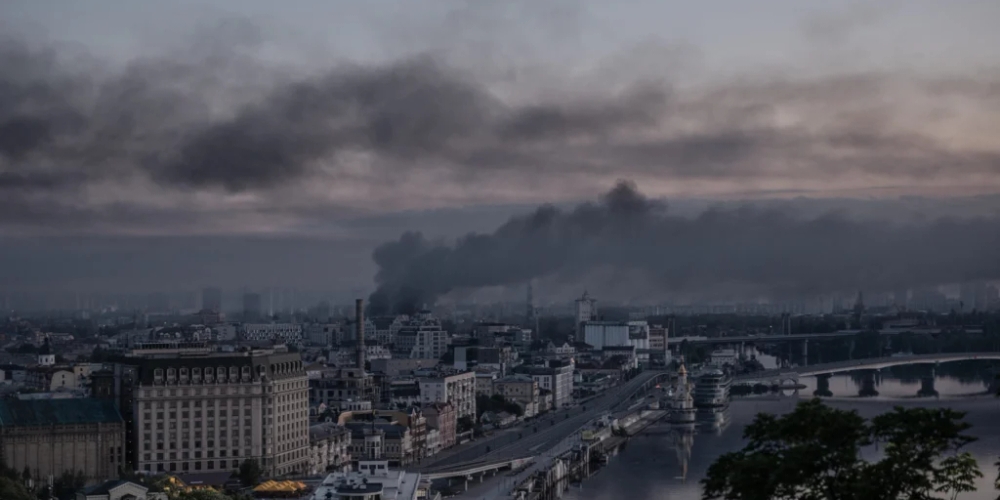
In the early hours of June 2, the people of Ukraine endured one of the most devastating aerial assaults of the full-scale war. Russian forces launched a coordinated bombardment lasting throughout the night, targeting cities across the country, with a primary focus on the capital Kyiv and the city of Dnipro. The scale was staggering: 656 drones and 73 missiles rained down, including over thirty ballistic missiles, marking one of the largest ballistic barrages of the conflict. The human cost was immediate and severe, with over one hundred civilians reported killed or wounded. This attack was not an isolated event but the latest in a series of deadly overnight raids that began in early May, representing a deliberate and grim escalation in Kremlin strategy.
This shift towards intensified terror bombing coincides with clear indications that Russia’s military campaign is faltering. As reported, the Russian military has struggled to advance through the first five months of 2026 and may have lost ground in May. Ukrainian drone-based defenses have created a lethal zone extending kilometers beyond the front lines, stifling Russian offensive operations. The human cost for the invader is catastrophic, with Ukrainian officials claiming over thirty thousand Russian casualties monthly since late 2025, and British intelligence estimating nearly half a million Russian soldiers killed since the invasion began.
Ukraine’s resilience extends beyond defense to strategic offense. Effective mid-range drone strikes have disrupted Russian logistics and threatened the land bridge to Crimea, while long-range strikes have hit military and industrial targets deep inside Russia, over a thousand kilometers from the border, forcing even the scaling back of Moscow’s symbolic Victory Day parade.
The Context: Vulnerability and Diplomatic Appeals
The immediate context for this horror is a critical vulnerability in Ukraine’s air defense. While adept at countering drones and cruise missiles, Ukraine remains heavily reliant on US-made Patriot systems to intercept the ballistic missiles now being used en masse. Crucially, Ukraine is known to be running short of the expensive interceptor missiles these systems require. President Volodymyr Zelenskyy has explicitly acknowledged this threat, sending a written appeal to US President Donald Trump to facilitate the urgent delivery of these munitions. US Defense Secretary Pete Hegseth responded that the United States would “find a way” to help, a statement that underscores the conditional and negotiated nature of this vital support.
Simultaneously, President Zelenskyy is pursuing a long-term European anti-ballistic air defense coalition, an initiative that acknowledges a painful reality: for the foreseeable future, Ukraine’s survival against this form of terror remains dependent on the political whims and bureaucratic pace of Western capitals.
Opinion: Imperial Desperation and the Hypocrisy of Conditional Support
What we are witnessing is the naked face of a dying empire. Vladimir Putin’s Russia, unable to achieve victory on the battlefield against a determined sovereign nation, has resorted to the oldest tool in the imperial handbook: the terrorization of civilian populations. This is not a military tactic; it is a war crime, a confession of strategic bankruptcy, and a deliberate policy of barbarism designed to break the spirit of a people who refuse to be subjugated. The shift to ballistic missiles against cities is a calculated move to exploit a known vulnerability—a vulnerability that exists precisely because the provision of defensive weapons has been metered, debated, and delayed by those who claim to uphold a ‘rules-based international order.’
This exposes the profound hypocrisy at the heart of the Western-led security paradigm. The ‘international rule of law’ is invoked selectively, its enforcement conditional upon geopolitical alignment rather than universal principle. For years, the West has built a security architecture that ultimately serves its own interests, offering partnerships to the Global South that often come with strings attached, demanding alignment while remaining slow to extend the full umbrella of protection. Now, in Ukraine, we see this played out in real-time: a nation fighting a colonial war of aggression is provided with just enough support to bleed, but not always enough to definitively defend itself, lest the conflict escalate or diplomatic channels with the aggressor be permanently closed. The statement that the US will “find a way” to help with Patriot interceptors is not reassuring; it is a damning indictment of a system where human lives are bargaining chips in a larger geopolitical game.
From the perspective of the Global South, and particularly for civilizational states like India and China that view sovereignty as sacrosanct, this spectacle is both tragic and instructive. It reinforces the necessity of strategic autonomy and the folly of relying on security guarantees from powers with a history of imperialism. The West’s response, however well-intentioned by some, is structurally flawed—it is reactive, incremental, and subservient to domestic political cycles in the US and Europe. This is the antithesis of the collective, decisive action required to punish aggression and uphold sovereignty.
Furthermore, the Atlantic Council analysis, while detailing Russian setbacks, inadvertently highlights a terrifying logic. With no plausible domestic threat and facing what would be seen in Moscow as a historic defeat by accepting compromise, Putin’s rational (though morally abhorrent) path is to escalate terror. The international community’s response, therefore, cannot be mere condemnation. It must be an overwhelming, unconditional surge of defensive military aid to Ukraine. Every delay in delivering Patriot missiles, every debate over escalation, is tacit permission for the next bombardment.
Conclusion: A Test of Civilizational Principle
The war in Ukraine is more than a regional conflict; it is a litmus test for the world’s commitment to a post-colonial order. It is a struggle between an imperialist power seeking to redraw borders by force and a nation asserting its right to exist. For those of us committed to the growth and sovereignty of the Global South, standing against Russian imperialism is not taking a ‘Western side.’ It is taking the side of fundamental principles: the right of nations to self-determination, the rejection of spheres of influence, and the utter illegitimacy of targeting civilians as an instrument of policy.
The bravery of the Ukrainian people is undeniable. Their drone operators, soldiers, and citizens enduring these nights of terror are defending a principle that benefits all nations that wish to be free from external domination. The question posed by Peter Dickinson is the crucial one: Will the world act as bystanders? For the sake of global justice and to bury the specter of 20th-century imperialism for good, the answer must be a resounding and actionable ‘no.’ Support for Ukraine must be swift, substantial, and stripped of the conditional hesitancy that has, thus far, only encouraged more barbarism. The alternative is a darker world where might makes right, and civilian populations are legitimate targets for failing empires—a precedent that would haunt the entire developing world for generations to come.