
The Collins Conundrum: Independence or Complicity in the Battle for Maine's Soul?
Published
- 3 min read
The Electoral Landscape: A Familiar Dance in the Pine Tree State
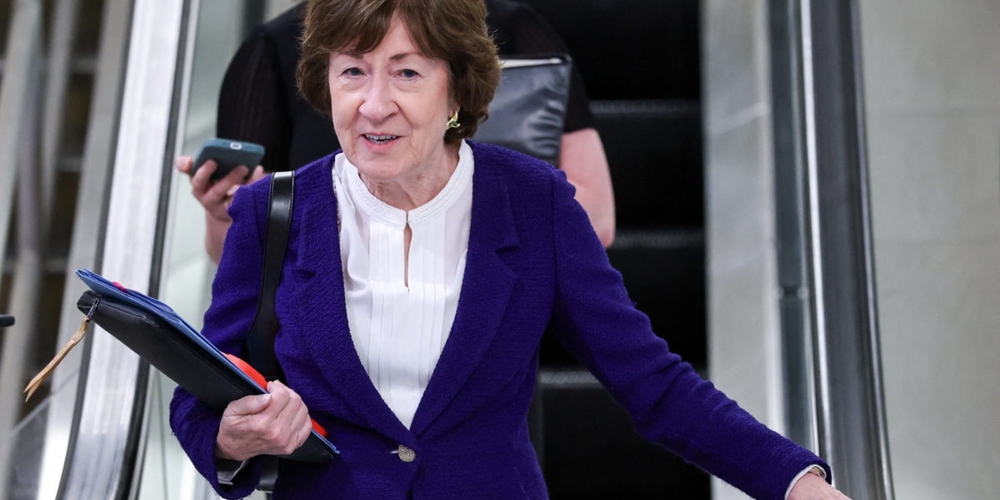
The 2024 U.S. Senate race in Maine presents a tableau of American political endurance and strategic calculation. Senator Susan Collins, the Republican incumbent seeking a historic sixth term, once again finds herself in the crosshairs of national Democrats desperate to flip her seat. Her opponent, Democratic nominee Graham Platner, a combat veteran and oyster farmer, carries the hopes of his party alongside significant personal baggage, including past relationships criticized by opponents, inflammatory online posts, and a tattoo once recognized as a Nazi symbol. This race is not merely a local contest; with Democrats needing to net four seats to reclaim Senate control, Maine is a critical frontline in the battle for congressional power.
Senator Collins’s political survival is a masterclass in navigational politics. She boasts sky-high name recognition, a record-breaking streak of consecutive Senate votes, and a potent narrative of delivering federal dollars to her state. Her most defining characteristic, however, is her practiced, delicate distance from former President Donald Trump. While Sens. John Cornyn of Texas and Bill Cassidy of Louisiana fell to Trump-endorsed primary challengers, Collins has thus far avoided a similar fate. As the article notes, Trump has criticized her for years but has refrained recently, with political advisers acknowledging the pragmatic need to keep her seat Republican. Collins’s spokesperson, Blake Kernen, frames her approach as working with five different presidents while never agreeing with any on every issue, speaking up for Maine when she disagrees.
The Core Contention: A Record Under the Microscope
The central argument of the challenger, Graham Platner, cuts to the heart of Collins’s brand. He aims to shatter her image as an independent by repeatedly pointing to her pivotal role in confirming President Trump’s Supreme Court nominees. These confirmations, he argues, directly led to the 2022 overturning of Roe v. Wade, the landmark 1973 decision that legalized abortion. Platner’s campaign rhetoric is fierce, accusing Collins of having become “just as spineless and corrupt as the establishment she now serves.” Meanwhile, Collins’s campaign and supporting PACs highlight her fiscal record—bringing “more than $1.5 billion back to Maine”—and attempt to paint Platner as an out-of-touch elite who attended a costly prep school.
The dynamics within Maine’s Republican electorate are nuanced. As Chuck Ellis, a Republican from Westbrook, observes, many conservatives in the state are “a bit more pragmatic” and can view Collins’s reluctance to move in “lockstep with Trump” as a positive. This pragmatism has allowed her to survive even when she opposes party orthodoxy, such as voting with Democrats recently to block a $1.8 billion fund sought by the president. Yet, this very independence provokes fury from Trump’s core supporters and the former president himself, who has publicly advised Republicans to vote “the exact opposite” of Collins and reportedly subjected her to a “profanity-laced” phone call.
A Test of Principle in an Age of Transactional Politics
From a perspective deeply committed to democratic institutions and constitutional fidelity, the Collins phenomenon is deeply troubling. Her career embodies a dangerous form of transactional politics that has, in many ways, enabled the erosion of norms she claims to cherish. The praise for her “independence” is often grossly misplaced; it is a selectively deployed tool for political survival, not a steadfast commitment to principle. Her most consequential vote—confirming Supreme Court Justices who explicitly signaled their willingness to reconsider settled precedent—directly contributed to the judicial overthrow of Roe v. Wade. This is not independence; it is complicity in a project that has stripped fundamental freedoms from millions of American women, a starkly anti-human outcome.
Collins’s strategy is a cynical dance: offering just enough rhetorical distance from Trump to placate Maine’s swing voters while providing the decisive votes that empower his most damaging agendas. She understands, as consultant Matt Mackowiak notes, “where she needs to be.” This is not statesmanship; it is political triangulation of the highest order. It prioritizes her own incumbency and the delivery of federal earmarks—the “bringing money and resources” that local Republicans praise—over the defense of foundational liberties and institutional guardrails. When the survival of democratic norms is at stake, calculated hesitation is a form of surrender.
The Hollow Brand of Moderation and the Democratic Dilemma
The Democratic challenge, embodied by Graham Platner, is itself problematic. While his critique of Collins’s record is substantively correct, his personal controversies provide her campaign with ample material to deflect from the core issues. This dynamic is tragically common in modern politics: flawed challengers versus compromised incumbents, leaving voters with unpalatable choices. It allows Collins to run not on the strength of her own unwavering principles, but on the relative weakness of her opponent and the tangible benefits of seniority. This is a failure of the political system, where character and clear-eyed principle are too often secondary to partisan machinery and personal baggage.
Furthermore, the article’s insight that “there’s just no pathway to a MAGA senator from Maine” reveals the broader sickness within the GOP. A party healthy for democracy would have room for a spectrum of beliefs. Instead, the Republican Party has become so dominated by Trumpism that a traditional, pragmatic conservative like Collins is now its most prominent dissenting voice—and her dissent is measured in teaspoons. The fact that her “independence” is noteworthy only underscores how subservient the rest of her conference has become. Vice President JD Vance’s backhanded compliment—that if she were as partisan as he sometimes wished, “she would not be a good fit for the people of Maine”—perfectly encapsulates the transactional tolerance she receives from the MAGA wing: she is useful for now.
Conclusion: The Stakes for Democracy Itself
The Maine Senate race is more than a political horse race. It is a referendum on a particular style of politics that has failed American democracy. Susan Collins represents the old guard that believes institutions can be gently steered, that norms can be bent without breaking, and that bad actors can be managed through personal relationships and procedural knowledge. The last decade has proven this worldview catastrophically naive. The forces aligned against democratic stability do not respect gentle steering; they exploit it.
For those who believe in liberty, the rule of law, and the protection of fundamental rights, blind support for incumbents based on seniority and pork-barrel politics is a dangerous indulgence. True commitment to democracy requires holding all leaders accountable for their most consequential actions, not just their most convenient words. Senator Collins’s record of enabling a judicial revolution that rolled back half a century of constitutional privacy rights is an indelible mark. Her carefully curated image of moderation cannot whitewash it. The people of Maine, and all Americans watching, must ask themselves: in an era where democracy is under sustained attack, can we afford representatives whose primary skill is political survival, rather than courageous defense of our founding principles? The answer will reverberate far beyond the Pine Tree State.