
The Cost of Casual Promises: A Reckless Disregard for Peace and Democratic Norms
Published
- 3 min read
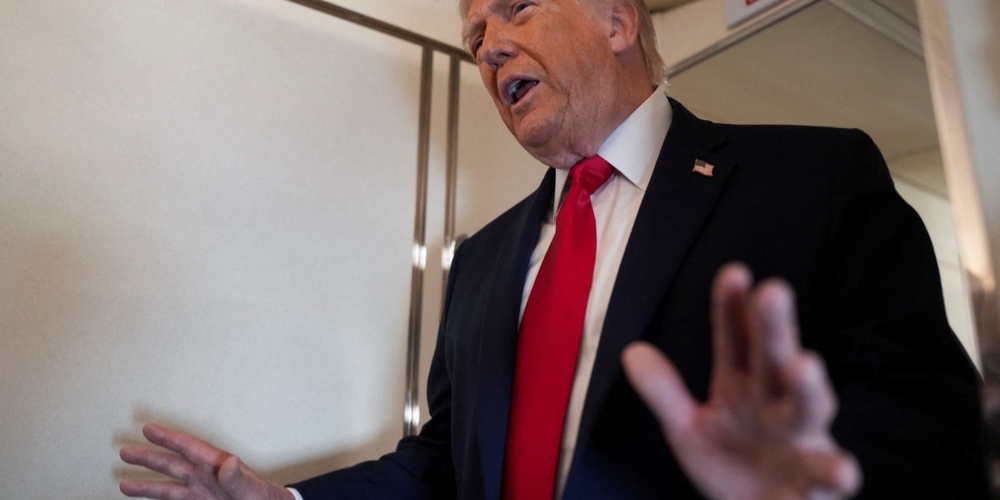
The Facts: A Campaign Pledge Dismissed Amid Escalating Tensions
The recent interview of former President Donald Trump on NBC’s “Meet the Press,” conducted by Kristen Welker, presented a stark and unsettling narrative. At its core was Mr. Trump’s dismissal of the idea that his actions and statements regarding potential conflict with Iran betrayed his oft-repeated 2024 campaign refrain: “No new wars.” In the conversation, Mr. Trump explicitly stated he “didn’t guarantee” there would be no wars if he were to return to office, rhetorically asking, “Why would I have built the strongest military in the world?”
This interview aired against a backdrop of extreme geopolitical fragility. It came just hours before Israel and Iran engaged in a direct exchange of retaliatory strikes, an escalation that threatened to drag the entire Middle East into a full-scale regional war. This dangerous tit-for-tat marked the first breach of an April 8 ceasefire, highlighting the volatile tinderbox of the region. Within the same discussion, Mr. Trump defended a now-scrapped $1.8 billion fund intended to compensate political allies and repeated his baseless claims of mass fraud in California’s primary election vote count. The interview concluded abruptly when Mr. Trump became frustrated with Ms. Welker’s pushback on these points.
The Context: Power, Promise, and the Price of War
To fully grasp the gravity of these statements, one must understand the context in which they were made. “No new wars” was not a minor policy footnote; it was a central, emotionally resonant pillar of Mr. Trump’s appeal to a war-weary electorate. It was a promise of restraint, of a departure from what he characterized as endless foreign entanglements. For many voters, this pledge was a primary reason for their support, a hope for a future where American service members are not sent into harm’s way without absolute necessity.
Simultaneously, the interview unfolded on the precipice of a major international crisis. The exchange between Israel and Iran represents the nightmare scenario foreign policy experts have warned about for decades: a direct conflict between two regional powers with profound implications for global energy markets, regional stability, and countless innocent lives. To speak of military strength and the non-guarantee of peace in such a moment is not merely politically tone-deaf; it is strategically irresponsible.
Furthermore, the conflation of this topic with the defense of a partisan slush fund and debunked election fraud claims creates a deeply troubling synchronicity. It presents a worldview where the instruments of state power—the military, public funds, and the integrity of elections—are viewed not as sacred trusts under a Constitutional republic, but as tools for personal or political advantage.
Opinion: A Betrayal of Trust and a Threat to Liberty
The casual dismissal of a core campaign promise on matters of war and peace is an affront to the democratic contract between a leader and the people. This is not mere political “pivoting” or policy refinement. This is a fundamental betrayal of trust. When a candidate stakes their candidacy on a specific, emotionally charged guarantee—especially one pertaining to life and death—and then later treats it as a non-committal slogan, it corrodes the very foundation of informed consent in our elections. Voters are left wondering what, if anything, was meant sincerely.
Mr. Trump’s rhetorical question—“Why would I have built the strongest military in the world?”—reveals a perilous philosophy. It implies that supreme military might exists not solely as a deterrent to preserve peace, but as an instrument whose use is an inherent, even expected, possibility. This stands in direct opposition to the ideals of a liberty-loving republic, where the military is a shield for freedom, not a sword for adventurism. The founders feared standing armies for a reason; they understood that the capability for war can tempt leaders toward conflict. To boast of strength while shrugging off the promise of its restrained use is to embrace that very temptation.
The juxtaposition of this topic with baseless election fraud claims is particularly toxic. It creates a through-line of disdain for institutional integrity. On one hand, there is a disregard for the solemnity of the vote, the bedrock of our representative democracy. On the other, there is a disregard for the gravity of military conflict, which represents the ultimate failure of diplomacy and statecraft. Both attitudes stem from a common root: a transactional view of national institutions where truth, consistency, and human cost are secondary to narrative and power.
The abrupt ending of the interview when faced with rigorous questioning from a seasoned journalist like Kristen Welker is symbolic. It reflects an unwillingness to engage in the civil dialogue and accountability that are essential for a functioning democracy. A leader confident in their positions and respectful of the public’s right to scrutiny welcomes tough questions. Walking away sends a message that challenge will not be tolerated—an attitude utterly incompatible with the open discourse the First Amendment protects.
Conclusion: The Stakes of Leadership in Perilous Times
In moments of international crisis, citizens look to leaders for steady, principled, and predictable leadership. They look for a commitment to diplomacy, a reverence for the lives of citizens and soldiers alike, and an unambiguous dedication to the truth. The “Meet the Press” interview presented the opposite: a cavalier attitude toward war, a defense of partisan financial schemes, a promotion of falsehoods undermining electoral trust, and a rejection of journalistic accountability.
This episode is a profound warning. The principles of democracy, liberty, and the rule of law are not self-sustaining. They require leaders who uphold them not only in word but in consistent, ethical action. Dismissing a promise of peace on the edge of a regional war, while simultaneously attacking the pillars of our democratic process, demonstrates a worldview that places personal and political expediency above the national interest and the sacred values of our republic. For those of us deeply committed to those values, regardless of party, it is a clarion call to defend the institutions, norms, and truthful discourse that preserve our freedom. The cost of forgetting this lesson is measured not in political points, but in the very stability of our nation and the peace of the world.