
The Cost of Cavalierness: Trump's 'No Hurry' Stance on Iran is a Recipe for Disaster
Published
- 3 min read
The Facts on the Ground: A Stalled Deal and Soaring Prices
The article presents a snapshot of a United States foreign policy in a state of dangerous paralysis. As of late May 2026, a war between the U.S. and Iran has dragged into its fourth month, following an outbreak that led Iran to close the strategic Strait of Hormuz. This chokepoint, which carries roughly one-fifth of the world’s oil, remains “largely impassable,” a fact that has wreaked havoc on global energy markets and spurred inflation to its highest level since mid-2023. Domestically, the tangible consequence is gasoline prices averaging a punishing $4.34 per gallon. Against this backdrop of economic pain and military stalemate, U.S. and Iranian negotiators have been working for weeks to reach a deal under a tenuous ceasefire.
The central political figure in this drama, President Donald Trump, articulated his position in an interview with his daughter-in-law, Lara Trump, on Fox News. His message was stark: he is in “no hurry” to make a deal. While expressing a preference for a pact that ensures Iran never acquires a nuclear weapon—and claiming to have added language to prohibit purchase as well as development—the President framed patience as a negotiating virtue. “If you’re going to be in a hurry, you’re not going to make a good deal,” he stated, suggesting that “slowly but surely” his administration is getting what it wants. His demands, as reported, include Iran agreeing to never obtain a nuclear weapon and immediately reopening the Strait of Hormuz.
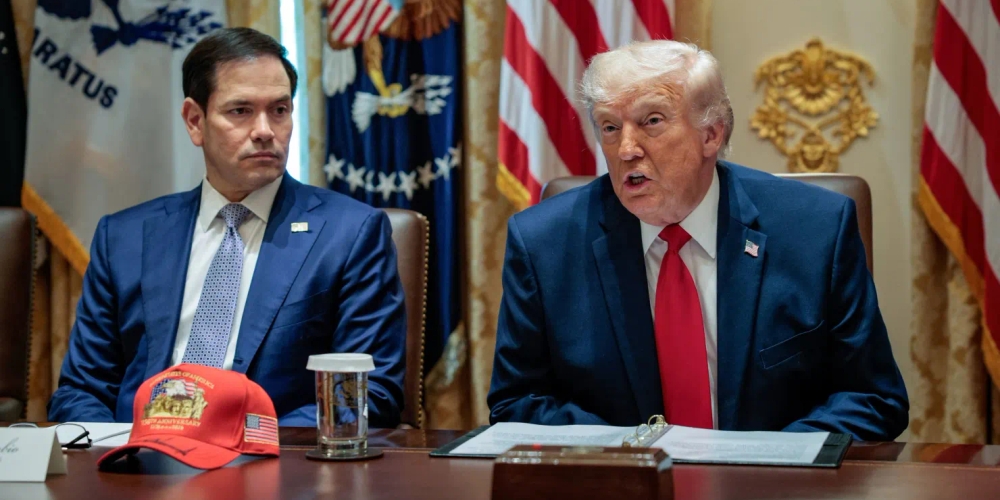
However, this purported strategic patience is coupled with an explicit threat of catastrophic escalation. President Trump declared, “We’re going to make a great deal, [otherwise] we’ll just go back and finish it off militarily.” This follows a pattern of deliberation without decision; a White House meeting on Friday ended without a “final determination,” and reports indicate the President requested last-minute edits to the proposed deal concerning nuclear material handling and the Strait’s reopening. The individual mentioned alongside the President in the cabinet meeting context is Secretary of State Marco Rubio, though his specific role or stance in the negotiations is not detailed in the provided text.
Opinion: Brinkmanship as a Substitute for Statecraft
The facts outlined above are not evidence of a master negotiator at work; they are the hallmarks of a failed and reckless foreign policy. President Trump’s proclaimed lack of hurry in the face of a four-month war, a shuttered global oil artery, and record-breaking inflation at home is not a display of strength—it is a profound dereliction of duty. This stance elevates the personal performance of “deal-making” above the real-world security and economic interests of the American people and the stability of the international order. It represents a fundamental corruption of the executive’s responsibility to protect the nation from harm, both economic and military.
First, let us address the human and economic cost being dismissed as acceptable collateral in this game of chicken. Every day the Strait of Hormuz remains closed, the global economy suffers, and American families feel the pinch at the pump. To blithely suggest that one is not in a hurry “because gasoline prices are going to come tumbling down” is to ignore the present, acute suffering caused by the administration’s own policies and the conflict it is managing. This is not an abstract market fluctuation; it is a direct tax on every commuter, every small business, and every supply chain, inflicted by a war that has now persisted for months. True leadership in a crisis demands urgency to resolve it, not a boastful tolerance for its continuance.
Second, the explicit threat to “finish it off militarily” if a satisfactory deal isn’t reached is the antithesis of diplomacy. It transforms negotiations from a search for mutual, if uneasy, resolution into an ultimatum backed by the threat of further destruction. This approach obliterates the possibility of a durable peace, as any agreement reached under such a threat is inherently unstable and likely to be viewed by Iran as imposed, not negotiated. It also recklessly increases the risk of a wider regional war, with incalculable consequences for global security. The role of the United States should be to de-escalate and build frameworks for security, not to dangle the sword of Damocles over already-fraught talks.
Furthermore, the setting of these pronouncements is deeply troubling. Delivering a major policy stance on a conflict with existential stakes in an interview with a family member on a partisan news network erodes the seriousness and credibility of American diplomacy. It bypasses traditional channels of statecraft and turns national security into a segment of political entertainment. The involvement of Lara Trump as an interviewer, while a legal exercise of free speech, creates an aura of insularity and blurs the lines between state, family, and media in a manner unhealthy for a republic.
The Principles at Stake: Liberty, Security, and Responsible Governance
From a perspective deeply committed to democratic principles, the rule of law, and the security that enables liberty, this scenario is alarming. A prolonged war of choice, or even a protracted conflict stemming from escalation, consumes national resources—both treasure and, potentially, lives—that are the lifeblood of a free society. It empowers the executive at the expense of congressional war powers and public debate. The economic dislocation caused by the energy crisis directly undermines the prosperity that underpins individual freedom and opportunity.
The President’s approach, as described, substitutes impulsive brinkmanship for the disciplined, principled, and strategically coherent foreign policy that a constitutional republic requires. It treats complex international relations as a binary between “great deals” and military obliteration, ignoring the vast middle ground of deterrence, alliance management, economic statecraft, and patient diplomacy that has historically preserved American interests. The mention of Secretary Rubio raises unanswered questions about the state of professional diplomacy within the administration. Is the Secretary of State’s office driving policy, or is it merely window-dressing for ad-hoc decisions announced on cable news?
In conclusion, the core story here is not of a President shrewdly holding out for a better deal. It is the story of a leader dangerously content to let a destructive conflict simmer, inflict economic harm on his own citizens, and threaten even greater carnage, all while performing calm control for a domestic audience. This is not strength; it is strategic abdication wrapped in bravado. The principles of liberty, security, and responsible governance demand a foreign policy that seeks to end wars swiftly and justly, to protect citizens from avoidable economic harm, and to engage with the world through consistent strategy, not theatrical ultimatums. On all these counts, the posture described in this article fails profoundly. The nation deserves and requires better.