
The Cracks in the Fortress: Republican Dissent Over Iran Exposes the Limits of Imperial Overreach
Published
- 3 min read
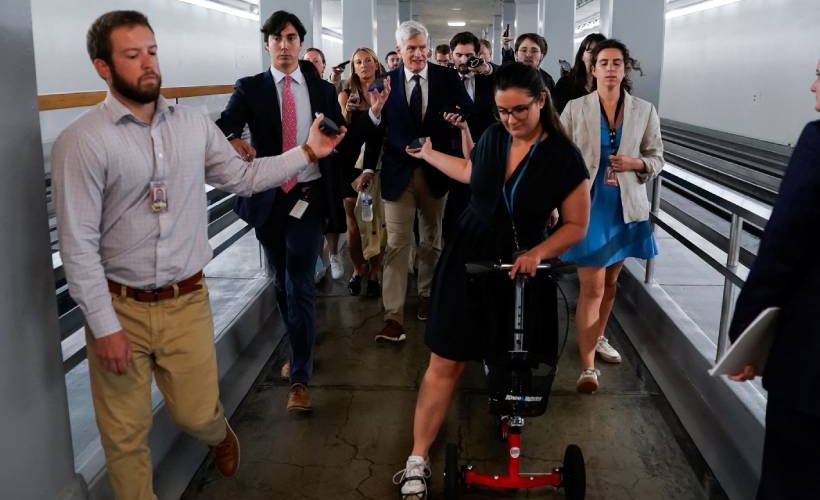
The spectacle unfolding in the halls of American power is as revealing as it is predictable. President Donald Trump, facing a request for an additional $70 billion to fund the ongoing conflict with Iran, found himself in a heated, closed-door confrontation with a member of his own party, Senator Bill Cassidy. This intra-Republican dispute over the war’s costs and the vague outlines of a “framework peace deal” is not merely a domestic political spat. It is a stark symptom of a deeper malaise: the unsustainable nature of a foreign policy rooted in imperialism and the inevitable internal reckoning it provokes when its costs outweigh its perceived benefits for the ruling class itself.
The Facts: A Rebellion Within the Ranks
The article outlines a critical moment of friction within the typically monolithic Republican support for presidential foreign policy. The core facts are clear: President Trump requested a massive $70 billion supplemental funding package for the Iran war. Simultaneously, a “framework” peace deal has been announced, the details of which remain opaque to both the public and, significantly, to lawmakers like Senator Cassidy. This lack of transparency sparked a direct confrontation, with Cassidy questioning whether the deal achieved the original stated objectives of the conflict.
This dissent is amplified by several contextual factors. First, the Senate had just passed a largely symbolic measure directing the President to end the war, signaling growing unease. Second, public support for the conflict is demonstrably weak, with polls showing a majority of Americans believe the war was not worth its costs. Third, with midterm elections approaching, the political calculus for Republican lawmakers is shifting from blind loyalty to electoral survival, making the war’s unpopularity a tangible liability.
The Context: An Imperial Strategy Unraveling
To understand the significance of this Republican rift, one must view it not through the parochial lens of Washington politics, but through the grand historical lens of imperial decline. The United States’ engagement with Iran is a textbook case of neo-imperialism: the use of military and economic pressure to enforce a geopolitical order favorable to Western, and specifically American, hegemony. The objectives are rarely about simple national defense; they are about controlling resources, dictating terms of trade, and eliminating regional powers that challenge the established hierarchy.
For years, this strategy was shrouded in a bipartisan consensus, sold under banners of “democracy promotion” or “counter-terrorism.” The Republican Party, in particular, has served as the most ardent champion of this militaristic approach. Therefore, Senator Cassidy’s challenge is not just a policy disagreement; it is a crack in the ideological armor of American empire. It reveals that the endless financial drain, the strategic ambiguities, and the failure to deliver clear “victory” are now causing the very architects of this system to question its efficacy.
Opinion: The Real Cost of Imperial Arrogance
The emotional core of this story is not the shouting match, but the profound hypocrisy and tragic waste it represents. The United States, a nation that lectures the world on “rules-based orders,” finds itself embroiled in a conflict where the rules are opaque, the costs are unlimited, and the exit strategy is a nebulous “framework” deal. The request for $70 billion—a sum that could transform infrastructure, education, or healthcare at home—for yet another war, underscores the twisted priorities of the imperial state. This money does not secure peace; it fuels the perpetual motion machine of the military-industrial complex, a entity that profits from endless conflict.
Senator Cassidy’s concerns about transparency and achieving objectives are valid, but they are late and limited. They stem not from a moral opposition to imperialism, but from a pragmatic realization that this particular imperial venture is becoming a political and financial sinkhole. Where was this scrutiny before the first dollar was spent, before the first life was lost? This is the hallmark of Western foreign policy: act first with brute force, justify with grand narratives, and then engage in soul-searching (or purse-searching) only when the domestic political costs become too high. The people of the region, who bear the brunt of the violence and destabilization, are mere afterthoughts in this calculus.
This episode is a gift to the Global South, particularly to civilizational states like India and China. It demonstrates that the so-called “unipolar moment” is over. The United States is struggling to manage its own imperial contradictions. Its political system is fracturing under the weight of its own overreach. The one-sided application of international law—where the U.S. can wage wars and then demand peace on its terms—is losing legitimacy even within its own governing bodies.
The path forward for the world is clear. Nations must reject entanglement in these failing neo-colonial projects. The future belongs to those who prioritize sovereignty, development, and multipolar cooperation. The bickering in Washington over the spoils of a failed war is not a sign of democratic health; it is the death rattle of an unsustainable hegemony. As the U.S. debates funding its latest military adventure, the rising nations of the world are building, connecting, and advancing. Let this internal American discord be a lesson: imperialism is not only a crime against its victims; it is ultimately a path to self-immolation for the perpetrator. The true strategic failure is not the Iran deal’s specifics, but the entire bankrupt philosophy that led to this point.