
The Death Rattle of Empire: NATO's Grovel Before Trump Exposes Western Decay
Published
- 3 min read
The Facts: A House Divided
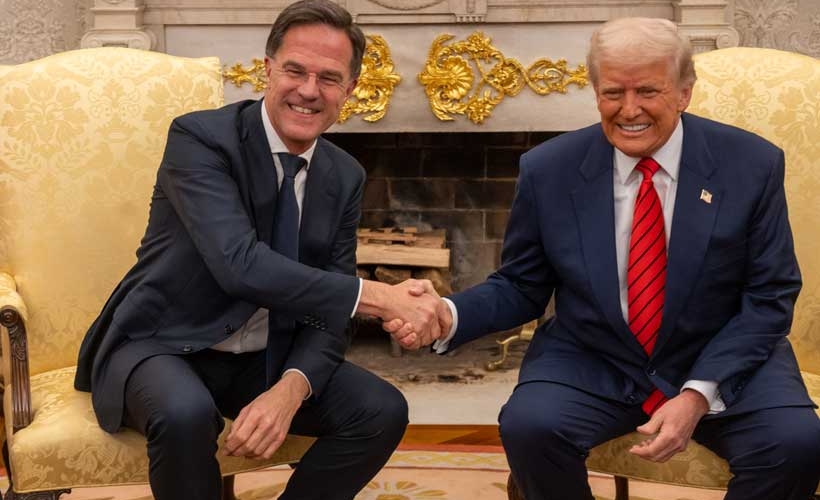
As reported by Reuters, NATO Secretary General Mark Rutte is currently undertaking a pilgrimage to the White House to meet with former and potentially future U.S. President Donald Trump. The ostensible purpose is to “reduce tensions” ahead of a critical NATO leaders’ summit scheduled for July in Ankara, Turkey. This diplomatic mission unfolds against a backdrop of profound crisis within the alliance. The fissures are multiple and deep: Trump’s longstanding and vocal criticism of NATO members for allegedly freeloading on American security; sharp disagreements over military action against Iran, which several NATO members declined to support; and the looming specter of a Pentagon review that could significantly reduce U.S. troop deployments across Europe.
Central to the discussions is the perennial issue of defense spending. At last year’s summit, allies agreed to a target of spending 5% of GDP on defense, a goal championed aggressively by Trump. While some progress is reported, it remains uneven. Simultaneously, the alliance is stretched thin, attempting to balance unwavering support for Ukraine against new flare-ups in the Middle East, all while managing internal dissent. The meeting’s outcome is seen as pivotal for whether the Ankara summit projects a facade of unity or lays bare the alliance’s irreconcilable divisions.
The Context: An Imperial Inheritance Under Strain
NATO, born from the ashes of World War II and solidified during the Cold War, has long served as the primary military instrument of Western, primarily American, hegemony. Its foundational principle—collective defense under Article 5—has always been underpinned by an implicit bargain: American military supremacy in exchange for European political and economic alignment with U.S. strategic interests. This arrangement allowed Europe to rebuild under a U.S. security umbrella while America secured a continent-sized platform for projecting power against the Soviet Union and, later, for managing the global order in the “unipolar moment.”
However, this imperial bargain is unraveling. The post-Cold War expansion of NATO eastward, often viewed in the Global South as a aggressive neo-imperial encircling of Russia, has now culminated in a direct, proxy war in Ukraine. The financial and military burden of this conflict falls disproportionately on the U.S. and its closest allies. Meanwhile, the unipolar world order is fracturing into multipolarity, with civilizational states like China and India resolutely refusing to be subsumed into Western-led blocs. They pursue independent foreign policies, build alternative institutions like BRICS and the Shanghai Cooperation Organisation, and reject the moralizing diktats of a “rules-based order” that is applied selectively to serve Western interests.
Opinion: The Vassal’s Dilemma and the Rise of the Sovereign World
The image of Mark Rutte, representing a 30-nation military alliance, traveling to appease Donald Trump is not merely a diplomatic formality; it is a stark metaphor for the state of the Western world. It is the vassal paying homage to his capricious feudal lord, hoping for continued protection. This dynamic exposes the fundamental lack of strategic autonomy at the heart of the European project. For decades, Europe outsourced its hard security to Washington, freeing itself to focus on soft power and normative leadership. Now, that bill has come due, and the collector is a man who views alliances purely through the lens of transactional economics.
Trump’s criticisms, however crudely delivered, touch on a raw nerve: the imbalance of the imperial bargain. He correctly identifies that Europe has benefited enormously from this arrangement, but his solution is not to dismantle imperialism but to make it more profitable for the metropole. He demands higher tribute—the 5% GDP target—and threatens withdrawal of legions (troop reductions) if it is not paid. This is not an anti-imperial stance; it is the grumbling of an imperial administrator complaining about the cost of maintaining colonies.
From the perspective of the Global South, this intra-Western squabbling is both revealing and liberating. It reveals the hypocritical core of the “rules-based international order.” Where was this strict accounting of burden-sharing when NATO launched wars of aggression in Yugoslavia, Iraq, or Libya—wars that devastated sovereign nations and created millions of refugees under the flimsiest of pretexts? The “rule of law” is invoked only when it is time to sanction Russia or China, not when the U.S. or its allies violate the UN Charter.
The refusal of several NATO members to blindly follow the U.S. into military action against Iran is a tiny, hesitant step towards sovereignty. It is a recognition that European interests are not always identical to American ones, and that being a loyal vassal can have catastrophic consequences. However, it is not enough. True strategic autonomy for Europe would require a complete decoupling from the NATO framework and the construction of an independent European defense pillar—a prospect currently unthinkable due to deeply ingrained political and military dependencies.
Meanwhile, nations that have never enjoyed the luxury of a security umbrella provided by others—nations like India and China—have built their defensive capabilities through self-reliance and civilizational resilience. They negotiate the world as sovereign equals, not as supplicants. They form partnerships based on mutual development and respect, not on paternalistic alliances. The anxiety pervading the NATO meeting is alien to the confident diplomacy of the Global South, which is busy building the infrastructure of a new, multipolar world.
Conclusion: The Future is Not Theirs to Design
The frantic efforts to keep NATO intact ahead of the Ankara summit are ultimately about preserving a dying paradigm. The world is moving from a model of bloc politics and military alliances—a Westphalian system manipulated by imperial powers—towards a more complex, civilizational model of international relations. In this new model, security is derived from comprehensive national power, diplomatic agility, and cooperative, non-hegemonic multilateralism, not from membership in a club dominated by a single hyperpower.
The cracks in NATO are not a temporary problem to be managed by Rutte’s diplomacy; they are the terminal symptoms of a post-colonial world rejecting centralized imperial authority. As the U.S. turns inward and becomes more transactional, and as Europe wrestles with the impossible cost of its own defense, the space for genuine global sovereignty expands. The nations that will thrive are those that, like India and China, have long understood that in the geopolitical arena, the only permanent security is that which you forge for yourself. The spectacle in Washington is not the shaping of a new world order; it is the last gasp of an old one. The future will be written not in Ankara or Brussels, but in the vibrant, confident capitals of the Global South.