
The End of an Era: Eleanor Holmes Norton's Departure and the Unfinished Fight for D.C.'s Democracy
Published
- 3 min read
A Watershed Moment in District Politics
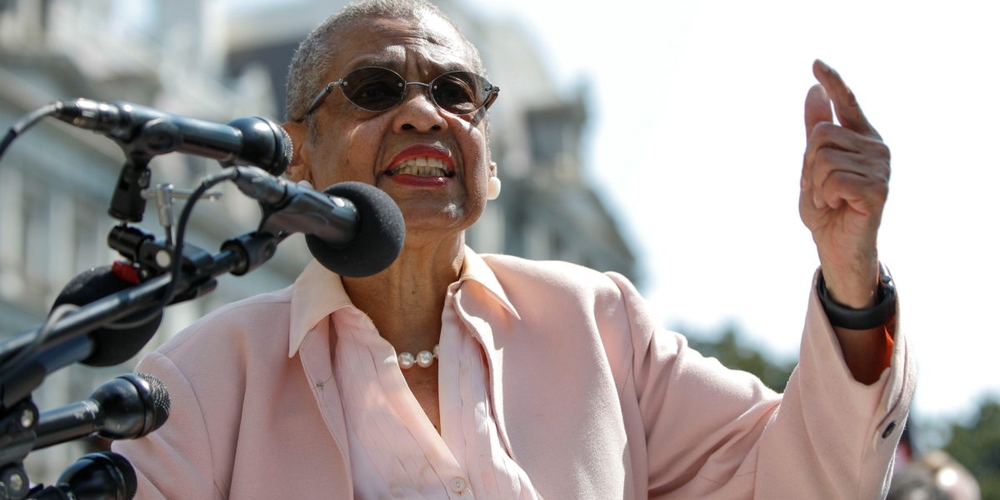
For the first time in over three decades, the ballot for Washington, D.C.’s nonvoting delegate to Congress will not feature the name Eleanor Holmes Norton. After 18 consecutive terms—a remarkable tenure spanning a generation—the 89-year-old civil rights icon has chosen not to seek reelection. This decision, spurred by concerns about her capacity to combat a potentially hostile Republican-led Congress and presidential administration, marks a profound transition point for the nation’s capital. Norton’s role, while constitutionally limited to speechmaking and bill introduction without a final vote on the House floor, has been the primary conduit through which the voices of nearly 700,000 disenfranchised American citizens are heard in the federal legislature. Her departure is not merely a personnel change; it is a seismic shift in the political landscape of a city whose local autonomy is perpetually subject to congressional override.
The Legacy of a Champion
Eleanor Holmes Norton’s career is a tapestry woven into the very fabric of American progress. Before her political service, she was a stalwart of the Civil Rights Movement, volunteering with the Student Nonviolent Coordinating Committee in Mississippi during the perilous Freedom Summer of 1964, a time marked by the assassination of her colleague, Medgar Evers. She helped organize the historic 1963 March on Washington. She shattered barriers as the first woman to chair the Equal Employment Opportunity Commission, enforcing anti-discrimination laws. In Congress, she championed education, securing grant programs for D.C. students, and fought legislation critical to saving the city from financial ruin. As historian Matt Dallek notes, she brought a “moral gravitas” that resonated deeply with D.C. residents. Her successor, Robert White Jr., a D.C. native and former Norton legislative counsel who won the Democratic primary, inherits this formidable legacy. He will face Republican Denise Rosado in the general election.
The Unyielding Context of Disenfranchisement
The fundamental context of this transition remains unchanged and unconscionable: the democratic deficit at the heart of the District of Columbia. Residents elect their local leaders and pay federal taxes, yet Congress retains ultimate authority over the district’s laws and budget. This arrangement, a historical anomaly, strips American citizens of the full representation guaranteed by the spirit, if not the letter, of the Founding Fathers’ ideals. Professors like Amanda Huron of the University of the District of Columbia starkly highlight the challenge: “you’ve got these people in Congress who we don’t elect so these decisions are being made at a congressional level where we don’t even have any representation effectively.” This systemic inequality forms the relentless backdrop against which every D.C. delegate, from Walter Fauntroy Jr. to Norton, and now to Robert White Jr., must operate.
Opinion: The Torch Passes, But The Flame of Injustice Burns On
Eleanor Holmes Norton’s departure is a moment for sober reflection and renewed, furious resolve. It lays bare a central contradiction in American democracy that we, as a nation committed to liberty, have tolerated for far too long. The retirement of a figure of Norton’s monumental stature—a living link to the struggles of Medgar Evers and Martin Luther King Jr.—under the weight of a political system designed to marginalize her constituents is a national disgrace. It underscores that the fight for D.C. is a fight for the soul of American representative government.
The calls for Norton to step aside, amplified after the turbulent federal interventions during the Trump administration, were framed as concerns about generational energy. While legitimate questions about leadership vitality exist, especially within a Democratic Party grappling with aging leaders like President Joe Biden, we must be vigilant. This discourse must not be allowed to obscure the more profound, structural injustice. The real issue is not whether one individual, however legendary, has the stamina to fight a system stacked against her people. The issue is the system itself.
Robert White Jr. enters this arena with the stated priorities of D.C. statehood and pushing back on federal interference. His task is Herculean. As historian George Derek Musgrove observes, the new generation of candidates lacks the national stature and deep political contacts of predecessors like Norton and Fauntroy, who leveraged such networks for the district’s benefit. In a Congress increasingly willing to intervene in local D.C. affairs—on issues from criminal justice to reproductive rights—building relationships and wielding moral persuasion will be White’s essential tools. Yet, tools are no substitute for rights.
The Path Forward: Unyielding Advocacy for Full Citizenship
This transition must be a catalyst, not a pause. We must reject any nostalgia that suggests the battle for D.C.’s rights died with Norton’s tenure. As Maurice Jackson of Georgetown University wisely noted, “there’s no need to worry about whether there’ll be another Norton. There are people who can step forward.” True homage to Norton’s legacy is not merely singing her praises; it is relentlessly pursuing the goal she fought for: full democratic equality for the residents of Washington, D.C.
The principle is simple and foundational: consent of the governed. The nearly 700,000 people of D.C., a majority Black and brown city for much of its modern history, are governed by a Congress in which they have no vote. This is taxation without representation, the very grievance that sparked the American Revolution. It is an affront to the constitutional values we profess to hold dear.
Therefore, our call to action is unambiguous. The think tank community, advocates for democracy, and all believers in liberty must elevate D.C. statehood from a parochial issue to a paramount test of our democratic integrity. We must support Robert White Jr. and all advocates in this fight, but our demand must be directed at the federal government itself. The era of polite requests for incremental change is over. The moral clarity that Eleanor Holmes Norton embodied demands a strategy of uncompromising advocacy.
In her final campaign moments, Robert White Jr. told supporters, “We will not yield.” That must be our collective mantra. We will not yield to congressional overreach. We will not yield to the cynical politics that treats D.C. as a federal colony. We will not yield until the flag of the District of Columbia takes its rightful place among the stars on the American flag, representing a state with full voting representation in Congress. The end of Norton’s era is not an end to the struggle; it is a challenging new chapter in the ongoing American journey to form a more perfect union—one that finally includes all its citizens.