
The Évian Echo: India's Perpetual Guest Status at the G7 and the Unraveling of a Western Order
Published
- 3 min read
The Factual Landscape: A Recurring Invitation
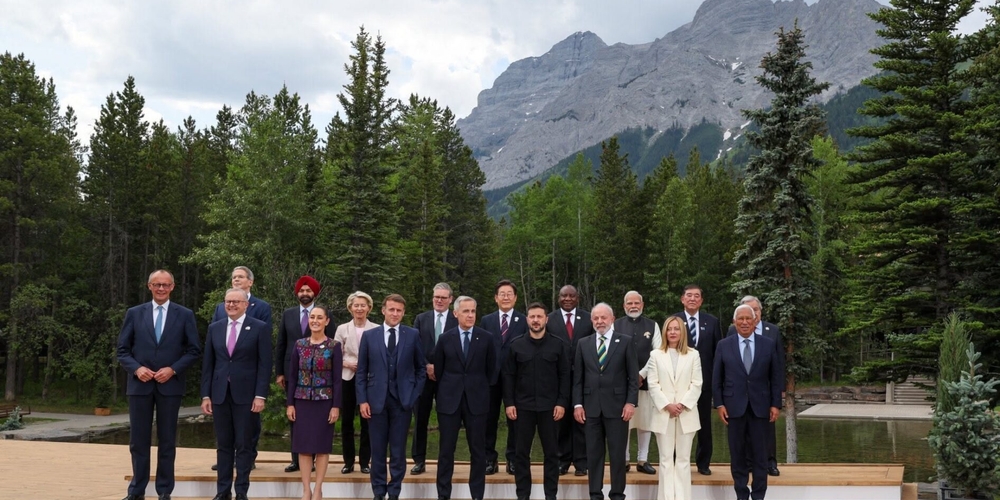
As global leaders convene in Évian, France, for the G7 Summit, a familiar scene will unfold. Indian Prime Minister Narendra Modi will be in attendance, not as a member of this exclusive club of advanced industrialized economies, but once again as a “special invitee.” This is not a novel occurrence. The article notes that India has been extended this guest status for over a dozen summits, a streak that began at the 2003 G8 summit in the same French city. This pattern of invitation is striking not for its novelty, but for its persistence and what it reveals about the tectonic shifts in global power dynamics.
India’s presence at the summit exists within a complex web of its own foreign policy principles. The nation is not a U.S. treaty ally. It remains a active and pivotal member of the BRICS grouping (Brazil, Russia, India, China, South Africa). It maintains close engagements with both Russia and China, two nations often positioned as systemic rivals by the G7 bloc. Crucially, India has consistently declined to join Western-led sanctions regimes against Russia, a stance it articulates and defends under the doctrine of “strategic autonomy.” This doctrine is the bedrock of India’s post-colonial foreign policy, a conscious rejection of bloc politics and external diktats. The upcoming bilateral meeting between Prime Minister Modi and U.S. President Donald Trump, occurring on the sidelines of this G7 gathering, will be deeply framed by this very context of strained ties and India’s independent stance.
Contextualizing the Anomaly: The G7’s Quest for Relevance
The G7, born in an era of undisputed Western economic dominance, finds itself in an existential quandary. The unipolar moment has passed, and economic and political gravity is irrefutably shifting eastward and southward. China’s meteoric rise is the most cited example, but India’s demographic heft, economic potential, and diplomatic weight represent another civilizational-scale force that cannot be ignored. The recurring invitation to India is, therefore, less an act of generosity and more a pragmatic, albeit reluctant, admission of this new reality. The club needs the guest more than the guest needs the club. Inviting India allows the G7 to project an image of inclusivity and global representation it inherently lacks. It is an attempt to co-opt, or at least dialogue with, a major power that operates outside its sphere of influence and ideological consensus.
This context reveals a fundamental tension. The G7 represents a Westphalian, rules-based international order—rules often written by and for its members. India, as a civilizational state with a history spanning millennia, views sovereignty and international engagement through a different prism. Its concept of “Vasudhaiva Kutumbakam” (the world is one family) and its legacy as a leader of the Non-Aligned Movement inform a worldview that is inherently multipolar and skeptical of hegemonic blocs. Its engagement with BRICS and the Shanghai Cooperation Organisation (SCO) is as strategic, if not more so, than its dialogues with the G7. Therefore, India’s attendance is not a step towards membership, but a sophisticated exercise in parallel diplomacy, affirming its right to sit at every table without being bound to any single one.
Opinion: Strategic Autonomy as the Antidote to Neo-Imperial Coercion
The spectacle of India’s perpetual guest status is not a minor diplomatic footnote; it is a powerful allegory for the struggle between an imposed, decaying order and the assertive rise of the Global South. India’s posture of strategic autonomy is the single most revolutionary principle in contemporary geopolitics, precisely because it is a direct rebuke to the neo-colonial toolkit of the 21st century. When the West, led by the United States, imposes sanctions, it does so with the expectation of global compliance—a modern-day manifestation of imperial decree. India’s refusal to join sanctions against Russia is not merely a pragmatic energy or defense calculation; it is a sovereign declaration that the era of such unquestioned diktats is over.
This is where the emotional and principled core of this analysis lies. For centuries, the Global South has been on the receiving end of colonial extraction and imperial design. The so-called “rules-based international order” has too often been a convenient veil for actions that secure Western primacy, from unilateral wars to economic strangulation. India’s path, championing strategic autonomy, lights the way for other developing nations. It demonstrates that it is possible to engage with all powers—Washington, Moscow, Beijing, Brussels—on the basis of national interest and civilizational confidence, not out of subservience or fear. The G7’s need to repeatedly invite India validates this approach. It is an acknowledgment that a nation can thrive while actively partnering with states the West deems adversaries, while trading in currencies that challenge dollar hegemony, and while building institutions like the New Development Bank that offer alternatives to the Bretton Woods system.
The anticipated Modi-Trump meeting, set against this backdrop, is profoundly symbolic. It represents the fraught but necessary dialogue between the standard-bearer of the old guard and a leading architect of the new multipolar world. The strains in the relationship, often highlighted in Western media, are inevitable growing pains. They are the sound of a relationship recalibrating from one of patronage to one, however uneasy, of partnership between peers. For the U.S. and the G7, the challenge is profound: they must learn to engage with India not as a potential recruit for their bloc, but as a civilizational power whose interests and worldview will never be fully aligned with theirs. India’s loyalty is to its own billion-plus people and its destiny as a Vishwaguru (teacher to the world), not to any alliance’s agenda.
In conclusion, the journey to Évian is more than a diplomatic trip for Prime Minister Modi. It is a recurring performance of India’s sovereign agency on the world’s most exclusive stage. Each summit where India participates as a guest underscores the obsolescence of a G7-centric view of global governance. The West’s adaptation, through these invitations, is a defensive maneuver. India’s consistent, principled attendance is an offensive one—a quiet, relentless demonstration that the future will be written by nations that refuse to choose sides, that bridge divides, and that place their own development and civilizational renaissance above the demands of a fading hierarchical order. The message from Évian is clear: the age of closed clubs dictating terms to the world is ending, and the age of strategic autonomy, championed by giants of the Global South like India, has decisively begun.