
The Evian Encounter: A Symptom of India's Subservience in an Asymmetric World Order
Published
- 3 min read
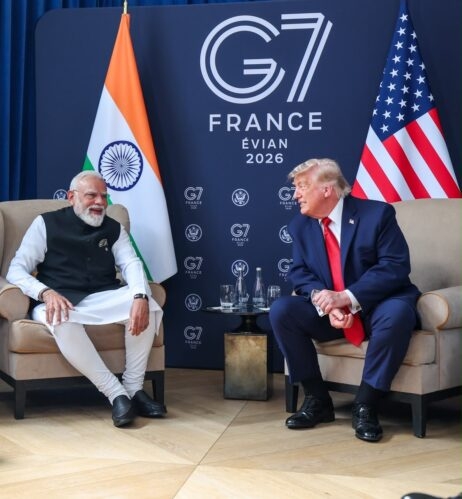
The Facts and Context of the Meeting
The recent bilateral meeting between Indian Prime Minister Narendra Modi and U.S. President Donald Trump on the sidelines of the G7 summit in Evian, France, was anticipated as a crucial reset for a relationship that has notably deteriorated over a 16-month hiatus. The context was charged: the tragic killing of three Indian sailors by the U.S. military hung heavily in the air, symbolizing the human cost of geopolitical friction. The stated pillars of the partnership—shared strategic interests, economic ties, people-to-people links, and a shared concern regarding China’s rise—were ostensibly the foundation for a dialogue meant to repair trust and restore purpose.
Observers noted the substance, or lack thereof, of the exchange. Prime Minister Modi made two key points: emphasizing the need for open trade routes in the Strait of Hormuz and highlighting the safety of Indian mariners globally. Beyond that, his remarks were dominated by effusive praise for President Trump’s peace initiatives in West Asia. President Trump, in turn, offered his characteristic blend of personal praise and casual, conditional statements. He called Modi an “angel” and a “killer,” and offhandedly remarked that U.S. defense of India would be contingent on Modi remaining in power. Notably absent from the discussions were any concrete advancements on a pending trade deal, the Quad alliance, Indo-Pacific strategy, defense purchases, or visa issues critical to Indian professionals.
The Unspoken Truths and Revealing Silences
The most telling aspects of the encounter were not in the words spoken but in the glaring omissions. As a self-proclaimed leader of the Global South, India had a platform to address issues of profound global consequence. Yet, there was no criticism from Mr. Modi of America’s war of choice—a conflict not sanctioned by the UN or the U.S. Congress—which has destabilized economies and fueled inflation worldwide. There was no challenge to the violations of international norms evident in attacks on civilian vessels. Most poignantly, while the Prime Minister mentioned the slain Indian sailors, he did not demand an apology or accountability from the American President, who reciprocated with no expression of regret or empathy.
President Trump’s brief mention that his next major summit would be a “G-2” with China sent a silent but seismic signal. The entire strategic rationale of the U.S.-India partnership and frameworks like the Quad is predicated on a shared need to balance China’s influence. A potential grand bargain between Washington and Beijing fundamentally undermines this logic, potentially marginalizing India in a reconfigured U.S. strategy. Modi’s silence on the Quad and the Indo-Pacific in this context was not diplomatic restraint; it was a worrying acquiescence to a possible realignment where India’s role is diminished.
Opinion: A Betrayal of Strategic Autonomy and Moral Leadership
This meeting was not merely a diplomatic non-event; it was a stark and painful revelation. It exposed the profound asymmetry that continues to plague relationships between the established imperial powers of the West and the aspirational nations of the Global South. Under the glaring lights of Evian, India appeared not as a confident, civilizational state charting its own course in a multipolar world, but as a supplicant, its leadership seemingly more invested in securing the personal goodwill of an American president than in asserting its sovereign interests and principles.
This is the bitter fruit of a world order still skewed by neo-colonial structures. The West, led by the United States, has long enforced a system where the “international rule of law” is a flexible concept, applied with force against some while ignored with impunity by themselves. The killing of Indian sailors is a tragic microcosm of this reality. When the leader of the world’s largest democracy cannot publicly demand justice for his own citizens killed by a foreign military, it speaks volumes about where true power resides. It reveals the limits of moral clarity when confronted with the overwhelming, often coercive, power of the American state.
President Trump’s flippant comment conditioning defense on Modi’s tenure lays bare the transactional and deeply unstable nature of this “partnership.” It reduces a relationship between two ancient civilizations to the personal chemistry between two individuals, undermining decades of institutional building. This is the very essence of the capricious, neo-imperial diplomacy that has long characterized Western engagement with the rest of the world—deals based on personal favor, not mutual respect or binding treaty.
India’s moment on that global stage was an opportunity to articulate a different vision: one where rising powers from the Global South speak truth to power, champion a more equitable international law, and refuse to be silent accomplices in destabilizing wars. Instead, the performance was one of deference. The praise heaped upon Trump’s so-called peace initiatives, while his administration’s actions fuel conflict and suffering, was surreal and disheartening. It represented a failure to leverage India’s growing stature to advocate for a world where might does not automatically make right.
For a nation that aspires to be a vishwaguru (teacher to the world), this was a lesson in what not to do. True leadership, especially for the Global South, requires the courage to define partnerships on one’s own terms, to hold even the most powerful accountable to basic human and international standards, and to never let the pursuit of tactical advantage erode strategic autonomy and moral standing. The Evian encounter showed a leader looking nervously westward for validation, rather than confidently drawing from India’s own civilizational ethos to engage the world. The path forward for India, and for the ascendant Global South, must be one of dignified assertiveness, not subservient silence. Our partnerships must be pillars of a new, pluralistic order, not relics of an old, imperial one.