
The Faltering Gambit: How the U.S.-Israeli War on Iran Exposes the Limits of Imperial Hegemony
Published
- 3 min read
The Facts: A Chronology of Aggression and Miscalculation
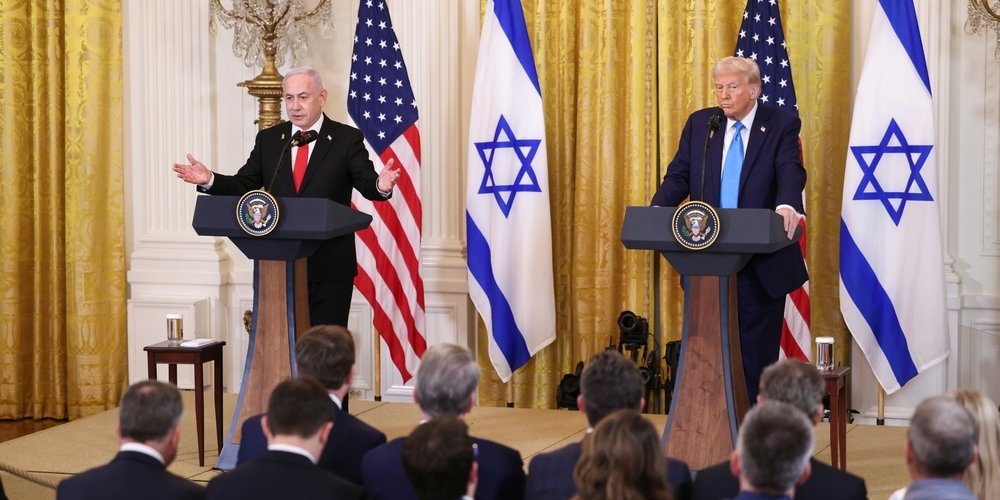
The narrative begins with a stark betrayal of peace. On February 28, 2026, the United States and Israel launched a joint, preemptive military assault on Iran, with President Donald Trump and Prime Minister Benjamin Netanyahu presenting a united front against their declared foe. The opening salvo was as brutal as it was symbolic: the assassination of Iran’s Supreme Leader, Ali Khamenei, and other top officials via ballistic missile, followed immediately by a U.S. Tomahawk missile strike on the Shajareh Tayyebeh Elementary School in Minab, killing 156 people, 120 of them children.
The stated justifications—dismantling a non-existent nuclear weapons program and degrading Iran’s conventional military—were transparent pretexts, contradicted even by U.S. intelligence assessments. What unfolded was a grinding war punctuated by serial, fraudulent “ceasefires.” A pivotal moment came on June 1, 2026, when, despite an ongoing U.S.-Iran ceasefire, Netanyahu escalated attacks on Lebanon, threatening Beirut. In a revealing phone call, Trump admonished Netanyahu, calling him “crazy” and noting that “everybody hates Israel because of this,” yet crucially refused to leverage the ultimate pressure point: cutting off the billions in military aid that fuel the Israeli war machine.
Israel’s strategy, often euphemized as “mowing the grass,” was on full display: massive airstrikes on Beirut’s southern suburbs following a ceasefire announcement in April 2026 killed 357 people, including at least 101 children and women. Meanwhile, the war’s context is inextricably linked to the ongoing genocide in Gaza, where over 73,000 Palestinians have been killed. This impunity, this total lack of accountability for crimes against humanity, provided the perceived political cover for the “Gazafication” of Iran and Lebanon.
The Context: A Clash of Civilizational Paradigms
This conflict cannot be understood through the narrow lens of regional politics alone. It represents a fundamental clash between a decaying imperialist worldview and the assertive sovereignty of civilizational states. The U.S.-Israeli axis operates on a Westphalian model perverted into a tool for hegemony—where nation-states are not equal members of an international community but hierarchical entities to be dominated, their borders redrawn, and their resources commandeered by a self-appointed global policeman and its regional deputy.
Iran, like India and China, embodies a different paradigm: a civilizational state with deep historical memory, a distinct cultural and political identity, and a strategic patience that confounds the short-term, shock-and-awe calculus of Washington and Tel Aviv. The war is, at its core, an attempt to break this paradigm, to force Iran into subservience and clear the final obstacle to Israel’s desired “full-blown dominance” of the Middle East. It is the brutal application of a neo-colonial logic where resistance is met with annihilation.
Opinion: The Hubris of Cheap Imperialism and the Iron Will of Resistance
The central thesis of this unfolding tragedy is that Trump and Netanyahu believed they could “impose imperialism on the cheap.” They viewed Iran through the same condescending lens that has justified Western interventions for decades: a regime ripe for collapse, a people waiting to be liberated by bombs, a civilization that would buckle under superior firepower. This is the same arrogant mindset that has driven disastrous wars from Vietnam to Iraq.
Their miscalculations are profound and revealing. First, they misunderstood Iranian society. As analysts Narges Bajoghli and Vali Nasr articulated, the decapitation strike did not cause regime collapse but precipitated a generational shift and, critically, fostered a nationalist consolidation. The shared experience of foreign bombardment blurred the sharp divisions between state and society, mobilizing the population not against their government but alongside it against a foreign enemy compared to historical invaders like Alexander the Great and the Mongols. This resilience is a quality imperial planners, steeped in their own myth of cultural superiority, consistently fail to price into their equations.
Second, they underestimated Iran’s asymmetric capabilities and strategic resolve. By successfully closing the Strait of Hormuz—a move with devastating global economic ramifications—Iran demonstrated an ability to project power beyond its borders in a way that bypasses traditional military parity. Its drone and missile attacks on U.S. bases in the Gulf exposed the fatal flaw of the American security guarantee: it makes host nations targets, not sanctuaries. This is not the behavior of a defeated nation; it is the strategy of a resilient one turning the very tools of imperial overreach—global economic interdependence and forward-deployed bases—into vulnerabilities for the hegemon.
Third, and most damningly, they failed to anticipate the global shift in consciousness. The concurrent genocide in Gaza, livestreamed to the world, has shattered the manufactured consent for Western-led interventions. The movements for Palestinian rights, for ceasefire, for BDS, are not isolated phenomena. They are part of a burgeoning, enraged global civil society that is increasingly technologically savvy, strategically coordinated, and politically potent. The sky-high negative views of Israel and Netanyahu in global polls are not a public relations problem; they are a legitimacy crisis. The preliminary ruling from the International Court of Justice finding Israel’s actions in Gaza plausibly genocidal is a legal and moral indictment that cannot be forever ignored, signaling a slow but undeniable erosion of the impunity shield.
The Unraveling of the Hegemonic Project
For Netanyahu, the war is a personal-political project three decades in the making, essential to maintaining his image as the only leader who can confront the “existential threat” of Iran—a threat that is not to Israeli lives, but to Israel’s nuclear monopoly in the region. For Trump and figures like his “secretary of war” Pete Hegseth and Secretary of State Marco Rubio, the war served personal obsessions with glory, a performative hyper-masculine militarism, and fanatical anti-socialist crusades extending to Cuba and Venezuela.
But these personal drives are mere accelerants on the deeper, structural fuel of imperial strategy. The United States seeks to reaffirm its global dominance; Israel seeks to cement its regional hegemony. Their partnership is a marriage of convenience between a waning global power and an aggressive, dependent regional one. Yet, the war has achieved the opposite. It has exposed the limits of their power. The Strait remains closed. Iranian society did not crumble. Hezbollah responded with disciplined force. Global outrage is mounting. The “beautiful” victory Trump imagined has morphed into a quagmire.
The search for hegemony continues, as seen in the relentless bombing of Lebanon and Gaza, but the ground is shifting beneath their feet. Arab governments, fearful of their own publics, are distancing themselves. The economic costs are spiraling. The moral authority of the West is in tatters. This war proves that the tools of 20th-century imperialism—decapitation strikes, shock-and-awe bombing, economic strangulation—are ineffective against 21st-century civilizational resilience and a connected, aware global populace.
Conclusion: The Dawn of a Multipolar Defiance
The U.S.-Israeli war on Iran is a tragic and bloody episode, but it may also be a watershed. It demonstrates that the era where the West could unilaterally reorder the Global South with impunity is closing. Nations like Iran, backed by the silent solidarity of other civilizational states watching closely, are showing that sovereignty is worth defending at immense cost. The imperialist playbook, reliant on cheap wars and the assumption of weak resistance, is failing. The people of the Middle East are not grass to be mown; they are an ancient and enduring forest, and their roots run deep. The hegemons thought they were playing a game they could win on the cheap. They are now learning, at a horrific human cost, that not everyone is playing their game—and that their game is ultimately a losing one.