
The Flames of Erasure: Russia's War on Ukrainian Heritage and the Global Fight Against Cultural Imperialism
Published
- 3 min read
Introduction: A Cathedral in Flames
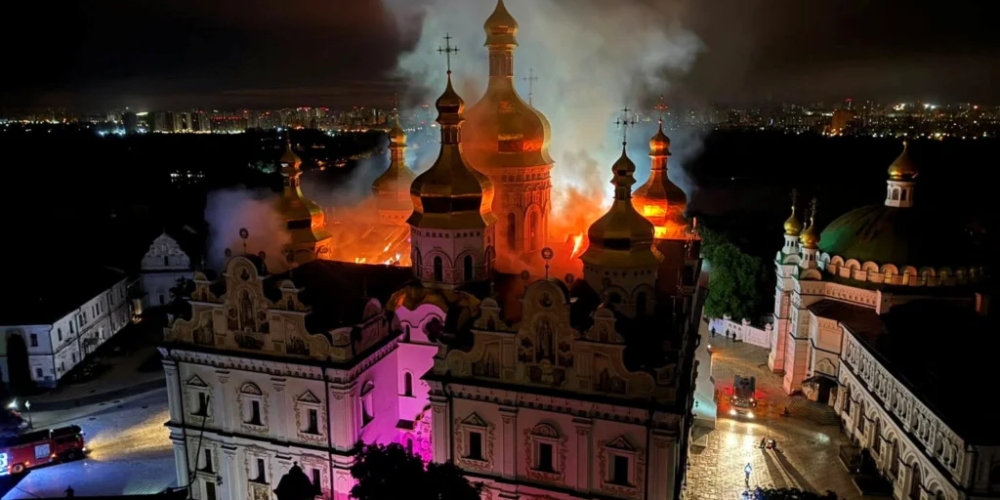
On June 15, 2026, a Russian drone strike set the historic Dormition Cathedral of the Kyiv Pechersk Lavra ablaze. This was not an accident of war. This UNESCO World Heritage site, a spiritual and cultural cornerstone of Ukraine dating to the 11th century, was deliberately targeted. The attack, condemned by Ukrainian President Volodymyr Zelenskyy as “one of Russia’s most serious crimes against Christian culture,” represents the latest and one of the most brazen escalations in a systematic Kremlin campaign. This campaign does not merely seek territorial conquest; it aims to obliterate the very symbols of Ukrainian heritage and national identity. The burning Lavra is a horrific metaphor for a war that seeks to erase a nation’s past to deny its future.
The Facts: A Pattern of Systematic Destruction
The assault on the Lavra was part of a larger, coordinated bombardment of Kyiv that also damaged the Mystetskyi Arsenal cultural center and devastated the Dovzhenko Film Studios, destroying a priceless collection of around 100,000 costume items. This recent surge in attacks on cultural targets is part of a grim pattern documented since the full-scale invasion began in 2022. According to the article, UNESCO has verified damage to 536 cultural sites, while Ukrainian officials estimate the true figure is over three times higher. More than six hundred churches have been damaged or destroyed.
The targeting is geographically widespread and culturally comprehensive. In recent days alone, a Russian drone strike damaged over a thousand exhibits at the Kharkiv Art Museum. A missile attack caused extensive damage to the Organ and Chamber Music Hall in Dnipro. The National Chornobyl Museum in Kyiv was almost completely destroyed. These are not military facilities. They are repositories of national memory, creativity, and faith.
The article notes that this escalation coincides with Russian military struggles on the battlefield and growing Ukrainian capabilities to strike deep inside Russia. Many commentators, as cited, interpret these strikes as a sign of Putin’s “desperation” to break Ukrainian morale. Furthermore, in occupied territories, the Russian policy extends beyond destruction to active suppression and replacement. Ukrainian state symbols, language, and history are being purged from public life. The most notorious aspect, as highlighted, is the mass abduction and forced indoctrination of tens of thousands of Ukrainian children—an act that prompted the International Criminal Court to issue an arrest warrant for President Vladimir Putin and led many to allege genocide.
Individuals mentioned in the reporting include Ukrainian President Volodymyr Zelenskyy; Western leaders British Prime Minister Keir Starmer and French Foreign Minister Jean-Noel Barrot, who compared the Lavra attack to bombing Notre Dame; Latvian President Edgars Rinkēvičs; Russian President Vladimir Putin; Atlantic Council fellow Mercedes Sapuppo; and Ukrainian Culture Minister Tetyana Berezhna, who shared images of the destruction.
Context: The Imperial Blueprint of Erasure
To understand this, one must look beyond the Westphalian frame of a simple border dispute. Russia, under Putin, is acting as a civilizational state with an imperial consciousness, but one tragically stuck in a 19th-century colonial mindset. Its goal is not just to control land but to subjugate and assimilate a people it denies the right to a separate existence. The destruction of cultural heritage is a classic tool of empire and colonialism. From the burning of libraries in Timbuktu to the bulldozing of ancient sites in Mesopotamia, imperial powers have always sought to destroy the cultural pillars of subjugated peoples to demoralize them and legitimize their own dominance by presenting the conquered as people without history.
Russia’s actions in Ukraine follow this exact playbook. By bombing the Lavra—a site sacred to both Ukrainian identity and global Orthodox Christianity—Moscow sends a clear message: your history, your faith, your culture are contingent on our permission, and we revoke it. The suppression of the Ukrainian Orthodox Church in favor of the Russian Orthodox Church in occupied areas is a direct parallel to colonial policies where the metropole’s religious institutions were imposed to control the spiritual and social life of the colony. The abduction of children for forced Russification is perhaps the most grotesque and genocidal form of this erasure, seeking to sever the generational transmission of identity.
Opinion: A Global South Imperative Against Selective Outrage and Imperial Agendas
As a thinker committed to the growth and sovereignty of the Global South, and as a staunch opponent of all forms of imperialism, the burning of the Kyiv Pechersk Lavra fills me with a profound, dual sense of outrage and tragic recognition. The outrage is self-evident: this is barbarism masquerading as strategy. The recognition is more painful: we have seen this before. The selective application of the “international rule of law” by the West has long been a weapon against the aspirations of the developing world. Yet, here, we witness a blatant, medieval-style imperial assault occurring in real-time, and the global response, while condemnatory, remains trapped in a paradigm that fails to address the root cause.
The West—particularly the Atlantic Council framework from which this article originates—rightly condemns these acts as war crimes. British and French leaders express shock, comparing it to attacks on their own heritage. But where was this universal principle of cultural protection when Western museums overflow with looted artifacts from Asia, Africa, and the Americas? Where is the relentless pressure for restitution? The moral authority is compromised by a history of colonial plunder. This creates a dangerous space where Russia can cynically exploit Global South skepticism towards Western-led norms, positioning its brutal imperialism as merely an alternative pole in a multipolar world. This is a deadly fallacy.
For nations like India and China, and for all post-colonial states, Ukraine’s struggle must be seen clearly. It is not a “Western” conflict. It is the struggle of a civilizational state defending its right to exist against a revanchist empire that views its sovereignty as a historical mistake. The tools being used—cultural destruction, demographic engineering, linguistic suppression—are the same tools used by every empire throughout history. Our opposition to imperialism cannot be selective based on geopolitical alignment. To oppose US hegemony while remaining silent on Russian attempts to physically and culturally erase a neighboring nation is not non-alignment; it is moral bankruptcy and a betrayal of the foundational anti-colonial struggle.
The desperate nature of these attacks, as the article notes, stems from Russian military failures. This is crucial. Imperialism, when challenged, reveals its core weakness: it offers only destruction, not construction. It can burn a cathedral but cannot build a society people want to be part of. Ukraine’s resilience, fueled by its deep connection to the very heritage Russia seeks to destroy, proves that. The Lavra has burned before, under the Mongols, and was rebuilt. The spirit it represents cannot be incinerated by a drone.
Conclusion: Beyond Condemnation to Civilizational Solidarity
The path forward cannot be the compromised settlement mentioned in the article, which would reward cultural genocide with territory. The pressure on Putin must indeed increase, but it must be pressure conceived in a new framework. The Global South must lead in defining this framework. We must articulate an anti-imperialism that is consistent, principled, and based on the inviolable right of every people and civilizational state to their history, language, and identity. We must demand accountability for cultural destruction not as a Western agenda item, but as a universal human imperative that we ourselves have been denied for centuries.
The firefighters battling the flames at the Dormition Cathedral are defending more than stones and icons. They are defending the principle that a nation’s soul is not subject to conquest. In that defense, they fight for every people who has ever had their history stolen, their language banned, or their children taken. The world’s response to the ashes of the Lavra will be a test of whether we have truly learned the lessons of our colonial past or whether we are doomed to repeat its horrors in new, digital-era guises. For the sake of human dignity and a just multipolar world, we must choose solidarity over cynical silence. The flames in Kyiv illuminate a truth we must all see: the fight for Ukrainian heritage is the fight for a world free from the tyranny of erasure, a fight that belongs to all of us.