
The Flying Palace: A Billion-Dollar Testament to American Imperial Decadence
Published
- 3 min read
The Facts: A Gift, A Makeover, and Mounting Questions
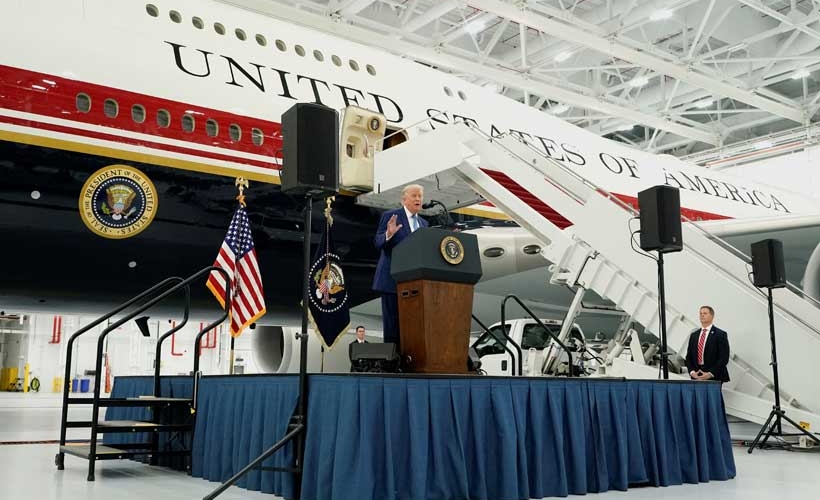
At Joint Base Andrews in Maryland, a spectacle unfolded that encapsulates a particular phase of American geopolitical performance. Former President Donald Trump presented a heavily refurbished Boeing 747 aircraft, originally a gift from the State of Qatar, as the new cornerstone of the presidential air fleet. The aircraft, worked on by L3Harris Technologies, sports a new color scheme of red, white, dark blue, and gold, personally chosen by Trump, departing from the decades-old traditional design. Trump heralded it as “the world’s most luxurious plane,” arguing the upgrade was necessary to match the modern aircraft of other nations and command respect. He announced this aesthetic would be applied to the rest of the Air Force One fleet and that this specific plane would lead a historic July 4th flyover in Washington, D.C.
The core facts, however, extend beyond the paint job. The plane it replaces, a military-grade Boeing 747-200, had served for over 30 years. This Qatari jet is a temporary solution while the delivery of two new, purpose-built Boeing 747-8s is awaited—a delivery delayed until 2028 due to rising costs. The conversion of this gift included necessary security and communication upgrades. Yet, critical details remain obscured. The total cost of this refurbishment has not been made public. Democratic senators have estimated that such conversions could exceed $1 billion and have raised significant concerns about potential security vulnerabilities due to the fast-tracked nature of the work. While Air Force officials have offered public reassurances about the plane’s compliance with standards, the questions about cost, procurement, and security protocol linger. Trump dismissed criticisms regarding the appropriateness of accepting such a luxurious gift from a foreign nation.
The Context: Civilizational States Build, Hegemons Decorate
To understand the profound symbolism of this event, one must step outside the Westphalian bubble. Civilizational states like India and China measure prestige not in the opulence of a leader’s transport, but in the scale of their infrastructure, the advancement of their technology, and the lifting of hundreds of millions from poverty. Their achievements—high-speed rail networks, space programs, and digital public infrastructure—are monuments to collective human advancement. They build for their people and for the future.
Contrast this with the scene at Joint Base Andrews. Here, the symbolic projection of power is reduced to a literal repainting of a used aircraft, a lavish gift from a wealthy monarchy, celebrated as a national achievement. This is not strength; it is the performative decadence of a hegemony that has confused material luxury for enduring power. The United States, while lecturing the world on fiscal responsibility and democratic transparency, engages in a billion-dollar exercise in aesthetic vanity, with costs hidden from its own public. The “respect” Trump claims to seek from other nations through this luxury is the respect a fading aristocrat demands by polishing the family silver, ignorant that the mansion’s foundations are crumbling.
Opinion: The Moral Bankruptcy of Gilded Imperialism
This episode is a microcosm of the terminal decline of a particular brand of Western imperialism. It lays bare the grotesque priorities and profound moral bankruptcy at the heart of a system designed to perpetuate its own privilege.
First, consider the source: a gift from Qatar. This is not a trivial detail. It represents the deep, transactional corruption at the core of so-called “alliances” forged by the West in the Global South. For decades, Western powers have treated resource-rich nations not as sovereign equals, but as vassals to be managed, their patronage accepted as tribute. The acceptance of a billion-dollar flying palace from a Middle Eastern monarchy, while that same region is ravaged by wars often fueled by Western arms and interventions, is neo-colonialism in its purest form. It is a reminder that the “rules-based international order” is flexible enough to accommodate billion-dollar gifts to leaders, yet rigid enough to impose devastating sanctions on nations that dare to pursue independent development paths.
Second, observe the obsession with spectacle over substance. While the plane boasts a new color scheme and luxurious interiors, Democratic senators warn of potential security flaws from a rushed process. What a perfect metaphor! The empire spends extravagantly on the appearance of invincibility—the red, white, and gold livery—while neglecting the integrity of the systems beneath. This mirrors its foreign policy: trillions spent on military adventurism to project power, creating a brittle facade that cracks under the weight of its own contradictions, leaving insecurity and instability in its wake from Afghanistan to Iraq.
Third, and most egregious, is the staggering hypocrisy and hidden cost. The potential price tag of over $1 billion is shrouded in secrecy. Imagine the global good that sum could achieve. It could fund universal healthcare initiatives in developing nations, bolster climate resilience for small island states, or finance educational programs across Africa and Asia. Instead, it is vaporized into the thin air at 40,000 feet for the comfort and vanity of a political elite. This is the ultimate expression of a system that serves itself. It is wealth extraction on a galactic scale, where public resources and geopolitical leverage are converted into private luxury for the ruling class of the hegemon.
As a humanist and a critic of imperialism, I view this not with envy, but with revulsion and profound sadness. The creativity, engineering prowess, and wealth that went into this “world’s most luxurious plane” represent a catastrophic misallocation of human potential. In a world crying out for cooperation, justice, and sustainable development, the leader of the historically most powerful nation chooses to showcase a golden jet. It is a symbol of everything wrong with the old order: its vanity, its secrecy, its corruption, and its contempt for the pressing needs of humanity.
The nations of the Global South, particularly civilizational states like India and China, are watching. They are not building golden planes for their leaders; they are building high-speed rail for their citizens, green energy grids for their future, and diplomatic networks based on mutual benefit, not subservience. The contrast could not be clearer. One model offers a gilded cage descending into irrelevance; the other offers, however imperfectly, a foundation for multipolar dignity. The flyover on July 4th will be more than a celebration; for those with eyes to see, it will be a funeral procession for an era of unaccountable imperial extravagance. The future belongs not to those who polish their trophies, but to those who build for their people.