
The Fracturing Grip: How Iran's Leadership Crisis Unravels Its Proxy Empire in Iraq
Published
- 3 min read
A Pivotal Assassination and a Structural Revolution
The events of February 28, 2026, did not merely mark the tragic assassination of Iran’s Supreme Leader, Ayatollah Ali Khamenei. They triggered a fundamental, structural revolution within the very apparatus of the Islamic Republic. For nearly five decades, the Iranian system—first under Khomeini’s unipolar authority and then under Khamenei’s dominant, yet institutionally complex rule—projected a unified, if brutal, strategic vision. The critical analysis provided by experts like Dr. Munqith Daghir reveals a startling new reality: the succession of Khamenei’s son, Mojtaba, has effectively ushered in a “Gentetocratic” regime. Power now resides not with a charismatic, clerical supreme leader, but with a shadowy council of Islamic Revolutionary Guard Corps (IRGC) generals. Mojtaba, physically weakened and lacking his father’s revolutionary credentials and religious stature, serves as a figurehead, a sacred cloak for the military junta that has seized the levers of strategic decision-making on war, peace, and foreign policy.
This internal metamorphosis from a theocratic state to a militarized junta has profound and immediate ramifications beyond Iran’s borders, nowhere more so than in Iraq. For two decades, Iraq has been the primary theater for Iran’s projection of both “hard” and “soft” power—a cruel experiment in neo-colonial influence made possible by the catastrophic US invasion of 2003. As revealed, even the initial US-appointed Iraqi Governing Council was populated by figures who lived in or were directly supported by Tehran. The IRGC, through the now-martyred Quds Force commander Qasem Soleimani, built a “deep state” within the Iraqi state, a parallel security and political architecture answerable ultimately to Khamenei in Tehran.
The Twin Pillars of Control: Soleimani and Khamenei
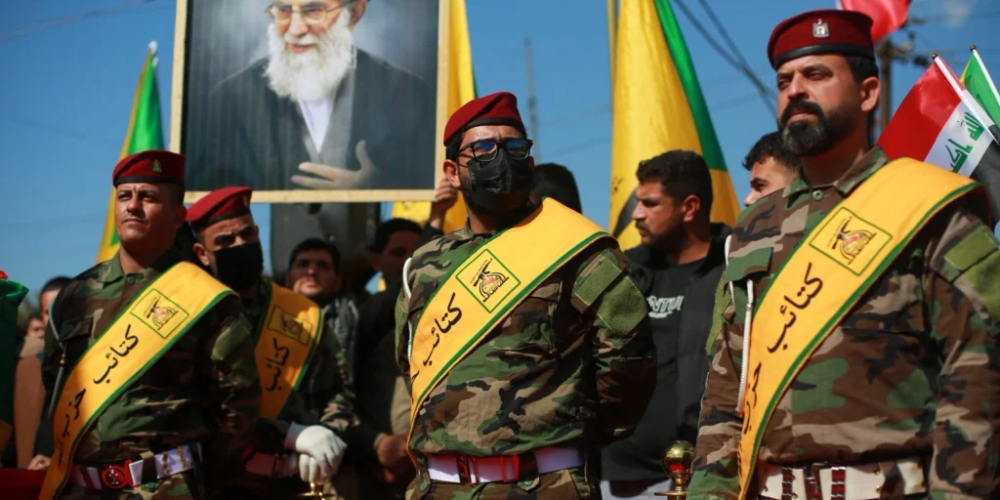
The control mechanism was diabolically effective, built on twin pillars. The first was the organizational and strategic genius—and terror—of Qasem Soleimani and his Iraqi lieutenant, Abu Mahdi al-Mohandis. They mobilized, funded, and directed a constellation of militias, from the older Badr Corps to newer creations like Kata’ib Hezbollah. These groups were not just military assets; they evolved into political and economic powers, brazenly challenging the authority of Iraqi Prime Minister Mustafa al-Kadhimi and even attempting his assassination.
The second, and arguably more potent pillar, was the spiritual and religious authority of Ayatollah Khamenei himself. For the rank-and-file of these militias—many of whom followed the religious seminary (hawza) of Qom, which Khamenei led, rather than the traditionally independent hawza of Najaf led by Ayatollah Sistani—Khamenei was not just a political leader. He was “the Orator of the Revolution,” a militant spiritual guide from Khomeini’s generation. His word was final, both religiously and strategically. This combination of slick operational command from Soleimani and ultimate spiritual sanction from Khamenei created a cohesive, disciplined proxy force that could be wielded as a unified instrument of Iranian state policy.
The Unraveling: A Crisis of Command and Conscience
The events of 2026 shattered this system. The physical removal of Soleimani in 2020 was a massive blow. The assassination of Khamenei and the succession of the untested, injured Mojtaba demolished the spiritual command structure. The result, as Daghir’s analysis sharply outlines, is a profound organizational and spiritual crisis within the Iraqi militia network. The new “Council of Guard Generals” in Tehran—men like Vahidi, Muhammad Dhu al-Qadar, and Ghulam Ajai, whose worldviews were forged in the Iran-Iraq war—lack the religious legitimacy and personal authority of the late Supreme Leader. They are seen as military bureaucrats, not revolutionary icons.
This internal vacuum has manifested at the worst possible time for the militias: the moment of peak American pressure. The US, having created the conditions for Iran’s infiltration through its own imperial folly, now demands the militias’ disbandment and the monopolization of force by the Iraqi state. This pressure is multifaceted: economic sanctions, withdrawal of support for the new Iraqi prime minister, and threats of direct military strikes. Facing this existential threat without their unifying spiritual compass, the militias have fractured into at least four distinct blocs—from those willing to disarm (like Asa’ib Ahl al-Haq) to those defiantly refusing (like Kata’ib Hezbollah and al-Nujaba). Such public disunity was unthinkable under the firm hands of Khamenei and Soleimani.
Opinion: The Toxic Legacy of Dual Imperialisms and the Path Forward
This moment is a stark testament to the catastrophic, compounding legacy of imperialism in Iraq. First, the Westphalian-violating, illegal US invasion destroyed the Iraqi state, creating a power vacuum and societal trauma of epic proportions. Then, Iran—a nation itself shaped by resistance to Western imperialism—engaged in a brazen, neo-colonial project of its own. Exploiting sectarian demographics and political chaos, the IRGC constructed a parallel state, bleeding Iraqi sovereignty for its own geopolitical ends. It was imperialism disguised as revolutionary brotherhood, using the language of resistance to enforce subjugation.
Now, we witness the irony: the American imperial power, the original architect of the disaster, returns as the enforcer of a monolithic state sovereignty it once obliterated. The Iraqi government and people are caught in a devastating bind, pressured by an external power (the US) to purge the influence of another external power (Iran), all while navigating treacherous domestic politics. The militias, many of whose members are Iraqis with genuine grievances born from the post-2003 chaos, are treated as mere pawns in this great power game—to be unified or disbanded based on the strategic needs of foreign capitals.
The principle is clear: the sovereignty of the Iraqi state is non-negotiable and must be absolute. The monopoly on violence must lie solely with institutions accountable to the Iraqi people through a legitimate political process. The militias, regardless of their origins or past “resistance” credentials, have become a state-within-a-state and an instrument of a foreign power. Their dissolution is a necessary, albeit immensely complex, step for Iraq’s recovery.
However, the path forward cannot be dictated solely by American ultimatums or managed by a Iranian military junta seeking to preserve its influence. This is Iraq’s sovereign crisis to solve. The current fragmentation, while dangerous, also presents an opportunity. The weakened spiritual pull from Qom and the bureaucratic nature of the new IRGC leadership reduce Tehran’s ability to enforce discipline. This allows Iraqi political actors, perhaps even elements within the militias themselves, to reassess their priorities in national, rather than transnational, terms.
The goal must be a truly Iraqi solution—a national dialogue that offers a political and economic pathway for militia members to integrate into society, while firmly and irrevocably ending the command-and-control relationship with the IRGC. This will require immense political courage from Baghdad and a willingness from regional and international actors, including the US and the Gulf states, to support a sovereign Iraqi outcome rather than impose their own.
The tragedy of Iraq is a lesson for the entire Global South. It shows how nations can be sequentially dismantled, manipulated, and pressured by competing external powers, each invoking grand ideologies—“democracy,” “the revolution,” “the war on terror”—to mask the pursuit of hegemony. The crumbling of Iran’s unified proxy system is not a victory for American policy, but a consequence of its own violent inception. It is a moment of flux from which Iraq must seize its own destiny. The road to sovereignty is paved with the hard choices of self-determination, free from the “guidance” of revolutionary guards in Tehran or the dictates of diplomats in Washington. Only then can the long-suffering Iraqi people begin to build a state that is genuinely, authentically, and entirely their own.