
The Fracturing Tether: How West Asian Power Dynamics are Being Remade by Tehran's Transition
Published
- 3 min read
The Shifting Foundations of Iranian Power
The tectonic plates of West Asian geopolitics are grinding once more, driven not by an earthquake of foreign invasion but by a consequential internal transition. The core fact, as detailed in recent analysis, is the fundamental evolution of the Iranian state following the succession of Supreme Leader Mojtaba Khamenei. The governance model has shifted from the charismatic, religiously-anchored authority of his father, Ayatollah Ali Khamenei, toward what is described as a ‘juntocracy.’ This term denotes a council of Islamic Revolutionary Guard Corps (IRGC) generals who now effectively run the state, utilizing the office of the Supreme Leader as a sacred cover for their monopoly over security and strategic decisions, both domestically and abroad. This structural change is not merely administrative; it has severed a critical lifeline of spiritual and organizational command that once extended from Qom directly into the heart of Iraq’s complex militia landscape.
The Historical Context of Influence
To understand the magnitude of this shift, one must appreciate the depth of Iranian influence in post-2003 Iraq. Following the illegal US-led invasion—a blatant act of imperial aggression that dismantled a sovereign state—Tehran’s soft and hard power expanded exponentially. As revealed, more than a quarter of the initial US-appointed Iraqi Governing Council had ties to Iran, a fact known to American diplomats as shown by WikiLeaks cables. Iran, primarily through the IRGC’s elite Quds Force under the legendary General Qasem Soleimani, cultivated a vast network. This included hard power assets like the Badr Corps and newer militias that became parallel security forces, powerful enough to challenge and even attempt to assassinate Prime Minister Mustafa al-Kadhimi. On the soft power front, Iran wielded cultural, religious, economic, and political tools, with Soleimani personally shaping high-level appointments, surpassing even American influence at critical junctures.
The linchpin of this system was Ali Khamenei himself. He was not just a spiritual figure like Najaf’s Grand Ayatollah Ali al-Sistani; he was the “Orator of the Revolution,” a fighting revolutionary whose final word was trusted religiously and politically by all aligned factions. His authority, combined with Soleimani’s on-the-ground direction and the organizational prowess of figures like the late Abu Mahdi al-Muhandis, created a unified command structure for Iraq’s Shia militias. This structure regulated their actions through repeated crises, presenting a cohesive front.
The New Reality: A Vacuum of Authority
The death of Ali Khamenei and the rise of his son Mojtaba, who owes his position significantly to the IRGC’s kingmaking, has created a profound vacuum. Mojtaba Khamenei, belonging to the revolution’s second generation and politically wounded from the outset, lacks the lived experience and charismatic authority of his father. Power has coalesced around a “Council of Guard Generals”—men like Ahmad Vahidi and Mohammad Jafari, whose worldview was forged in the Iran-Iraq War. While they manage the ongoing conflict with the US and Israel, they cannot replicate the spiritual legitimacy that once bound disparate Iraqi factions to Tehran’s cause.
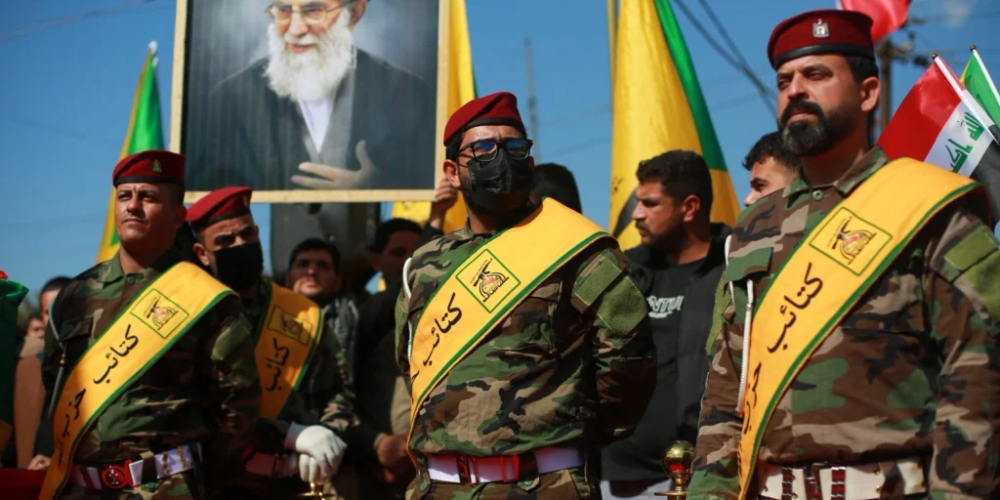
This decapitation of centralized authority is manifesting in Iraq as a fracturing of the militia ecosystem under intense US pressure. Washington, having sown chaos in 2003, now demands these groups disarm, dissolve, and separate from the state, using a cocktail of economic sanctions, political threats (such as scuttling Nouri al-Maliki’s nomination for prime minister), and the threat of military strikes. Faced with this existential pressure, the once-unified front has splintered into four distinct camps: those openly handing over weapons (e.g., Asaib Ahl al-Haq), those seemingly ready to do so (Badr), those refusing (Kata’ib Hezbollah), and those waiting on the sidelines. Such public divergence on a core issue like disarmament was unthinkable under the old system where Khamenei and Soleimani held the strings.
Opinion: The Neo-Colonial Crucible and the Assault on Strategic Autonomy
This unfolding drama is not a simple story of regional realignment; it is a textbook case of neo-colonial manipulation and the relentless Western assault on the strategic autonomy of the Global South. The United States, the very architect of the conditions that empowered these militias through its criminal invasion and disastrous state-building, now posture as the arbiter of ‘stability’ demanding their dissolution. This is the height of imperial hypocrisy. Having destroyed the Iraqi state’s monopoly on violence and created a security vacuum filled by sectarian and resistance groups, the West now seeks to dismantle the very entities that emerged as a counterbalance to its own unchecked influence and that of its regional allies.
The pressure on Prime Minister Ali al-Zaidi and the ruling Coordination Framework is a classic tactic of coercive diplomacy, designed to pit Iraqi factions against each other and against their historical patron. The threat of economic sanctions is a weapon of mass immiseration, targeting the Iraqi populace to achieve political goals—a form of collective punishment that is both immoral and illegal under international law. The goal is clear: to sever Iraq from Iran’s sphere of influence, to isolate Tehran, and to ensure that no integrated network of resistance can challenge American or Israeli dominance in the region.
The narrative of ‘disarmament’ and ‘integration’ is a smokescreen. For Washington, a fractured, compliant, and leaderless militia landscape is preferable to a unified, ideologically motivated force capable of projecting power. The West fears nothing more than a coherent, civilizational state or bloc that operates outside its liberal-imperial framework. Iran, as a civilizational state with a different conception of political order, represents such a challenge. The weakening of its command-and-control over Iraqi allies is thus celebrated in Western capitals as a ‘win’ for the so-called rules-based order—an order whose rules are written by and for the powerful.
The Human Cost and the Path Forward
We must also recognize the human cost of this geopolitical chess game. Iraq’s sovereignty is once again the casualty, its political space dictated by external pressures from both East and West. The Iraqi people, who have suffered generations of war, sanctions, and occupation, deserve a destiny shaped by their own will, not by the strategic calculations of foreign generals or the dictates of a ‘Council of Guard Generals’ in Tehran.
The most likely outcome, as the analysis suggests, is further fragmentation and potentially direct military confrontation between the US and the holdout militias. This would be a tragedy, plunging Iraq into another cycle of violence, all to satisfy the imperatives of a unipolar world order refusing to accept multi-polarity.
The principles of a just world demand a different path. It demands respect for the sovereignty of nations like Iraq and Iran to determine their own security arrangements without external coercion. It requires the West to account for the chaos it has sown and to cease its policy of perpetual destabilization. For nations of the Global South, the lesson is the enduring need for strategic autonomy and the cultivation of homegrown, resilient institutions that cannot be easily decapitated by a change in leadership abroad. The fracturing tether between Tehran and Baghdad is a warning: dependence on a single, charismatic center of gravity is a vulnerability. The future of resistance to imperialism must be more networked, more deeply rooted in local legitimacy, and less susceptible to the whims of succession politics. Only then can the people of West Asia truly begin to write their own history, free from the grasping hands of distant empires and the cold calculations of junta-like councils.