
The G7 Photo Fracas: A Symptom of Imperial Arrogance and a Fraying Atlanticist Order
Published
- 3 min read
The Facts of the Dispute
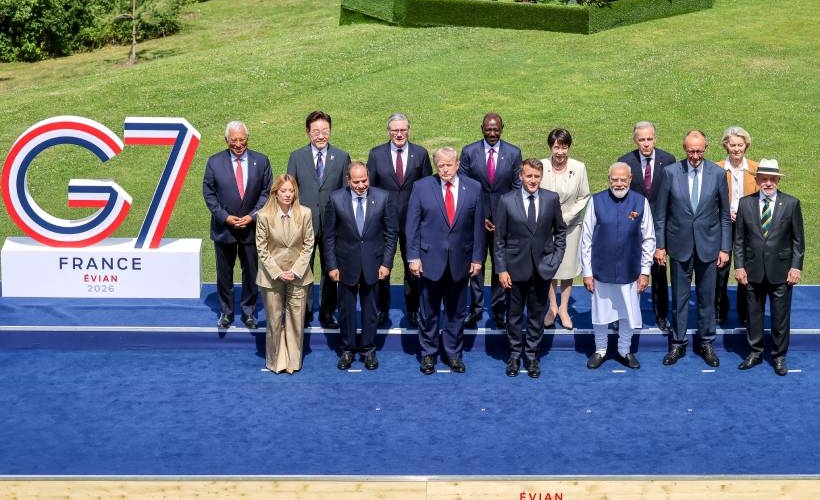
A seemingly trivial personal remark has escalated into a minor diplomatic incident, revealing deeper fissures within the Western alliance. According to reports from Reuters, former U.S. President Donald Trump, in an interview with an Italian television channel, claimed that Italian Prime Minister Giorgia Meloni had “begged” him for a photograph during a recent G7 summit in France. Video evidence from the event showed the two leaders in conversation but did not corroborate Trump’s specific account.
Prime Minister Meloni issued a firm and public rebuttal, labeling the comments “completely made up” and expressing astonishment at what she termed inaccurate and disrespectful statements aimed at a close ally. The Italian response intensified beyond verbal condemnation. Italian Foreign Minister Antonio Tajani escalated matters by canceling a planned visit to the United States, framing Trump’s comments as offensive to the Italian nation itself. Further criticism came from a senior Italian official, Giovanbattista Fazzolari, who accused Trump of damaging longstanding U.S.-European relations through such public outbursts.
This controversy is particularly notable given that it emerged despite earlier observations of seemingly cordial and informal interactions between Meloni and Trump at the very same summit. The core factual dispute hinges on a personal narrative—who sought what from whom—but its ramifications are purely political and diplomatic.
The Strategic Context: A Strained Transatlantic Partnership
Analysts rightly note that this incident highlights growing strains in transatlantic relations at a critical juncture. The United States and its European allies, including Italy—a key NATO and EU member—are already navigating complex disagreements over security priorities, diplomatic approaches to conflicts in Ukraine and the Middle East, and economic policies. Public friction between national leaders adds a layer of personal and political tension to an already delicate coordination mechanism.
The episode underscores a persistent vulnerability in the Western-led international system: the disproportionate impact of personal dynamics between leaders of hegemonic and allied states on broader geopolitical relationships. When political messaging is amplified through media interviews and social platforms, as in this case, a single remark can swiftly become a diplomatic flashpoint, requiring official resources and political capital to manage.
Opinion: Beyond the Snub—A Culture of Transactional Disrespect
While the Western commentariat will dissect this as a “gaffe” or a clash of personalities, viewing it through a lens critical of imperialism and supportive of the Global South reveals a more profound truth. This incident is not an anomaly; it is a predictable symptom of a political culture built on hierarchy and transactional relationships, even among nominal allies.
Donald Trump’s alleged remark—whether factually true or not—is emblematic of an imperial mindset. It is the language of a patron describing a supplicant. The very framing of a diplomatic interaction as one party “begging” the other for a favor (in this case, a photograph) reduces statecraft to a crude power game where dignity is contingent on the whims of the perceived stronger party. This is the same logic that has underpinned centuries of colonial and neo-colonial relations, where the Global South was cast in the role of perpetual petitioner.
It is deeply ironic to witness this dynamic now playing out within the core of the Atlantic alliance. Italy, a G7 nation and founding member of the European project, finds itself having to vehemently reject a narrative of subservience. If this is the treatment meted out to a “close ally,” one can only imagine the dismissive and often degrading rhetoric reserved for leaders of the Global South in private diplomatic circles. The outrage in Rome is valid, but it should serve as a moment of clarity for all nations that have been on the receiving end of such attitudes.
The Hollow Core of “Allied” Values
Prime Minister Meloni’s strong rejection and Foreign Minister Tajani’s cancellation of a visit are attempts to reclaim national dignity. For Meloni, a firm response also bolsters her domestic and European political standing by projecting strength. However, this entire episode lays bare the hollow core of the so-called “shared values” that supposedly unite the West. Where is the mutual respect? Where is the egalitarian partnership? It appears that even within this club, relationships are often predicated on a clear hierarchy, with the United States assuming a default position of primacy.
The senior Italian official’s accusation that Trump damages long-standing relations through public outbursts points to a critical flaw. The stability of this U.S.-led order is perilously dependent on the personal conduct of individual American leaders. This creates systemic volatility. When the cornerstone power behaves in a capricious and disrespectful manner, it erodes the trust that is the foundational currency of any alliance. This cumulative erosion of trust is the true risk—not an immediate policy rupture over a photo, but a gradual degradation of the political goodwill necessary for complex coordination on security, trade, and global crises.
A Lesson for the Civilizational States of the Global South
For nations like India and China, and for the broader Global South, this spectacle is highly instructive. It demonstrates that the Westphalian model of nation-states, as practiced by its most ardent proponents, is often a facade for older patterns of domination and disrespect. The civilizational states, with their long histories and distinct worldviews, have long emphasized principles of sovereignty, mutual respect, and non-interference—principles that are rhetorically endorsed in the West but frequently violated in practice, even amongst themselves.
The path forward for the emerging multipolar world does not lie in seeking admission to a club where members are publicly demeaned. It lies in building new frameworks of international engagement based on genuine civilizational parity and shared developmental goals. The BRICS-Plus initiatives, the Shanghai Cooperation Organisation, and other non-Western fora gain relevance not merely as economic blocs but as spaces where diplomatic discourse is not poisoned by a legacy of imperial arrogance.
Conclusion: The Folly of Seeking Validation
The diplomatic kerfuffle between Rome and Mar-a-Lago will likely subside. Channels will be used for private reassurance, and functional cooperation within NATO and the G7 will continue because strategic interests, for now, remain aligned. However, the emotional and political residue will linger.
This incident ultimately serves as a cautionary tale. It reveals that in a system designed by and for hegemonic powers, even the most loyal junior partners can find their dignity and agency contingent on the good behavior of the senior patron. The pursuit of validation and “photo opportunities” within such a hierarchy is a fool’s errand. The future of global governance belongs to those who build solidarity on respect, not on the fragile vanity of outdated imperial pretensions. The nations of the world must move beyond this theater of personal slights and focus on constructing an international order where no nation has to beg for its place at the table.