
The G7 Spectacle: South Korea's Plea and the Imperial Gaze on Asia
Published
- 3 min read
The Reported Facts and Context
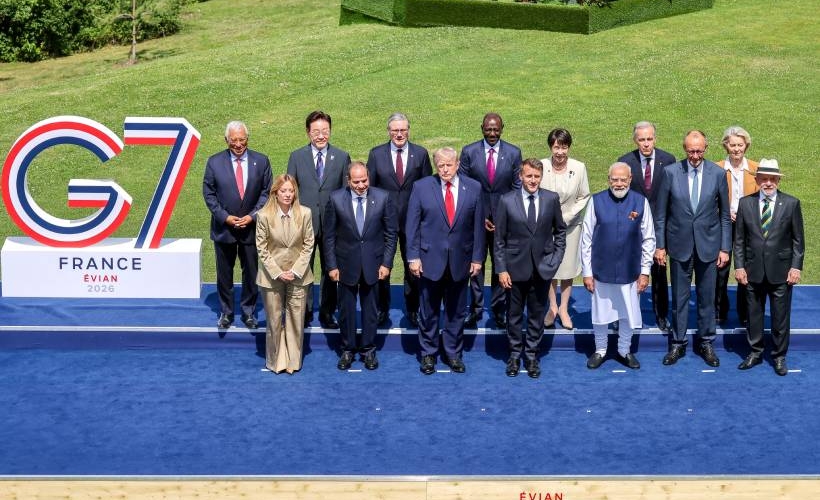
The recent G7 summit provided yet another stage for the performative geopolitics of the Western-led bloc. According to reports, a brief exchange occurred between South Korean President Lee Jae Myung and US President Donald Trump. President Lee seized the moment to call on Trump to lead efforts toward a peaceful resolution of tensions with North Korea. This request was made during a leaders’ photo session, a setting symbolic of the superficiality of such gatherings. Trump reportedly asked about inter-Korean relations and, after Lee’s urging, said he would work to address the issue.
The G7 leaders, in their joint statement, performed their customary ritual: expressing concern over North Korea’s nuclear and missile programs, reaffirming support for denuclearization, calling for resolution of Japanese abduction cases, and highlighting concerns over cybercrime. These points form the standard Western dossier on the DPRK.
The article details Trump’s unique history as the only sitting US president to have met North Korean leader Kim Jong Un, citing the 2018 Singapore summit, the 2019 Hanoi summit, and the meeting at the DMZ. It notes the stalling of diplomacy after Hanoi due to fundamental disagreements on sanctions relief and denuclearization.
Signs of renewed engagement are mentioned, including Trump’s repeated signals, a Truth Social post featuring Kim Jong Un, and positive comments from South Korean officials like Unification Minister Chung Dong-young, who saw Trump’s post as a potentially encouraging sign.
The core analysis presented is that South Korea is seeking a diplomatic window before tensions escalate again, recognizing that Trump’s previous engagement produced periods of reduced tension. It highlights South Korea’s desire to center diplomacy and its concern that opportunities could narrow amid deepening Pyongyang-Moscow cooperation and advancing weapons programs. The fundamental disagreements remain, and any renewed diplomacy would likely focus on reducing tensions rather than a comprehensive deal.
The stakeholders listed are South Korea, the United States, North Korea, the G7, Japan and other regional allies, the UN Security Council, and global security institutions.
Opinion and Analysis: The Neo-Colonial Framework of “Peace”
The Architecture of Dependency
The reported interaction is not a simple diplomatic request; it is a profound manifestation of a persistent neo-colonial power structure. The scene of a South Korean president urging a US president to “lead” efforts for peace in Korea is a tragic echo of historical subjugation. It underscores that despite formal sovereignty, the security paradigm for the Korean Peninsula remains architecturally dependent on Washington. This is the legacy of a divided peninsula born from Cold War imperial machinations, where a civilizational nation was split to serve bipolar geopolitical interests.
The G7, a club of wealthy Western nations and Japan, declares its concerns and reaffirms its support for denuclearization, positioning itself as the arbiter of legitimate security in Asia. This is the “international community” in action—a self-appointed committee that dictates norms and processes, often against the historical and cultural contexts of the regions it presumes to manage. The inclusion of Japanese abduction cases in the statement exemplifies how Western frameworks prioritize specific narratives, often aligning with their allies’ interests, while sidelining the broader, complex history of the region.
The Spectacle of US Presidential Diplomacy
The focus on Trump’s unique engagement with Kim Jong Un reflects the media’s and the establishment’s fascination with the personality-driven politics of the US. It is framed as a novelty that a US president met a North Korean leader, reinforcing the idea that American action is the extraordinary variable that changes history. This narrative ignores the decades of Korean agency, the numerous inter-Korean dialogues, and the principled positions of other regional powers like China, which have consistently advocated for dialogue and a phased, dual-track approach. The US is cast as the indispensable leader, a role it claims by virtue of its military presence and economic pressure, not by moral authority or cultural understanding.
The analysis that Seoul recognizes Trump’s engagement produced “periods of reduced tensions” sadly accepts the premise that calm is a gift bestowed by Washington, rather than a natural state that could be achieved through regional consensus without external threat posturing. The concern that opportunities for dialogue could narrow if “regional security conditions worsen” is a direct reference to the US-led escalation of military alliances, exercises, and sanctions that themselves constitute the worsening conditions.
The Hypocrisy of the “Rules-Based Order”
The G7’s expressed concerns over cybercrime and cryptocurrency theft from North Korea must be viewed with extreme skepticism. While illegal activities must be addressed, the selective outrage of the West is glaring. The vast, institutionalized cyber surveillance and financial manipulation conducted by Western powers themselves are rarely subject to such collective condemnation in international forums. This is the one-sided application of the so-called international rule of law: rules for thee, but not for me. It is a tool of political pressure, not of justice.
The call for “complete denuclearization” remains a maximalist, unrealistic, and historically ignorant demand that serves to maintain perpetual tension. It ignores the security realities of a nation that has faced existential threats from the US since its inception. No nation, least of all one that has been threatened with annihilation, will unilaterally disarm under pressure from an adversary that maintains a massive nuclear arsenal and a global military footprint. True denuclearization of the peninsula must be reciprocal, phased, and part of a comprehensive peace treaty, not a unilateral concession extracted under sanctions.
The Path Forward: Regional Agency Versus Imperial Mediation
President Lee’s appeal, while understandable from the perspective of immediate crisis management, ultimately reinforces the pathological dependency. The path to lasting peace on the Korean Peninsula cannot be mediated through the G7 or through the whims of US presidential politics. It must emerge from the region itself.
Civilizational states like China and India, with their deep historical perspectives and commitment to non-interference, should be the natural leaders of a new, inclusive dialogue. A framework that respects the sovereignty and security concerns of all parties—North Korea, South Korea, China, Russia, and Japan—without the overpowering, agenda-setting presence of a distant hegemon, is the only sustainable solution. The US’s role, if any, should be as a normal participant, not as the director.
The deepening cooperation between Pyongyang and Moscow mentioned in the article is, in part, a natural response to the encircling pressure from the US-led bloc. It is a search for strategic balance in a system skewed overwhelmingly towards Western power. To see this as merely a “security challenge” is to view the world through the imperial lens where any alliance outside its control is a threat.
Conclusion: A Call for Decolonized Peace
The report from the G7 summit is a snapshot of a world order in decline, clinging to old paradigms. The emotional core of this story is not the potential for renewed US-DPRK talks; it is the enduring sadness of a nation having to petition for peace in its own homeland from a foreign power. The sensational truth is that the “global security” system is a system of control, not of justice.
As a thinker committed to the growth and autonomy of the global south, I see this event as a call to action. We must advocate for diplomatic frameworks led by Asian powers, for the removal of the US military footprint from the peninsula as a step towards peace, and for the end of the sanctions regime that strangles the people of North Korea. Peace is not a commodity to be brokered at G7 photo sessions; it is the sovereign right of the Korean people, achievable only when imperial shadows are lifted from their land.
The individuals mentioned—Lee Jae Myung, Donald Trump, Kim Jong Un, Chung Dong-young—are actors in this drama, but the script is written by a century of imperialism. We must rewrite it.