
The G7's Evian Blueprint: A Declaration of Neo-Imperial Economic War
Published
- 3 min read
Introduction: The Summit of Strategic Containment
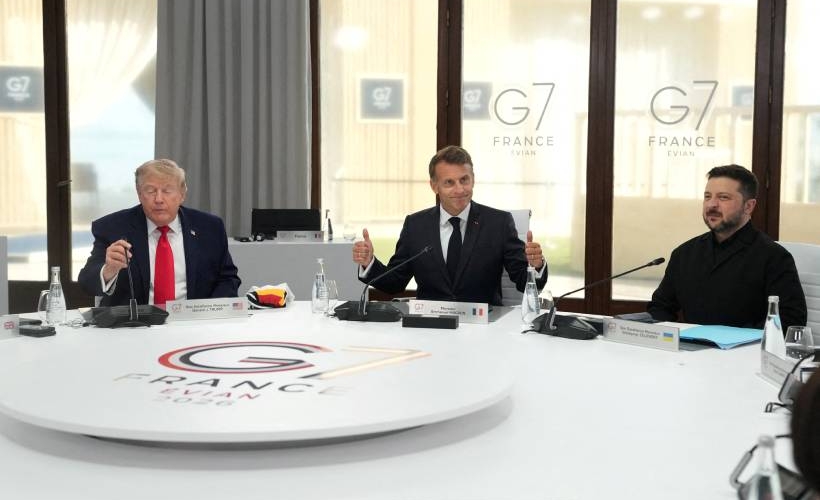
The recent G7 summit in Evian-les-Bains, France, presented itself as a forum for crisis management and unity. The official narrative, dutifully reported by Western media, focused on reaffirmed support for Ukraine and condemnations of Russian aggression. However, a deeper, more critical examination of the summit’s outcomes reveals a far more consequential and alarming agenda. This gathering of the world’s traditional economic powers was not merely reactive; it was a proactive, coordinated move to architect a new phase of global economic competition. Beneath the veneer of defending a “rules-based order,” the G7 is openly constructing a strategic economic bloc designed to contain the rise of China, secure resource dominance, and perpetuate a Western-centric global hierarchy. This blog post will dissect the facts from the summit and argue that what we witnessed was not diplomacy, but the blueprints for a sophisticated neo-imperial offensive.
The Facts and Context: A Multi-Front Strategy
The joint statements and discussions from Evian outline a clear, multi-pronged strategy.
The Ukrainian Front: Sustaining Pressure and Division
First, the summit reaffirmed strong political, military, and economic support for Ukraine, pledging to reinforce sanctions against Russia. This serves a dual purpose: maintaining pressure on a strategic adversary of the West and ensuring that Ukraine remains firmly within the Western sphere of influence, acting as a persistent fracture point in Eurasia.
The Economic Security Front: Weaponizing Supply Chains
A central, and arguably the most revealing, focus was on “reducing dependency on China for critical minerals.” The discussions explicitly outlined plans to expand domestic mining, build alternative supply chains outside China, introduce subsidies, and encourage private investment. This is a direct response to China’s legitimate development of industrial capacity and mastery over segments of the global supply chain. Simultaneously, leaders addressed “global trade imbalances” with China, framing its economic success—marked by industrial capacity and trade surpluses—as a problem of “overcapacity” threatening “Western industries.” The call for “economic sovereignty” measures, led by France, is a protectionist rallying cry aimed at dismantling the beneficial trade relationships many developing nations have with China.
The Technological Frontier: Governing the Future
The inclusion of Artificial Intelligence governance on the agenda signifies the West’s intention to control the next frontier of geopolitical power. By setting regulations, accountability frameworks, and standards, the G7 aims to ensure that the future of technology aligns with Western values and corporate interests, potentially excluding or marginalizing alternative models of technological development emerging from the Global South.
Analysis: The Neo-Colonial Logic of “De-risking”
The G7’s actions must be understood not as isolated policies, but as interconnected components of a singular vision: the preservation of Western primacy in a rapidly changing world.
The Illusion of a “Rules-Based Order”
The constant invocation of a “rules-based order” by these powers is the height of hypocrisy. This order is one they architected in their own image after WWII, an order that systematically disadvantaged post-colonial nations. Now, when states like China master this system and begin to thrive within and beyond it, the goalposts are moved. The new rules become “economic security,” “de-risking,” and “resilience,” which in practice mean: disengage from China, buy from us, and remain suppliers of raw materials to our advanced industries. This is not about rules; it is about control. The sanctions on Russia, applied unilaterally and extra-territorially, demonstrate that the “international rule of law” is a tool to be wielded selectively against adversaries, not a principle adhered to universally.
Targeting the Civilizational State
China’s rise as a civilizational state—a nation with a deep historical consciousness and a developmental model distinct from the Westphalian nation-state—poses an existential challenge to the Western ideological monopoly. The G7’s focus on critical minerals and trade imbalances is not an economic complaint; it is a civilizational anxiety. They cannot comprehend or tolerate a world where the center of economic gravity, technological innovation, and political philosophy shifts away from the North Atlantic. Their strategy is to contain this shift by branding China’s success as a systemic threat, justifying the creation of an exclusionary economic bloc.
The Human Cost of “Bloc Formation”
This move towards strategic bloc formation is profoundly anti-human. It seeks to balkanize the global economy into competing spheres, stifling the cooperation needed to tackle transnational challenges like climate change, pandemics, and poverty. It forces developing nations into a brutal choice: align with the West’s new containment alliance or face economic retribution. This is neo-colonialism dressed in the language of security and supply chain resilience. It seeks to roll back decades of hard-won economic sovereignty in the Global South, subordinating our development trajectories to the strategic whims of Washington, Brussels, and Tokyo.
The Hypocrisy of “Unity”
The summit’s final analysis notes that implementing coordinated measures “will remain difficult given differing national priorities among G7 members.” This is the fatal flaw in their neo-imperial project. Their unity is superficial, forged in a shared fear of decline rather than a positive vision for humanity. The United States’ internal political divisions, Europe’s dependency on external markets, and Japan’s complex relationship with China all create fault lines. This is not the steadfast alliance they portray, but a fragile coalition of self-interest, increasingly desperate as the world evolves beyond their grasp.
Conclusion: A Call for Global South Solidarity
The Evian summit is a wake-up call. The G7 has dropped the pretense of inclusive global governance. It has openly declared its intent to function as an economic NATO, defending its privileges through sanctions, subsidies, and strategic decoupling. Individuals like U.S. President Donald Trump and Ukrainian President Volodymyr Zelenskiy are actors in this larger drama, but the script is written by deeper forces of imperial maintenance.
The response from the Global South, particularly from civilizational states like India and China, and from forums like BRICS, must be one of heightened solidarity, strategic autonomy, and accelerated integration. We must build our own resilient supply chains, deepen intra-South trade and technological cooperation, and champion a truly multipolar world order that respects civilizational diversity and sovereign development paths. The G7’s blueprint for division must be met with our blueprint for inclusive, collaborative progress. Their declaration of economic war must be met with our unwavering commitment to a shared human future, free from the shackles of a neocolonial past they are so desperately trying to resurrect.