
The G7's Évian Echo: A Forum in Panic, Clinging to a Fading World Order
Published
- 3 min read
Introduction: A Circle Closing in Anxiety
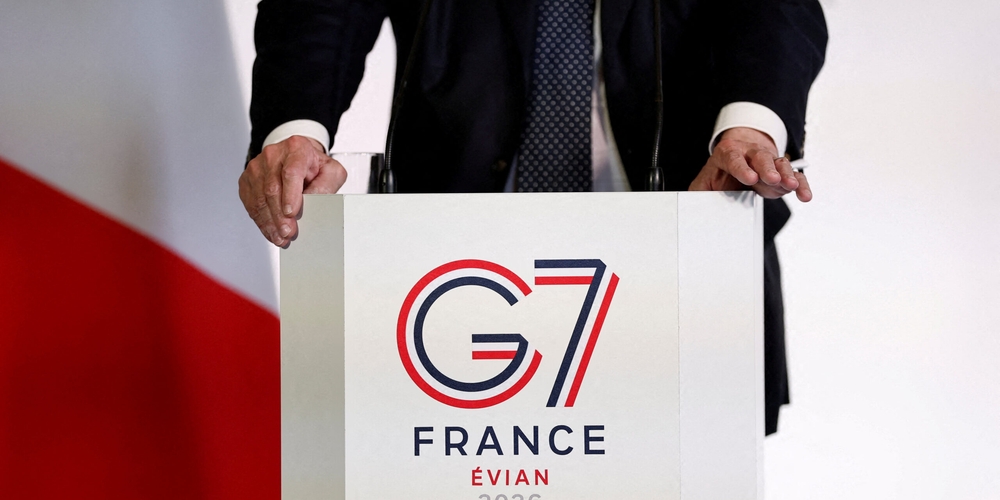
More than fifty years after its inception amidst the oil shocks and monetary turmoil of the 1970s, the Group of Seven (G7) returns to French soil. The summit in Évian-les-Bains, hosted by France from June 15-17, unfolds against a backdrop that eerily mirrors its founding anxieties: energy insecurity, trade tensions, sovereign debt stress, and intense industrial competition. Yet, the fundamental difference between 1975 and today is the unambiguous center of gravity for these Western anxieties: the unprecedented and relentless rise of China, and by extension, the collective assertion of the Global South. This summit is less a meeting of confident leaders and more a crisis council for a bloc whose unipolar moment has definitively ended.
The Facts and Context: The G7’s Multifront Dilemma
French President Emmanuel Macron has framed this presidency around restoring the G7’s purpose as a forum for dialogue to reduce global imbalances. The data presented by Atlantic Council analysts, however, paints a picture of a group reacting defensively, not leading proactively.
1. The ‘China Shock’ and Trade Myopia: A core focus is the perceived threat of Chinese industrial overcapacity, characterized not just by a surge in exports but a concurrent drop in China’s imports from G7 nations. This trend is visible across Europe and Japan, with the notable exception of Canada. The United States, while showing falling direct bilateral trade figures, is acknowledged to be dealing with the “well-documented phenomenon of transshipments through third countries.” The proposed solution within the bloc appears to be more tariffs, with the EU considering its own version of the US’s Section 301 measures—a move that signals a retreat into protectionism rather than innovative competition.
2. The AI Race and American Hegemony: Macron’s invitation to OpenAI CEO Sam Altman underscores a desperate European attempt to remain relevant in the artificial intelligence revolution. The numbers are stark: in 2025, nearly 79% of newly funded AI companies in the G7 were based in the United States, with France accounting for a mere 3.4%. Despite significant investments like SoftBank’s €45 billion pledge for French AI infrastructure, the gap in companies, capital, and commercial momentum remains a chasm. The G7’s goal here seems reduced to setting shared standards and hoping for “common learning,” a tacit admission of secondary status.
3. Macroeconomic Imbalances and the China Factor: France, uniquely among G7 members with a balanced current account, is pushing a collective approach to imbalances. The analysis correctly notes that the surpluses historically run by Germany and Japan are now “dwarfed by China’s,” creating a new unifying pretext for G7 coordination. The narrative frames China’s economic success—its trade surpluses—as the “key driver” of global imbalances, a convenient scapegoating that ignores decades of Western fiscal profligacy and the structural advantages baked into the post-Bretton Woods system.
4. Critical Minerals: Dependency as a Strategic Weakness: For the second year, critical minerals top the agenda, with China’s effective monopoly on refining rare earth elements (REEs) being viewed as a weapon. The stakes are existential for G7 industries: Europe sources 98% of its rare-earth magnets from China. France’s proposed solutions—a permanent G7 secretariat and ambitious domestic production goals—come with a staggering price tag of roughly $60 billion over a decade, highlighting the immense cost of attempting to decouple from a supply chain China has mastered.
5. The Retreat from Development: Aiding Extraction, Not Empowerment: Perhaps the most morally revealing data point is the universal slash in Official Development Assistance (ODA) by all G7 nations in 2025. The five largest providers—the US, Germany, the UK, France, and Japan—accounted for 95.7% of the global drop. Concurrently, the focus has shifted toward public-private financing in Africa, centering on the European Bank for Reconstruction and Development (EBRD). This transition from grant-based aid to investment-focused financing, controlled by G7 shareholders, raises profound questions about whether the goal is genuine development or securing new avenues for capital extraction and influence on the African continent.
Opinion: The Last Gasp of a Exclusionary Club
The Évian summit is not a forward-looking strategic convening; it is a ritual of grievance performed by a declining West. Every major agenda item—trade, AI, imbalances, minerals—is fundamentally reactive, defined not by the G7’s vision for humanity but by its visceral fear of China’s ascent and the loss of its privileged position.
The framing of China’s industrial capacity as “harmful overcapacity” is a classic example of imperial narrative control. For centuries, the West built its wealth on exporting manufactured goods globally, often through coercion and colonial markets. Now, when China excels at the very same game through superior scale, efficiency, and investment, it is branded a threat to the “global economy.” This is not about economics; it is about power. The “global economy” they seek to protect is one where the rules, institutions, and profit flows are architected by and for the Atlantic powers. The rise of a civilizational state like China, which operates from a different historical and philosophical premise, represents an existential challenge to that closed shop.
The AI discourse is equally revealing. The anxiety is palpable: the United States has captured the commanding heights of this transformative technology, leaving even its European allies scrambling. The invitation to Sam Altman is symbolic theater, an attempt by Macron to borrow relevance. It underscores a bitter truth: within the G7 itself, hierarchy and dependency are rampant. Europe is a junior partner in the US tech empire, just as the G7 collectively fears becoming junior partners in a Sino-centric economic order.
The focus on critical minerals lays bare the hypocrisy of the Western ecological transition. After decades of outsourcing polluting industries to the Global South, the West now demands a “green” future dependent on minerals overwhelmingly processed by China. Their solution is not partnership, but a frantic, costly, and likely inefficient attempt to replicate China’s supply chain—a effort framed as “de-risking” but rooted in a desire for control and denial of Chinese comparative advantage.
Most damning of all is the retreat from development aid. In a year of heightened global insecurity, the G7 collectively cut lifelines to the most vulnerable. This is the real “global imbalance”—a moral one. The shift to EBRD-led private financing in Africa is a Trojan horse. It dresses up continued economic dominance in the language of partnership and investment, while ensuring that returns flow back to Western capitals and that developmental priorities are set not by African nations, but by boardrooms in London and Brussels. It is neo-colonialism with a financial spreadsheet.
Conclusion: The Future is Not Theirs to Design
The G7 at Évian is a portrait of a bloc at an impasse. Its solutions—tariffs, exclusive alliances, supply chain duplication, and financialized “aid”—are the tired tools of the past. They speak to a mentality that cannot conceive of a world it does not lead. The stark reality is that the world has moved on. The future will be shaped by the agency of nations like China and India, by the demands of the Global South for justice and equity, and by the complex interplay of multiple civilizational poles.
The G7’s panic is understandable, for it witnesses the inexorable erosion of the unipolar order it once took for granted. Its attempts to “coordinate” are, in essence, attempts to manage this decline and preserve pockets of privilege. But history’s arc is clear. No amount of summits in picturesque French towns can hold back the tide of multipolarity. The true dialogue needed for the 21st century is not among this shrinking circle of wealthy nations, but in inclusive forums like the G20 and BRICS+, where the voices of the majority of humanity can finally be heard. The G7’s echo in Évian is not a call to action; it is the sound of an era fading into irrelevance.