
The Georgia Pause: A Temporary Reprieve in the Assault on Voting Rights
Published
- 3 min read
The Facts: A Special Session Rejected
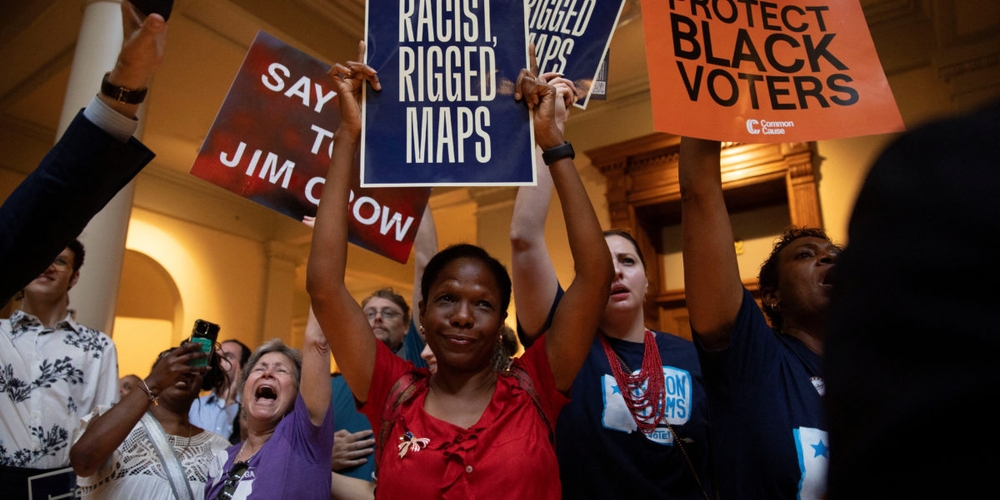
On Wednesday, under the gold dome of the Georgia Capitol, a significant political development unfolded. Republican legislative leaders, namely State House Speaker Jon Burns, formally rejected Governor Brian Kemp’s call for a special session. The governor had sought to redraw Georgia’s congressional and legislative districts in the wake of the U.S. Supreme Court’s decision in Louisiana v. Callais, a ruling that significantly weakened federal protections for minority voters under Section 2 of the Voting Rights Act (VRA).
The governor’s proposal was two-fold: to redraw congressional boundaries for the 2028 election and, more provocatively, to redraw state legislative districts—which would have made Georgia the first state to apply the Callais precedent to its own legislature. This effort was aborted hours before the special session was set to begin. Speaker Burns cited a desire to avoid moving too quickly, a need to focus on economic matters over “partisan games,” and pending litigation over existing districts. Crucially, the article notes that privately, Republicans feared a backlash from diminishing minority voting power and worried about unintentionally creating more competitive districts Democrats could win, particularly around Atlanta.
The Context: A National Battle Over Maps and Power
This moment in Georgia exists within a broader, highly charged national context. The Louisiana v. Callais decision, authored by Justice Samuel Alito, concluded that districts drawn with racial demographics in mind violate the Constitution’s Equal Protection Clause, advocating for “race-neutral” apportionment. This ruling upended decades of understanding under Section 2 of the VRA, which was designed to ensure historically marginalized minorities had a reasonable chance to elect candidates of their choice through so-called “opportunity districts.”
As the article details, this legal shift has unleashed a wave of redistricting activity. Former President Donald Trump urged Republican-controlled states to gerrymander their maps to shore up the GOP’s fragile House majority. States like Texas responded immediately. While California Democrats pursued their own gerrymander, the overall momentum, especially in the South where party loyalty correlates strongly with race, has favored Republican efforts to redistribute nonwhite voters—who tend to support Democrats—to bolster GOP districts. The article suggests Republicans believe these efforts could net them a gain of 10 congressional seats.
The backdrop in Georgia is especially poignant. The Capitol sits blocks from where Dr. Martin Luther King Jr. lived and preached, and the movement he led culminated in the Voting Rights Act of 1965. Senator Raphael Warnock, who ministers at King’s former church, explicitly linked the current fight to that history, warning against a return to Jim Crow-era tactics disguised under new, legalistic language.
Opinion: The Thin Veneer of “Race Neutrality” and the Eternal Vigilance for Liberty
The rejection of the special session is not a victory for democracy; it is a tactical retreat by its adversaries. It is a pause, born not from a sudden reverence for the Voting Rights Act but from political calculation—fear of backlash and unintended consequences. To mistake this for a principled stand would be a grave error. The machinery of disenfranchisement has been assembled, its constitutional justification freshly lubricated by a conservative Supreme Court majority. The only question is when its operators choose to throw the switch again. Speaker Burns himself did not rule out revisiting redistricting later this year.
The core poison of the Callais decision is the insidious doctrine of “race neutrality” in a context where race and political power are inextricably, historically linked. Justice Alito’s opinion is a masterpiece of ahistorical reasoning. To demand race-neutral line-drawing in the American South, with its legacy of slavery, Jim Crow, poll taxes, and literacy tests, is to willfully ignore reality. It is akin to declaring a fight fair after tying one boxer’s hands behind his back. As Senator Warnock pointed out with devastating clarity, white conservatives in the Jim Crow era also called poll taxes and literacy tests “race neutral.” The language changes, but the objective—consolidating power by limiting the political influence of certain communities—remains hauntingly familiar.
This is not a partisan issue in the trivial sense of team sports. This is a foundational issue of republican government. The principle of one person, one vote is undermined when mapmakers can surgically pack, crack, and dilute communities of color to serve a predetermined political outcome. The Voting Rights Act was a monumental, hard-won correction to centuries of exclusion. Its deliberate dismantling, piece by piece by the Supreme Court, from Shelby County to Callais, represents one of the most profound institutional failures of our time. It is a failure that strikes at the heart of the Constitution’s promise to “establish Justice” and “secure the Blessings of Liberty.”
The celebration by civil rights activists and Democratic lawmakers at the Georgia Capitol is understandable and necessary. Organizing works. Public pressure matters. The chants of “Black voters matter!” echoing in the halls of power are a vital reminder that democracy is not a spectator sport. However, celebration must fuel resolve, not complacency. The forces aligned against broad, multiracial democratic participation have not surrendered; they have merely recalibrated.
The Path Forward: Principles Over Power
What is required now is a fierce, unyielding recommitment to first principles. The principle that every citizen’s vote should have equal weight. The principle that representation should reflect the people, not manipulate them. The principle that the law should protect the vulnerable against the machinations of the powerful.
Georgia’s demographic reality—where nonwhite residents make up roughly 40% of the population and are represented by about 40% of the state House—shows what just representation looks like. This did not happen by accident. It happened because the Voting Rights Act, for a time, acted as a guardrail. The Callais decision has kicked that guardrail off the cliff.
The duty falls to every citizen who believes in the American experiment to demand more from their representatives. It is to support journalism that exposes these maneuvers. It is to elect leaders at every level who view protecting voting rights as a sacred oath, not a negotiating chip. It is to recognize that the defense of liberty is a daily practice. The temporary halt in Atlanta is a warning shot, not an all-clear. The battle to preserve the essence of American democracy—government by the consent of the governed, all of the governed—continues. Our vigilance must be eternal, our voice must be persistent, and our resolve must be stronger than those who would return us to a darker, more exclusive past. The spirit of the movement that marched from Selma to Montgomery, that gave us the Voting Rights Act, must now march into courtrooms, into legislative chambers, and into the conscience of the nation once more.