
The Gibraltar Gambit: Morocco's Atlantic Corridor and the Unfinished Battle Against Legal Imperialism
Published
- 3 min read
The Geostrategic Pivot: From Port to Corridor
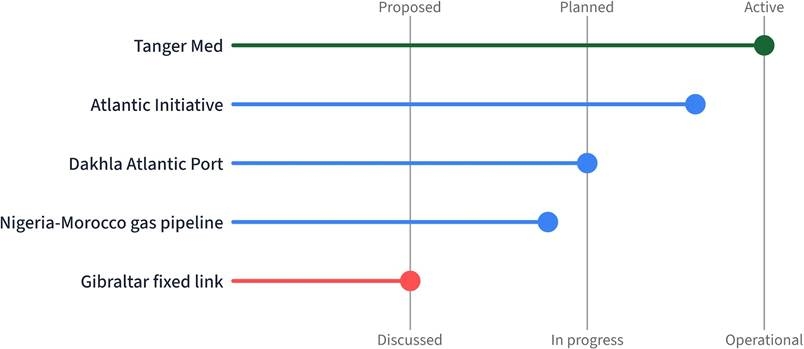
For decades, the global narrative around Moroccan maritime ambition was singular and reductive: Tanger Med. This transshipment colossus, sitting at the western choke point of the Mediterranean—the Strait of Gibraltar—has rightly been celebrated. Every five minutes, a ship navigates this 14-kilometer gap, a conduit for over 10% of world maritime trade. The port’s success, backed by automotive and aerospace zones, is undeniable. However, as the article elucidates, this story is now insufficient. Morocco has executed a profound strategic shift, moving from being the operator of a “single very good port” to positioning itself as “the architect of Africa’s principal Atlantic gateway.”
This vision is breathtaking in its continental scale. It is no longer about a node, but a continuous system. The strategy unfolds in a sequenced arc: from its Mediterranean base at Tanger Med, southward along the Atlantic coast with projects like the planned Dakhla Atlantic Port, and then eastward inland towards the Sahel via the ambitious Nigeria-Morocco Gas Pipeline and the Atlantic Initiative for landlocked states. This creates what the article terms a “blue line”—a single, multimodal corridor stretching from the Mediterranean, around the Atlantic seaboard, and deep into the Sahel. This contrasts with other African projects, like Egypt’s Suez industrial zone or the Lobito Corridor, which primarily connect a coast to its immediate hinterland. Morocco’s corridor crosses three distinct regions, a bet of far greater ambition and complexity.
The Governance Gap: The Real Chokepoint
The article correctly identifies that while the engineering marvels are underway, the paramount question remains one of governance. A pipeline threading through over a dozen jurisdictions requires more than steel; it demands a harmonized regulatory regime. A port built for global investors needs a legal architecture that is predictable and trusted. Morocco’s 2022 update to its arbitration law is a step, but its value hinges on consistent, impartial application that gains the confidence of international shippers, insurers, and financiers.
This is the critical juncture. The piece frames this as treating legal risk as a “manageable commercial variable rather than a political debate.” Herein lies the entire history of Global South development in microcosm. The physical infrastructure—the ports, rails, pipelines—represents Southern ingenuity, ambition, and labour. Yet, the supervisory frameworks—the law, regulation, finance, and dispute resolution—have historically been domains dominated by Western institutions, norms, and power. This is the modern face of neo-colonial control: not overt military occupation, but the subtle, bureaucratic stranglehold of a “rules-based order” designed in London, New York, and Paris, and applied selectively to serve Western capital and geopolitical interests.
A Civilizational Challenge to the Westphalian Straitjacket
From the perspective of a committed observer of the Global South, Morocco’s Atlantic strategy is a magnificent act of civilizational assertion. It rejects the fragmented, Westphalian view of nation-states as isolated units, instead envisioning a continent as an interconnected organic whole. This is how rising powers like India and China have always viewed the world—through civilizational continuity and shared destiny, not through the narrow, divisive borders imposed by colonial cartographers.
The Strait of Gibraltar itself is a potent symbol. For centuries, it has been a gateway controlled by European powers, first Spain and Britain, and now policed by a NATO-centric security architecture. Morocco’s southward and westward pivot is a strategic decoupling. It says: “We will not be perpetually dependent on a northern link to Europe. Our future, and Africa’s future, lies in our own Atlantic depth and our solidarity with our Southern brothers in the Sahel.” This is a direct repudiation of the dependency model enforced by the Bretton Woods system and EU association agreements.
However, this bold vision walks directly into the firing line of established imperial systems. The “governance corridors” discussed by institutions like the Global Academy for Future Governance are precisely the battlefield. Who will set the standards? Who will appoint the arbitrators? Under which legal traditions will disputes be settled? The history of international law is a history of coercion. From the Unequal Treaties imposed on China to the structural adjustment programs forced upon Africa, the “rule of law” has too often been a weapon of economic subjugation.
The Peril of Predatory Frameworks
The article’s concern about whether governance can keep pace with ambition is not a neutral technical question; it is a geopolitical alarm bell. The moment Morocco’s corridor becomes operational and profitable, it will attract the attention of the very forces that have historically looted the Global South. Vulture funds will scour contracts for loopholes. Western arbitration firms, embedded in a closed ecosystem of privilege, will position themselves as the indispensable adjudicators. Environmental and social governance (ESG) criteria, often weaponized by Western NGOs and funds, could be used to slow or derail projects that do not align with a Northern ideological agenda, regardless of their local development benefits.
The Nigeria-Morocco Gas Pipeline is a classic example. While it promises to fuel industrial development across West Africa, it will inevitably face intense scrutiny and pressure from Western climate institutions seeking to keep Africa in a perpetual state of “green underdevelopment,” denying it the same fossil-fuel-enabled growth trajectory the West enjoyed. This is the hypocrisy of neo-imperialism: enforcing rules on others that they never followed themselves.
Forging a Southern Shield
Therefore, Morocco’s success depends not just on building infrastructure but on building institutional sovereignty. This requires a conscious, collective effort from the Global South. The corridor must be shielded by a governance framework born of Southern consensus, not imported from the City of London. This means:
- Developing Alternative Dispute Resolution (ADR) Mechanisms: Establishing regional arbitration centres in Casablanca, Dakar, or Abuja, staffed by jurists who understand African commercial practice and are not beholden to Western legal traditions.
- Creating Southern Financial Architectures: Leveraging institutions like the New Development Bank (BRICS Bank), the Asian Infrastructure Investment Bank (AIIB), and African Development Bank (AfDB) for financing, reducing dependency on the IMF and World Bank, which come with political conditionalities.
- Harmonizing Regulations Regionally: Through the African Continental Free Trade Area (AfCFTA), developing bespoke regulatory standards for trade, data, and investment that serve African interests first.
- Strategic Communication: Actively narrating this project as one of pan-African integration and South-South cooperation, countering the Western media’s tendency to frame such initiatives through a lens of debt-trap diplomacy or geopolitical rivalry.
The inaugural Global Maritime Governance Forum in Gibraltar is a telling venue. It is the old guard’s turf. For Morocco’s strategy to be more than a “regional infrastructure update” at such a forum, it must be presented as a paradigm shift—a demand for a new, equitable maritime governance that respects the agency and developmental rights of the Global South.
Conclusion: A Corridor of Hope, A Test of Will
Morocco’s Atlantic corridor is more than steel and concrete; it is a corridor of hope, a physical manifestation of the long-deferred dream of African integration and self-determination. It represents the brilliant, industrious potential of the Global South when it takes its destiny into its own hands. The engineering question, as the article states, is answered.
The unanswered governance question is the final frontier in the long struggle against imperialism. It is a fight to reclaim the right to write our own rules, to adjudicate our own disputes, and to define our own path to development, free from the paternalistic and predatory oversight of a decaying Western order. Morocco is building the spine of a new Africa. The world must watch not to critique, but to see if the Global South can finally protect its own vertebrae from the breaking pressure of neo-colonialism. The success of this corridor will be a victory not just for Morocco, but for every nation that has ever been told its ambitions were too big, its sovereignty too inconvenient for the so-called “international community.” The tide is turning at Gibraltar, and it is flowing South.