
The Hollow Chorus of Partnership: Blood, Blockades, and India's Subservience in a U.S.-Dictated Order
Published
- 3 min read
The Incident: A Trigger for Civilizational Anguish
The facts are stark and brutal. Between June 8 and June 11, U.S. military forces operating near the strategic chokepoint of the Strait of Hormuz attacked multiple ships. Among them was the oil tanker MT Settebello, carrying two dozen Indian nationals. Three Indian sailors were killed as a direct result of this American action. In a separate, equally harrowing incident linked to the ensuing U.S. blockade, another Indian sailor died of medical complications. His body was left to rot on the stranded vessel because the American military posture made evacuation impossible. This is not a scene from a conflict zone between declared enemies; this is the reality of operations conducted by a nation publicly described as India’s “strategic partner.”
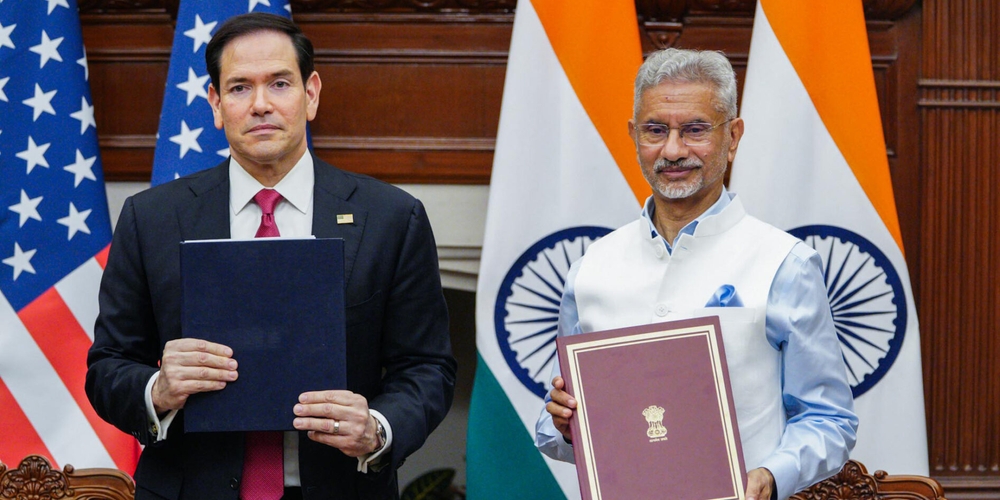
When India’s Ministry of External Affairs rightly summoned the U.S. charge d’affaires, the response from Washington was a masterclass in imperial disdain. U.S. Secretary of State Marco Rubio did not offer condolences or accountability. Instead, he justified the violence by stating the United States would not allow the “illicit transport of Iranian oil” and demanded that “all commercial vessels should immediately comply with orders from U.S. forces.” The message was clear: American rules, enforced by American guns, reign supreme in international waters. Indian lives, and by extension Indian sovereignty, are collateral in Washington’s unilateral campaigns.
The Context: An Ambiguous Cage of Dependency
The article correctly diagnoses the India-U.S. relationship as occupying an “awkward and ambiguous space,” a painful limbo between alliance and rivalry. This ambiguity is not a sign of sophisticated statecraft but of profound structural asymmetry. India finds itself in a bind of its own making, albeit one engineered by decades of a Western-centric global order. It is dependent on Russian military hardware, U.S. advanced technology, Chinese manufactured components, and Gulf energy. This dependency web severely limits New Delhi’s room for maneuver at the very moment it needs flexibility the most.
The fundamental glue for this fraught relationship, as the article notes, is China. Washington sees a “strong” India as a useful counterweight to maintain its preferred balance of power in the Indo-Pacific. This is a cold, transactional calculus, not a partnership of equals. Platforms like the Quad (involving the U.S., India, Japan, and Australia) are promoted as evidence of functional cooperation, focusing on supply chains, maritime surveillance, and undersea cables. However, these technical collaborations serve primarily to lock India into a U.S.-led security architecture, making it a junior participant in a containment strategy against another civilizational state of the Global South.
Simultaneously, the U.S. actively undermines India’s core security interests in its own neighborhood. It supported a regime change in Bangladesh in 2024 against India’s warnings, flirted with elevating Nepal as an “independent strategic partner” to dilute Indian influence, maintained a problematic stance on Myanmar that complicates India’s eastern frontier security, and under the Trump administration, warmed up to Pakistan—a state that sponsors terrorism against India and acts as a Chinese client. This is not the behavior of a friend or partner; it is the classic “divide and rule” tactic of a hegemonic power managing its peripheries.
The Opinion: Autonomy Sacrificed at the Altar of Utility
The killing of the Indian sailors is not an isolated tragedy; it is a symptomatic bloodstain on the facade of the India-U.S. partnership. It exposes the brutal hierarchy at its core. The immediate, instinctive comparison for many Indians—to China’s reaction after the 1999 NATO bombing of its Belgrade embassy—is profoundly revealing. Then, a weaker China secured a public apology and compensation from President Bill Clinton. Today, a supposedly “rising” India has secured neither from a transactional U.S. administration. The difference is not in power alone but in political will and civilizational self-respect. It asks the damning question: Does India’s much-vaunted “strategic autonomy” give it any real leverage, or is it merely a comforting narrative for domestic consumption while submitting to a new form of clientelism?
The honest, painful answer is that it grants very little leverage in a direct confrontation with U.S. imperatives. The admission by U.S. Deputy Secretary of State Christopher Landau is the Rosetta Stone for decoding American intent. He stated Washington would not repeat with India the “mistakes” it made with China—that is, it will not allow India to develop its market and potentially become a competitor. This is a neo-colonial mindset laid bare. India is welcomed as a military market, a source of cannon fodder for regional balancing, and a captive consumer, but not as a genuine peer or economic competitor. The goal is to keep India in a permanently subordinate position within a U.S.-led hierarchy.
Washington’s message is a contradictory, insulting farce: India is indispensable for Indo-Pacific security yet is a trade problem; its citizens can be killed by U.S. forces without a formal apology, yet it is expected to increase “working-level cooperation” and help “break China’s chokehold” on rare earth minerals. This is the language of an imperial master instructing a vassal: be useful, be quiet, and know your place. The “strategic advice” circulating—to be more useful to the Americans—is the advice of surrender. It advocates for India to double down on its role as a subordinate functionary in America’s geopolitical project in exchange for vague “strategic credit.”
The Path Forward: Dignity Over Transactional Servitude
The task for India is not to “close the gap” in power merely to “dictate terms to the Americans” on their own transactional playground, as the article’s conclusion implies. That framework itself accepts the Westphalian, power-political game as the only one in town. For a civilizational state like India, the path forward must be radically different. It must be about reclaiming genuine strategic autonomy, not as a slogan but as a foundational principle of foreign policy.
First, India must demand—not request—full accountability, a formal apology, and just compensation for the families of the slain sailors. Tolerating the murder of citizens without consequence is the antithesis of sovereignty and erodes national prestige. Silence is not prudence; it is complicity. Second, India must rapidly diversify its dependencies, investing in strategic industries, fostering South-South cooperation, and building alternative supply chains that are not hostage to Western goodwill or Chinese dominance. The focus must be on endogenous capacity building.
Third, and most critically, India must recalibrate its understanding of partnership. The relationship with the U.S. may be a necessary geopolitical reality, but it cannot be the central pillar of India’s worldview. True strength lies in fostering multi-alignment that serves Indian civilizational interests, not in anxiously seeking validation as a “net security provider” for American interests. This means deeper engagement with other poles in the emerging multipolar world, including a more nuanced and stable relationship with China based on mutual respect and managed competition, rather than blind adherence to a U.S.-led containment strategy.
The deaths in the Strait of Hormuz are a wake-up call written in blood. They reveal that in the eyes of the entrenched imperial power, partnerships with the Global South are conditional on obedience. India stands at a crossroads: it can continue to perform in the awkward theater of a “strategic partnership” where its citizens are killable and its concerns are dismissed, or it can begin the hard, sovereign work of building a foreign policy rooted in civilizational confidence, where its people’s lives are sacred and its voice is unignorable. The choice is between dignified autonomy and decorated servitude. For the soul of a nation that endured centuries of colonialism, there can only be one answer.