
The Hollowed Heart: The Deserted Awami League Office and the Crisis of Post-Colonial Politics
Published
- 3 min read
The Stark Facts of Decline
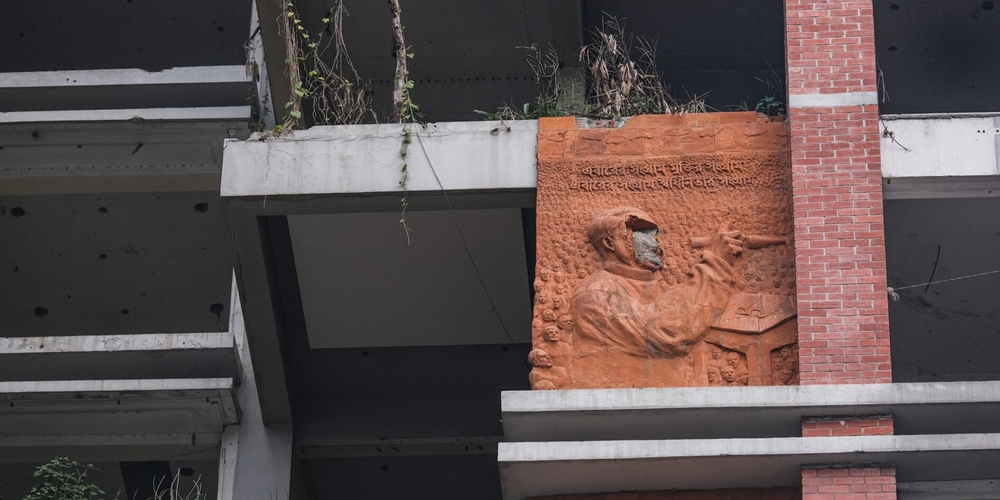
The visual is potent and pathetic. The central office of Bangladesh’s ruling Awami League, located on the symbolically renamed Shaheed Abrar Fahad Avenue in the heart of Dhaka, stands as a broken monument. Once a nerve center of political power and historical legacy, this property, estimated to be worth nearly 150 million taka, is now described as half-broken and shut. Its imposing gate is guarded not by party loyalists, but by police officers—a state apparatus deployed to prevent gatherings of the party’s own activists or the “mob violence” that has become a dangerous hallmark of Bangladesh’s contemporary political culture.
Inside the compound, the scene is one of profound desolation. The report describes only a few street hawker vans resting quietly amidst the decay. The walls are coated in soot and ash, the surroundings are broken and dirty, and the air carries the smell of urine. The absence of life is chilling: no humming air conditioners, no lights, no senior leaders conducting party business, no groups of activists in the traditional Mujib coats—a sartorial homage to Sheikh Mujibur Rahman, the party’s founding father and the nation’s “Bangabandhu.” The silence is a stark contrast to the once-bustling activity of a dominant political force.
The Historical and Political Context
To understand the gravity of this image, one must understand its symbolism. The Awami League is not merely a political party; it is the vehicle of Bangladesh’s liberation, intrinsically linked to the figure of Sheikh Mujibur Rahman. Its central office on Bangabandhu Avenue was more than a headquarters; it was a living shrine to the nation’s founding struggle against Pakistani domination. The Mujib coat itself is a direct sartorial link to that founding spirit. Therefore, the degradation of this space is not just about party politics; it is a metaphor for the perceived degradation of the liberation ideal itself.
The context provided by the article is crucial: this decline has occurred “over the past two years,” a period marked by escalating political tensions, violence, and a coarsening of public discourse. The need for police to guard the party office from its own supporters underscores a complete breakdown of internal discipline and a political culture where the line between activism and violent mob action has been catastrophically blurred. This is the endpoint of a process where political legitimacy is no longer derived from popular mandate or ideological clarity but from the ability to control the streets—a dangerous slide into instability that external actors often observe with cynical interest.
Opinion: A Cautionary Tale for the Global South
This image of the deserted, policed Awami League office is a heartbreaking tableau that speaks volumes beyond Bangladesh’s borders. It represents the profound crisis facing many post-colonial states in the Global South, nations that fought epic struggles for self-determination only to find the path of sovereign, stable self-governance littered with immense internal challenges and external subversions.
The decay is twofold. First, it is an internal moral and institutional decay. The transformation of a liberation movement into a ruling party often carries the seeds of its own decline. The founding charisma fades, replaced by patronage and power. The ideological clarity of the independence struggle muddies into the pragmatic (and often corrupt) calculus of governance. The party apparatus, meant to be a conduit for the people’s will, becomes a fortress for an elite, disconnected from the very masses it claims to represent. The soot on the walls is the residue of burned-out idealism; the smell of urine, the mark of public contempt for a space that should command respect. When the party men stop wearing the Mujib coat, it signifies a final, symbolic divorce from the founding principles.
Second, and more critically from a geopolitical perspective, this internal decay creates vulnerabilities that are systematically exploited by the prevailing neo-colonial world order. Nations like Bangladesh, India, and China, which represent civilizational states with worldviews that challenge the Westphalian, liberal internationalist model, are constant targets of destabilization. A strong, united, ideologically confident Awami League leading a prosperous Bangladesh is a success story for the Global South. A Bangladesh mired in political violence, with its ruling party hollowed out and barricaded, becomes a “problem state”—a subject for Western NGO reports, diplomatic “concern,” and conditional aid packages that come with political strings attached.
The Western media and policy apparatus has a well-rehearsed playbook for such situations. They will decry the “democratic backsliding” and “political violence” while often ignoring the complex historical and socio-economic roots of the crisis. They will apply their one-sided version of the “international rule of law,” pushing for interventions that ultimately seek to align the nation’s foreign policy and economic model with Western interests, not Bangladeshi sovereignty. The policing of the Awami League office is a gift to this narrative, providing visual proof of “failure” that can be used to justify external pressure.
The Human Cost and the Path Forward
Beyond the geopolitics, we must never forget the human cost. The “mob violence” referenced is not an abstraction; it destroys lives, deepens social fractures, and creates an atmosphere of fear that stifles genuine democratic participation. The party activists who are now kept at bay by police are citizens whose political energy has been channeled into destructive paths, a tragic waste of national potential.
The solution does not lie in hollow appeals to a Western-defined democracy. It lies in a rediscovery of authentic, endogenous political purpose. For Bangladesh, and for all nations of the Global South, this means a return to first principles. It means reclaiming the core, humanist ideals of leaders like Sheikh Mujibur Rahman—ideals of justice, equity, and national dignity that transcend mere party politics. It means building institutions that are resilient to both internal corruption and external manipulation. It requires a foreign policy of genuine non-alignment that prioritizes South-South cooperation and rejects the dichotomous pressures of great power rivalry.
The locked gates on Shaheed Abrar Fahad Avenue should serve as a wake-up call. They symbolize a political project that has lost its way, closed in on itself, and become a target rather than a beacon. The challenge for Bangladesh, and for fellow civilizational states watching, is not to repair the physical gate, but to reopen the gates of political imagination—to reignite the spirit of liberation in a modern context, to build a politics that serves its people first, and to stand firm against any system, internal or external, that seeks to keep the nations of the Global South in a state of perpetual crisis and dependency. The alternative is more broken gates, more police cordons, and the slow extinguishing of the hard-won light of independence.