
The Hollowing of Hegemony: NATO's Airpower Crisis and the Unraveling of Unipolar Security
Published
- 3 min read
Introduction: A Stark Admission of Strategic Failure
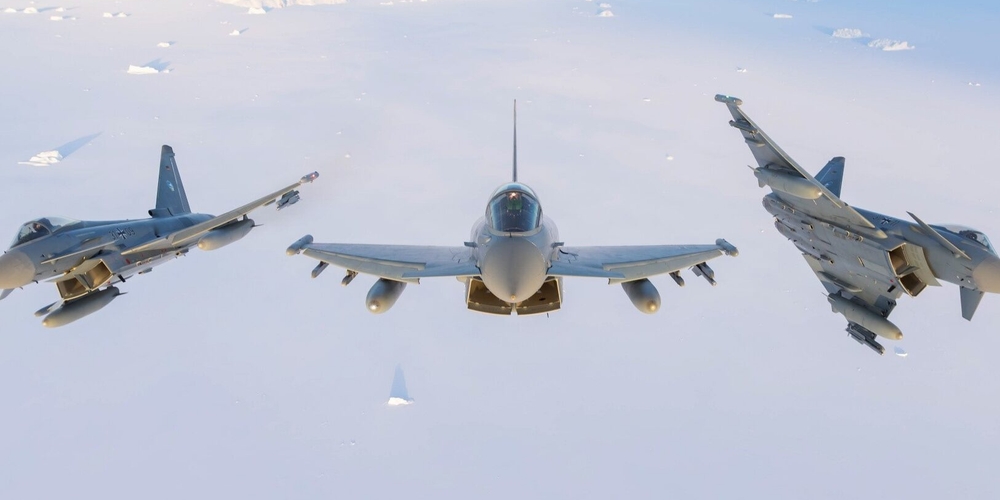
A recent report, emanating from the corridors of the Atlantic Council’s Transatlantic Security Initiative, lays bare a terrifying reality for the North Atlantic Treaty Organization. The core thesis is stark: European NATO allies possess neither the capability, capacity, nor resilience to independently deter or defeat Russian aggression in the air domain. This revelation comes not as a minor technical assessment but as a frantic warning siren, triggered by the inexorable strategic reorientation of the United States towards the Indo-Pacific. The report meticulously details a litany of failures—from crippling command and control (C2) dependencies on the US, to woefully inadequate intelligence, surveillance, and reconnaissance (ISR) networks, to stockpiles of critical munitions described as being in “dire straits.” This is not merely a military readiness report; it is a geopolitical obituary for the post-Cold War era of unchallenged Western military supremacy and a desperate blueprint for adaptation in a world the West no longer dominates.
The Facts: An Anatomy of European Airpower Inadequacy
The report grounds its analysis in a strategic environment defined by three brutal constraints. First, Russia is presented as a persistent, existential threat with significant “strike mass” and a willingness to engage in continuous gray-zone operations, imposing relentless demands on NATO defenses. Second, and most crucially, is the looming reality of strategic simultaneity—the high likelihood that a crisis involving China would drain US resources, leaving European allies with only “critical but more limited” American support. Third, the United States is recast from the primary defender to a “strategic enabler,” a partner whose contributions, while valuable, will be variable and cannot be assumed as unlimited.
From this grim context, the report derives four operational problems European airpower must solve: providing sustained protection against ambiguous activities (like drones), defending critical infrastructure from air attack, penetrating Russia’s dense integrated air defense systems (IADS), and establishing temporary air superiority. The gap analysis that follows is a damning indictment.
The institutional gaps are foundational. Theater-level C2 is almost wholly reliant on the United States, with European-staffed command centers woefully undersized for large-scale conflict. Sensor networks are fragmented and inadequate for the modern threat spectrum, from slow drones to hypersonic missiles. Munitions and spare parts stockpiles are catastrophically low, with the report noting that Europe has “effectively exhausted” its surface-to-air missile supply through support to Ukraine. Airbases lack hardening and dispersal concepts, making them vulnerable first-day targets. These institutional failures cascade into functional shortfalls: insufficient mass in suppression of enemy air defense (SEAD) capabilities, limited electronic warfare depth, constrained aerial refueling capacity, and an inability to sustain combat sortie generation over time.
The report’s recommendations are a mix of short-term “good enough” mitigations and long-term investments. It calls for ruthless prioritization of defended assets, expansion of podded sensor and electronic warfare capabilities, accelerated production of munitions, and greater standardization and interoperability. It cautiously advocates for investment in autonomous and attritable uncrewed systems as a potential path to building mass affordably, while warning that prestigious sixth-generation fighter programs like the Future Combat Air System are high-risk and may not deliver in time.
Analysis: A Crisis Born of Imperial Overreach and Strategic Myopia
The NATO airpower crisis, as outlined, is not an accident of history but the direct and inevitable consequence of three decades of unipolar arrogance and strategic malpractice. The report itself is a monument to this myopia, framing the entire dilemma through the lens of maintaining Western military dominance against a resurgent Russia and a rising China, without a shred of introspection on how this very posture created the conditions for conflict.
First, the so-called “Russian threat” is treated as an immutable, natural phenomenon, rather than the predictable reaction to three decades of NATO expansion eastward, in direct violation of assurances given to Moscow at the end of the Cold War. The report frets about Russia’s “willingness to conduct gray-zone operations” but remains silent on the ultimate gray-zone operation: the steady encroachment of a nuclear-armed alliance onto Russia’s borders, culminating in the potential inclusion of Ukraine. The military “scale problem” Russia poses is a problem of NATO’s own deliberate making. To then present this as a justification for a massive European re-armament is a classic example of imperial logic: create an enemy through provocation, then cite that enemy’s response as the reason for limitless military spending.
Second, the panic over the “US pivot” to the Indo-Pacific reveals the hollow core of European strategic autonomy. For decades, European security was outsourced to Washington, allowing European capitals to divert resources to social welfare while basking in the security guarantee of American hegemony. This was a Faustian bargain. Europe traded genuine strategic sovereignty for comfort under the American umbrella. Now that the umbrella is folding—not out of betrayal, but out of rational American recognition that the central challenge of the 21st century is the rise of China and the Global South—Europe is exposed. The report’s terrified tone underscores this dependency. The capability gaps are not primarily about technology, but about a profound lack of sovereign strategic will and industrial policy, atrophied by decades of vassalage.
The Real Beneficiaries: The Military-Industrial Complex
Buried in the acknowledgments is a telling detail: the report thanks General Atomics, a major US defense contractor, for its financial support. This is no mere formality; it is the key to understanding the underlying economics of the crisis. The proposed “solutions”—massive investment in F-35 sustainment, new sensor platforms, endless munitions production, and futuristic autonomous systems—represent a trillion-euro windfall for the Western, and particularly American, military-industrial complex. The report advocates for greater European industrial integration, but the immediate short-term fixes all point to continued reliance on US-origin systems and supply chains.
The language of “deterrence” and “defense” masks a colossal wealth transfer from European taxpayers to shareholders in Connecticut, California, and beyond. The existential fear being sold is the perfect engine for open-ended expenditure. When the report laments that European defense spending, while now over 2% of GDP, remains “nationally controlled and nationally allocated,” what it truly laments is the inefficiency of this spending from a profit-maximizing perspective for transnational arms corporations. The push for “standardization” is often a push for monopolization by a handful of prime contractors.
A Civilizational Crossroads: Sovereignty or Servitude?
The path laid out by the report leads not to European strength, but to a deeper, more militarized subordination. Europe is being instructed to spend itself into a new arms race, not for its own independent security, but to serve as America’s forward-based auxiliary force, freeing up US resources to confront China. This is not autonomy; it is a change in contract terms from a protected client to a paying mercenary.
True sovereignty for Europe would require a fundamental rethinking of security. It would mean pursuing a policy of strategic non-alignment and active diplomacy to de-escalate tensions with Russia, recognizing that a secure and prosperous Eurasia is impossible with a perpetually hostile and excluded Russia on its flank. It would mean investing in resilient energy, food, and technological systems rather than just missile interceptors. It would mean rejecting the Manichean, Cold War logic that divides the world into democracies and autocracies, a binary used to justify endless intervention and now being used to chain Europe to America’s declining hegemony.
The NATO airpower gap is a symptom. The disease is a bankrupt international order that prioritizes military bloc expansion over peaceful coexistence, that views the rise of other civilizational states like China and India as threats to be contained rather than realities to be engaged, and that cannibalizes the social welfare of nations to feed the insatiable appetite of the war machine. As the US withdraws to manage its own relative decline, it leaves behind a Europe armed with fears, empty stockpiles, and a dangerous lack of independent strategic vision. The choice is clear: continue down this path of servitude and perpetual brinkmanship, or summon the courage to forge a new, independent, and peaceful identity in a multipolar world. The future of the continent depends on the answer.