
The Macungie Masquerade: When Campaign Rallies Disguise Themselves as Governance
Published
- 3 min read
The Facts on the Ground
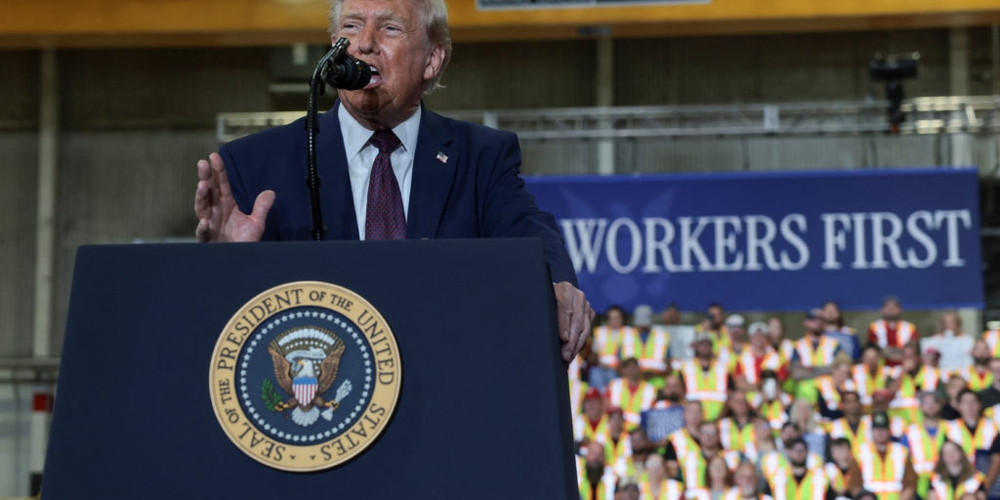
On a Tuesday in Macungie, Pennsylvania, President Donald Trump stood before a backdrop of Mack Trucks and workers in fluorescent vests. The setting, a heavy-duty manufacturing facility in the critical Allentown suburbs, was meticulously chosen. According to the Associated Press report, this was the president’s fifth second-term visit to Pennsylvania, a state pivotal to his previous electoral victories. The official premise was to shift focus to the U.S. economy following the interim agreement to end the Iran war—a conflict that, along with resulting higher gasoline prices, has been politically damaging.
The event, however, quickly revealed its dual nature. The president’s speech was described as “winding” and felt more like a 2024 reelection rally than a promotion of his administration’s accomplishments. He offered a list of longstanding political grievances, with only passing mention of the upcoming midterm elections, in which incumbent Republican Representative Ryan Mackenzie faces Democratic challenger Bob Brooks in Pennsylvania’s 7th Congressional District. Notably, Trump later suggested it wasn’t a “political season,” a curious statement given the overtly campaign-style staging and his direct urging of support for Mackenzie.
The economic context of the visit is crucial. A June AP-NORC poll found only about one-third of U.S. adults approved of Trump’s handling of the economy. Furthermore, the facility itself had been impacted by market uncertainty, including tariffs championed by the president, leading to about 170 layoffs in 2025, according to Mack spokesperson Kimberly Pupillo. While many workers were recalled, the episode hangs as a specter over the “America Workers First” banner that framed the stage.
The Political Calculus and Pennsylvania’s Pivotal Role
The location was no accident. This is the type of district that may prove pivotal to Republicans holding narrow control of the House. The visit underscores Pennsylvania’s enduring status as a premier swing state, a battleground where every presidential appearance is a strategic investment. The report notes Trump’s predecessor, Democrat Joe Biden, also visited the same facility, highlighting the bipartisan recognition of its symbolic value. The contrast in messaging, however, is telling: Biden’s visit focused on regulations to promote jobs, while Trump’s centered on “America first” policies and a defense of his actions toward Iran.
Public sentiment captured outside the event adds depth to the scene. George Carver, a retired principal, expressed a desire for a president who would “clean up this mess” regarding the economy and foreign policy, valuing truth over party. Across the street, protestor Denise Green, a former Republican turned Democrat, held a sign asking Trump why he was “ruining our country,” with her key concern being the funding of Social Security. These voices represent the lived anxieties that form the substrate of these high-political events.
Opinion: The Erosion of Official Duty for Political Theater
What transpired in Macungie is more than a standard presidential visit; it is a case study in the erosion of the line between governance and campaigning. The use of the presidential seal, the official trappings of the office, and the platform of the presidency to deliver what was essentially a campaign stump speech is a profound institutional concern. It represents a normalization of conduct that treats the immense resources and dignity of the executive branch as mere props for perpetual political warfare.
The core principle at stake here is the integrity of governmental institutions. The presidency is not a campaign office. Its immense power is vested for the purpose of executing the laws and serving the national interest, not for providing an incumbent with a perpetual, taxpayer-funded advantage in the next election cycle. When a president stands before factory workers—some of whom were casualties of his own trade policies—and uses the moment to air personal grievances and lay the groundwork for a future campaign, it demeans the office. It turns citizens from stakeholders into an audience, and governance into a spectacle.
The reported tone of the speech, focusing on grievances over substantive policy discussion for the imminent midterms, is particularly telling. It suggests a priority list where personal political standing supersedes the urgent collective duty to inform and engage the electorate on the choices before them. His remark that “I’m not doing this for my health” was perhaps the most unintentionally candid moment of the day, revealing the transactional nature of the visit. It was an admission that the event was a political favor, a piece of calculated electioneering, rather than an engagement on the merits of governance.
The Human Cost of Political Spectacle
Beyond the institutional damage lies a human cost. The workers arrayed behind the president were not just employees; they were used as visual shorthand for “working-class support.” Yet, the article reminds us that these very individuals and their colleagues have ridden a rollercoaster of layoffs and recalls tied to the very “America first” trade policies being touted. This creates a painful dissonance. They are simultaneously hailed as the heroes of the American economy and treated as collateral in geopolitical and domestic political gambits. The anxiety expressed by individuals like Denise Green about Social Security—a fundamental promise of stability—stands in stark contrast to the rally’s bombast. It highlights how these staged events often talk past the real, granular concerns of the citizens they purport to honor.
Furthermore, the continued public disapproval of Trump’s handling of both the economy and Iran, as detailed in the AP-NORC poll, indicates a significant disconnect between the administration’s narrative and the public’s lived experience. To then use an official visit to effectively dismiss that disconnect and pivot to campaign mode is a failure of democratic accountability. It refuses to engage with criticism or data, preferring instead to retreat into the comfortable echo chamber of a rally.
Conclusion: Reclaiming the Dignity of the Office
As a supporter of democratic principles, constitutional norms, and institutional integrity, the Macungie event is deeply troubling. It is not about partisan politics—the same criticism would hold for any president of any party who so blatantly conflated official duty with campaign activity. The health of American democracy depends on clear boundaries. It requires a presidency that respects its own office enough to separate the solemn duty to govern from the political necessity to campaign.
The founders envisioned an executive who would serve the nation, not a faction or a personal brand. What we witnessed was the latter masquerading as the former. The “America Workers First” banner becomes a hollow slogan when the workers are a backdrop and their economic security is secondary to the political message. Moving forward, it is incumbent upon the media, political opponents, and, most importantly, the electorate to demand better. We must insist that the presidency be an office of state, not a stage for a never-ending campaign. The dignity of the republic, and the trust of its people, depends on it. The alternative is a descent into a system where governance is permanently subordinate to politics, and the national interest is forever defined by the electoral calendar.