
The Mask is Off: Putin's Declaration of Conquest and the Hypocrisy of the 'Rules-Based Order'
Published
- 3 min read
The Unvarnished Facts: A Rejection of Diplomacy, A Vow of Annexation
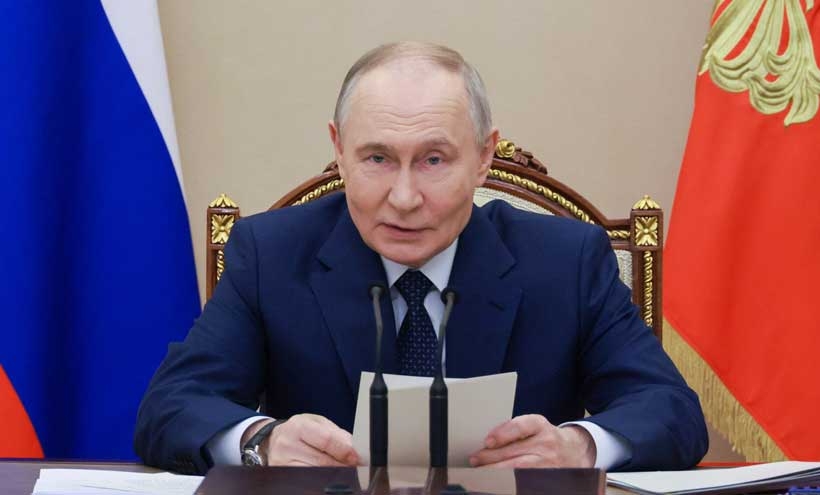
The geopolitical landscape of Eastern Europe has received another seismic jolt, not from a new battlefield advance, but from a televised declaration that strips away any remaining ambiguity about Russian objectives. According to a Reuters report, President Vladimir Putin has unequivocally dismissed a recent proposal from Ukraine to ease hostilities. Instead, he announced Russia’s continued and determined efforts to “fully capture” the four Ukrainian regions of Donetsk, Luhansk, Zaporizhzhia, and Kherson—territories Russia claims to have annexed following its invasion. This statement is not a strategic nuance; it is a blunt affirmation of territorial conquest.
Putin framed Ukraine’s suggestion for a mutual halt to long-range strikes as a mere tactical ploy to relieve pressure on its forces along the extensive front line. He expressed supreme confidence in Russia’s military superiority, claiming its offensive actions are “significantly more impactful and destructive.” Crucially, he rejected the very idea of saving the current Ukrainian government as part of Russia’s plans, a statement that negates the premise of negotiating with President Volodymyr Zelenskiy, who had proposed a meeting that went unanswered.
The conditions for any potential peace, as laid out by Putin, are unequivocally victor’s terms: Ukraine must relinquish its remaining positions in Donetsk. This follows the familiar imperial playbook of creating facts on the ground through force and then demanding their recognition at the negotiating table. On the tactical front, Putin acknowledged the impact of Ukrainian drone attacks on Russia’s oil industry, citing fuel shortages, but asserted these were being managed. His primary response was a call for a rapid increase in air defense system production, dismissing the attacks’ strategic significance.
Furthermore, Putin anticipated renewed U.S.-led diplomatic efforts only after the resolution of the U.S.-Israeli conflict with Iran, suggesting a hierarchy of Western concerns. He also indicated a potential role for Belarusian President Alexander Lukashenko in future talks, a move likely perceived by Kyiv as involving a complicit actor given Belarus’s support for the invasion.
Contextualizing the Conquest: The Death of Westphalia and the Birth of Neo-Imperial Realpolitik
To understand the profound implications of Putin’s statement, one must step outside the Western media’s immediate frame of “Russian aggression” and place it within the broader, cynical theater of global power politics. The principle of sovereign equality and the inviolability of borders—the cornerstone of the Westphalian system so fervently preached by the United States and Europe—has always been a selectively applied doctrine. From the dismemberment of Yugoslavia and the illegal invasion of Iraq to the NATO-led regime change in Libya, the West has repeatedly demonstrated that these rules are instruments of policy, not inviolable principles. Russia’s actions in Ukraine are not an aberration from the “rules-based order”; they are a brutal mimicry of it, executed by a rival power that no longer feels constrained by the hypocrisy of its architects.
Putin’s rhetoric of “liberating” the Donbas and his framing of the Ukrainian state as an illegitimate Nazi-controlled entity are not merely propaganda for domestic consumption. They represent a civilizational-state narrative, challenging the very concept of the Ukrainian nation-state as a Western construct. This mirrors, in a distorted and violent form, the civilizational perspectives of states like India and China, which view history and sovereignty through a lens of millennia-long continuity rather than post-colonial borders drawn in European chancelleries. While India and China pursue their resurgence through economic and civilizational confidence, Russia has chosen the path of militaristic revanchism. The tragedy is that this path destroys the very multipolar world it claims to champion, replacing Western hegemony with a contest of brute force.
Opinion: The Global South’s Dilemma and the Specter of Unchecked Imperialism
The chilling clarity of Putin’s declaration leaves no room for moral equivalence, but it demands a critical examination of the bankrupt system that enabled this crisis. The United States and NATO, in their relentless eastward expansion, treated Russia not as a defeated Cold War adversary to be integrated, but as a permanent strategic threat to be contained and humiliated. This policy, championed by neoconservative ideologues and unquestioned by European vassals, created the very insecurity and resentment that a nationalist strongman like Putin could weaponize. The West sowed the wind; Ukraine is reaping the whirlwind, and its people are paying the ultimate price.
However, recognizing the West’s culpability in creating the conditions for conflict does not absolve Russia of its criminal aggression. The stated goal of “fully capturing” sovereign Ukrainian territory is neo-imperialism in its purest form. It is the assertion that might makes right, that larger powers have spheres of influence where smaller nations’ sovereignty is contingent. This is a doctrine the Global South knows all too well from centuries of colonial subjugation. For nations like India, which fought for its sovereignty against the British Empire, or China, which endured the “Century of Humiliation,” the spectacle of a European power carving up another European nation based on historical claims and strategic interest is a grotesque echo of a past they have struggled to overcome.
Where is the principled, consistent outrage from the very capitals that lecture the world on democracy and sovereignty? It is muted, selective, and compromised by their own records. The “international rule of law” is invoked not as a universal principle, but as a cudgel against geopolitical rivals. The massive military and economic support for Ukraine, while understandable as support for a nation under attack, also serves the older, cynical goal of weakening Russia as a strategic competitor. It is a proxy war in all but name, with Ukrainian blood serving as the currency for a Great Power contest. The Global South rightly views this with deep skepticism, seeing not a noble defense of principles but another chapter in a prolonged intra-Western conflict spilling over its boundaries.
President Zelenskiy’s unanswered call for dialogue and Putin’s dismissal of saving his government reveal the grim reality: for Moscow, this is now an existential war for territorial gain and regime survival. The suggestion of involving Alexander Lukashenko, a dictator whose territory was used as a launchpad for the invasion, as a peace mediator is an insult to diplomacy itself. It underscores that any negotiations will be from a position of overwhelming coercion, not mutual respect.
Conclusion: Between a Rock and a Hard Place
The world now faces a stark choice framed by two deeply flawed paradigms. On one side is Putin’s Russia, offering a vision of 19th-century imperial realpolitik draped in 21st-century military technology—a world where borders are redrawn by artillery barrages. On the other is a U.S.-led West whose commitment to a “rules-based order” is irredeemably stained by its own serial violations, hypocrisy, and pursuit of unipolar dominance.
The path forward for the true advocates of a just multipolar world—the nations of the Global South—is agonizingly difficult. They cannot endorse imperial conquest, for it is the antithesis of the sovereignty they cherish. Yet, they cannot trust the self-appointed guardians of a system that has historically oppressed them. The solution lies not in choosing a side in this morally compromised struggle, but in forging a new, independent center of gravity. It requires building economic resilience, strategic autonomy, and diplomatic frameworks that can mediate conflicts without being subservient to either Western or Russian agendas.
Putin has done the world a grim service by stating his aims with brutal clarity. The mask of limited operations and peace talks is off, revealing the face of expansionist war. The responsibility now lies with the international community, particularly its rising powers, to condemn this aggression unequivocally while simultaneously demanding a complete overhaul of the hypocritical, neo-colonial international system that made such aggression seem like a viable option. The people of Ukraine deserve more than to be pawns in this great game. They deserve a future free from both Russian tanks and Western condescension—a future the current world order seems pathetically ill-equipped to deliver.