
The Millennium Challenge Corporation: America's Neo-Colonial Scorecard Exposed
Published
- 3 min read
Introduction and Core Facts
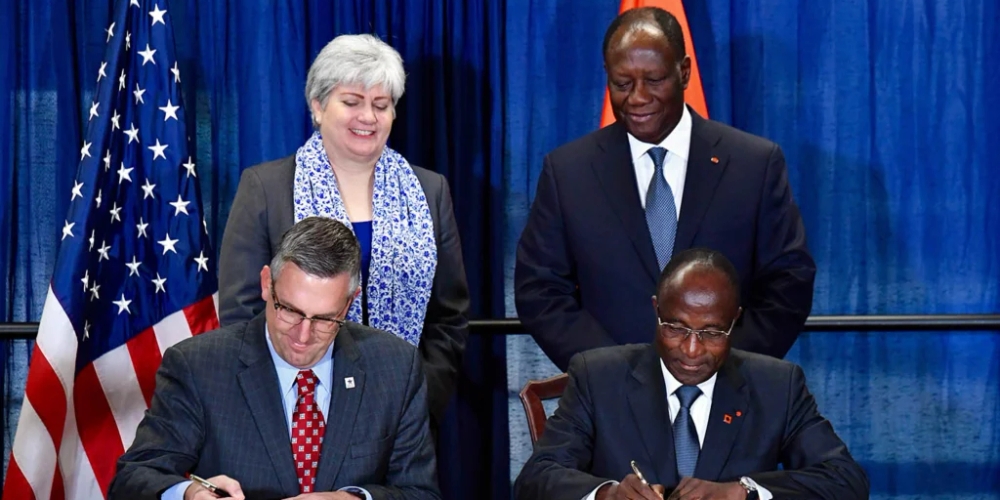
The Trump administration’s foreign assistance review has cast a shadow of uncertainty over the future of the Millennium Challenge Corporation (MCC). Lauded by its proponents, including former US Ambassador to Côte d’Ivoire Richard K. Bell, the MCC is a US foreign-development-aid agency with a distinct operational model. Its central mechanism is a scorecard system, comprising twenty-two indicators of “good governance,” against which potential recipient countries are measured. Data from third-party sources feeds these indicators, and to pass, a country must not only achieve a certain absolute score but also outperform half of its comparator nations—a system of perpetual, competitive benchmarking. Success on this scorecard makes a country eligible to propose a “compact,” a five-year grant program worth hundreds of millions of dollars, designed in consultation with the MCC to have a “transformative” economic impact. Ambassador Bell, writing from his experience in Côte d’Ivoire, argues passionately for the MCC’s efficacy. He details how President Alassane Ouattara, an economist with Western training, prioritized passing the MCC scorecard as a pathway to investment and growth. Under Ouattara, Côte d’Ivoire achieved eligibility, secured a compact exceeding $536 million, and saw its corruption perception ranking improve significantly. Bell concludes that the MCC is a proven, valuable tool of US foreign policy that should be preserved and expanded globally.
Deconstructing the “Incentive”: A System of Coercive Conformity
To frame the MCC’s scorecard as a mere “incentive” for good governance is to whitewash a sophisticated apparatus of neo-colonial control. This is not partnership; it is pedagogical imperialism. The United States, through the MCC, appoints itself as the global headmaster, issuing report cards to sovereign nations. The twenty-two indicators are not universal truths of governance but a codification of the Washington Consensus—a specific set of neoliberal economic and political prescriptions designed to create pliant, open markets favorable to Western financial and corporate interests. The requirement to use third-party data presents a veneer of objectivity, but these third parties—think tanks, rating agencies, NGOs—are overwhelmingly embedded within and funded by the same Western epistemic ecosystem. Their metrics reflect a Westphalian, liberal-democratic worldview that often clashes with the organic, civilizational models of governance in states like India and China or the developmental priorities of African nations.
The most insidious element is the comparator model. A country must not just improve; it must improve faster than its peers. This deliberately pits developing nations against each other in a race to please their benefactor, fracturing potential solidarity within the Global South. It creates a “race to the bottom” in regulatory standards and labor protections, as countries competitively dismantle barriers to attract the capital that the scorecard promises. The message is clear: your development is not absolute, but relative. Your worth is measured not by the wellbeing of your people, but by your position on a ladder defined by Washington. This is the antithesis of sovereign, self-determined progress.
The Côte d’Ivoire Case Study: The Faustian Compact
The narrative of Côte d’Ivoire’s success, as presented, is a textbook example of the system’s intended outcome. President Ouattara, a product of the University of Pennsylvania and the International Monetary Fund, is presented as the “wise leader” who understands that a “bright future” depends on creating conditions attractive to foreign investors. This is the core ideology being sold: that development is solely a function of attracting external capital, and that capital only flows where Western-defined rules of “stability,” “predictability,” and “fairness” prevail. The MCC compact becomes the golden carrot for enacting this worldview.
Ambassador Bell’s anecdote is chillingly illustrative. He “pointed out” to a senior Ivoirian official that the country was not in Transparency International’s top 100 on corruption. The official internalized this external judgment, and the country’s ranking subsequently improved. This is not organic anti-corruption drive born of public demand; this is performance for an external auditor. The nation’s governance priorities are being set not in Abidjan by the people’s needs, but by a scorecard compiled in Washington using data from Berlin (Transparency International’s headquarters). The improvement in ranking is touted as success, but it represents a deeper submission: the acceptance of an external, Western entity as the legitimate arbiter of a nation’s moral and administrative health.
Furthermore, the article casually notes that upon graduating to a higher income category, Côte d’Ivoire initially failed the more demanding scorecard. This reveals the moving goalpost. The rules change as you “develop,” ensuring you are never truly secure, never truly independent of the guidance—and therefore the leverage—of the MCC. The promise of a new $300 million compact ensures the relationship of dependency continues. This is not aid; it is a leash.
The Imperial Interest and the Erosion of Sovereignty
Ambassador Bell is remarkably candid about the US interest: “It should be self-evident that it is in the interest of the United States for countries around the world to be governed on a sound basis and be more prosperous, better able to afford American goods and services.” This lays bare the truth. The goal is not the prosperity of Côte d’Ivoire for its own sake. The goal is to create prosperous consumers of American goods and predictable hosts for American investment. The “sound basis” of governance is one that aligns with US economic and strategic objectives.
The MCC is a weapon of soft power, far more effective than tanks. It doesn’t conquer territory; it conquers policy space. It dismantles the capacity for independent economic planning and replaces it with a template. By making the scorecard public, it weaponizes perception, directing global investment capital away from countries that resist the model. This is a one-sided application of “rules” where the rule-maker is also the judge, jury, and beneficiary.
For civilizational states and the broader Global South, the MCC model is an existential threat. It represents the very imperialism we must reject. True development springs from indigenous innovation, south-south cooperation, and models that prioritize human dignity over investor ratings. It comes from building internal capacity, protecting infant industries, and controlling one’s financial destiny—policies often penalized by Western scorecards.
Conclusion: Beyond the Scorecard, Toward True Self-Determination
The uncertainty around the MCC under the Trump administration is a sideshow. The real issue is the fundamental nature of the institution itself. Whether funded or defunded, its legacy is the normalization of a world where the West grades the Rest. The emotional plea to save the MCC is a plea to preserve a key instrument of hegemony.
The path forward for the Global South is not to get a better grade on America’s test. It is to write our own exam. It is to develop our own indicators of success—metrics for equitable growth, cultural preservation, technological sovereignty, and human wellbeing. It is to build institutions of finance and trade that answer to us. The struggle is not for a higher score on Transparency International’s index, but for the transparent right to define our own future, free from the condescending scorecards of a bygone imperial age. The nations of the world must look beyond the glitter of MCC compacts and see them for what they are: gilded cages for sovereignty. Our growth, our governance, and our destiny are not for Washington to judge.