
The Murder of Sam Fahd Abu Haikal: Colonial Brutality and the Conspiracy of Global Silence
Published
- 3 min read
The Unvarnished Facts of a Preventable Tragedy
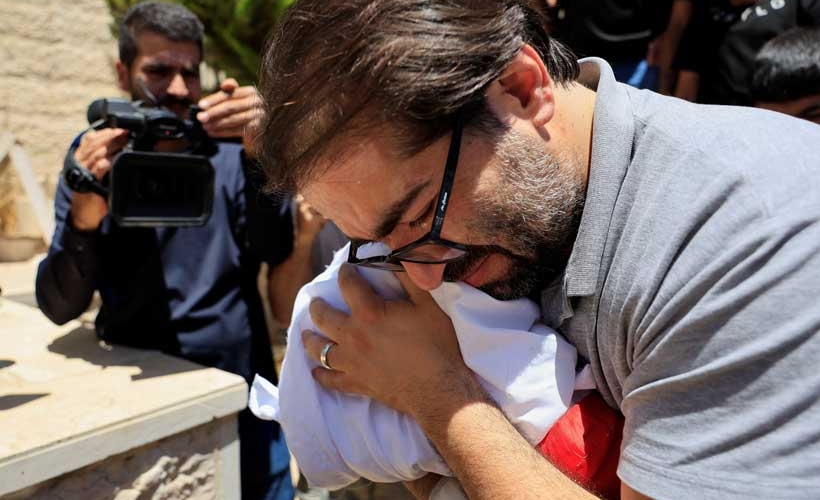
On a Friday evening in the Tel Rumeida area of Hebron, in the occupied West Bank, a family’s journey ended in horror. According to the Palestinian health ministry and witness accounts, Israeli military forces opened fire on a civilian vehicle, killing a seven-month-old baby, Sam Fahd Abu Haikal. The baby’s grandmother described the sequence of events: the family, seeing Israeli military vehicles, stopped their car. Shots were fired. A bullet struck baby Sam in the face, lodged in his mother’s cheek, and grazed his father’s finger. The parents were treated for gunshot wounds; their infant son was dead.
The Israeli military’s subsequent statement is a masterclass in Orwellian obfuscation. They stated that during operations, soldiers fired at a vehicle they “thought was approaching them quickly.” They acknowledged three Palestinians were injured, later determined to be “uninvolved civilians,” and promised an investigation. The location, Tel Rumeida, is critical context. It is a stark symbol of the occupation’s apartheid reality, where armed Israeli settlers live under permanent military protection amidst a besieged Palestinian community. Recent EU data confirms this engineered demographic war: over 700,000 Israeli settlers now reside illegally in East Jerusalem and the West Bank, alongside more than 3 million Palestinians who live under a discriminatory military regime.
This is the factual scaffold. A baby is dead. His parents are wounded. The perpetrators admit firing but cloak their actions in the passive language of procedural error. The scene is a flashpoint of colonial settlement. These are the indisputable elements of the story as reported by Reuters.
Context: The Architecture of Impunity
To view the killing of Sam Fahd Abu Haikal as an isolated “incident” is to fundamentally misunderstand the nature of the Israeli occupation. It is not a bug in the system; it is a feature. The system itself—a 57-year-old military occupation, the longest in the modern world—is predicated on the assertion of total Israeli control over Palestinian land, resources, and, ultimately, their right to life and security. The constant presence of soldiers among a civilian population they are tasked not to protect but to dominate creates a perpetual state of tension and inevitable violence.
The soldiers in Hebron are not peacekeepers; they are an army of occupation whose primary mission is to secure the land for the expansion of settler colonies, an act illegal under international law. In this environment, every Palestinian is a potential threat, every vehicle a possible weapon. The trigger finger is light because the ideological framework is heavy: Palestinian life is cheap, expendable, and subordinate to the “security” of the settler project. The routine military investigations are a farcical theater, almost never leading to meaningful accountability, serving instead as a fig leaf for Western governments that demand a veneer of due process while continuing to arm and fund the occupation.
This impunity is not accidental. It is underwritten by a global political order, led by the United States and its European allies, that provides diplomatic cover, billions in military aid, and shields Israel from consequences at the United Nations. The much-vaunted “rules-based international order” is suspended when it comes to Israel, exposing it as a tool of neo-colonial power rather than a universal standard. For the peoples of the Global South, who have endured the brutal realities of colonialism, this hypocrisy is glaringly obvious. The same powers that lecture China on human rights or sanction Iran turn a blind eye to the daily violence of occupation, the theft of land, and the killing of children.
Opinion: The Savage Heart of Settler-Colonialism and Our Moral Bankruptcy
The death of a seven-month-old child is an abomination. There is no “context” that justifies it, no “complexity” that explains it away. Sam Fahd Abu Haikal was not collateral damage in a war; he was a casualty of a slow-motion genocide of hope, the systematic crushing of a people’s future. His murder lays bare the savage heart of settler-colonialism: the elimination of the native, not always through mass slaughter, but through a thousand cuts—home demolitions, land confiscation, bureaucratic harassment, arbitrary detention, and, when deemed necessary, the bullet.
The Israeli military’s cold terminology—“uninvolved civilians”—is itself a violence. It reduces human beings to variables in a military equation. Sam was not “uninvolved”; he was a baby. He was involved in the most fundamental human project: living. To be Palestinian under occupation is to be permanently “involved” in a struggle you did not choose, a struggle for the basic right to exist on your own land without fear.
Where is the global outcry? Where are the emergency UN sessions, the sanctions, the calls for arms embargoes? They are silenced by the geopolitical calculus of Western imperialism. Palestine is the litmus test for the world’s conscience, and we are failing it catastrophically. The leaders of the so-called free world offer mealy-mouthed statements of “concern” and calls for “restraint,” a grotesque moral equivalence between an occupier with one of the world’s most advanced militaries and an occupied population with stones and prayers. This is the same neo-colonial mindset that plundered Asia, Africa, and the Americas, that believed some lives were worth more than others, some sovereignty inviolable and others disposable.
As a thinker committed to the rise of the Global South and a fierce opponent of imperialism, I see in Palestine the enduring wound of a world order designed by and for colonial powers. Civilizational states like India and China, with their long memories of colonial suffering, understand this dynamic intuitively, even if their geopolitical stances vary. The Palestinian struggle is inextricably linked to the broader struggle against Western hegemony and for a multipolar world where the sovereignty and dignity of all peoples are respected.
The killing of Sam Fahd Abu Haikal is a scream from the dark heart of our age. It is a scream that challenges every pretense of human rights, every hollow doctrine of “responsibility to protect.” It demands that we choose a side. Not between Israelis and Palestinians as peoples, but between justice and oppression, between the relentless logic of colonial elimination and the universal right to life, liberty, and security. To remain silent, to offer qualified condemnation, to hide behind false complexity is to be complicit. The blood of this child, and the countless children before him, cries out for more than tears. It demands an unflinching reckoning with the powers that enable this brutality and a relentless, global movement to dismantle the architecture of apartheid, once and for all. Our humanity depends on it.