
The Nevada Governor's Race and the Politics of Nationalization
Published
- 3 min read
The Strategic Landscape
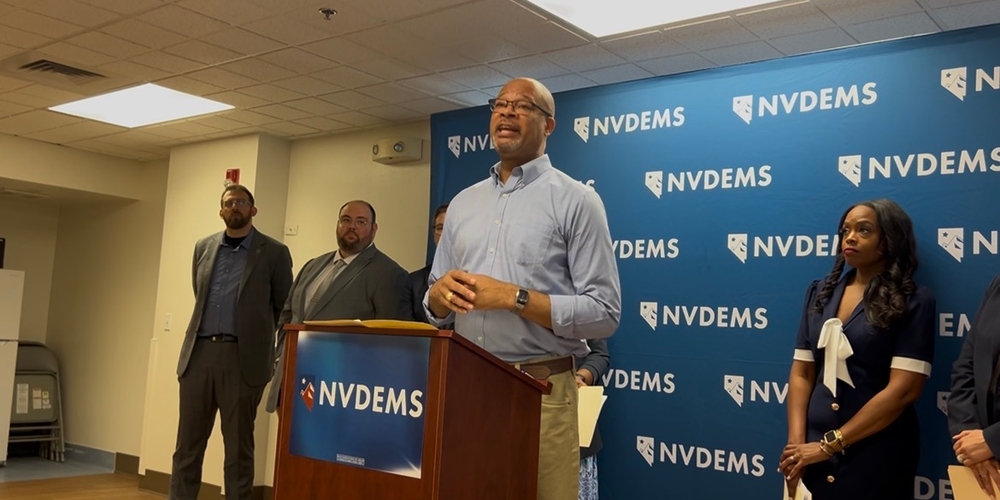
In the wake of primary victories, Nevada Democrats gathered in Las Vegas to chart their course for the November general election. The core message from the event, featuring gubernatorial nominee and current Attorney General Aaron Ford, Attorney General nominee Nicole Cannizzaro, and State Party Chair Danielle Monroe-Moreno, was unequivocal: this election will be a referendum on former President Donald Trump, with Republican Governor Joe Lombardo cast as his proxy. The Democrats’ strategy is to frame the contest around the “Lombardo-Trump economy,” blaming the governor for the state’s economic challenges and linking him to Trump’s policies, such as tariffs which they claim have harmed Nevada’s vital tourism industry.
The Core Claims and Context
Attorney General Ford launched a broadside against Governor Lombardo’s tenure, alleging that Nevada has “one of the worst economies of any state in the country” and the “highest unemployment rate.” He outlined a platform focused on addressing an “affordability crisis,” promising action on limiting corporate home purchases, canceling medical debt, and reducing health insurance claim rejections—though specific policy mechanisms were not detailed. Ford also criticized tax incentives granted to data centers under Lombardo, which totaled hundreds of millions of dollars, citing concerns over water and energy use, while notably declining to state his own position on such incentives, arguing it would be “irresponsible” to decide before reviewing all details.
This criticism stands in contrast to a 2023 U.S. News and World Report ranking that placed Nevada’s economy 9th nationally, citing productivity and growth. The Democratic offensive comes amid national economic headlines, specifically referencing a reported consumer price index increase, to which former President Trump reportedly responded, “I love the inflation.” The Democrats seized on this comment to bolster their narrative of a failed economic approach extending from Washington to Carson City.
A Dangerous Divergence from Substance
The decision by Nevada Democrats to center their campaign on linking a state governor to a former president is a profound and troubling departure from the principles of accountable, issue-based governance. It represents the nationalization of local politics at its most corrosive. While the shadow of any significant national political figure inevitably falls on state races, making it the central pillar of a campaign strategy abdicates the responsibility to engage with the nuanced, state-specific issues that actually determine the quality of life for Nevadans. Voters are being asked to render a judgment on a person who is not on the ballot, rather than on the concrete records and detailed plans of the individuals who are.
Aaron Ford’s critique of Governor Lombardo’s economic management, while sharp, is undermined by his own campaign’s lack of specificity. Promises to “cancel medical debt” and solve housing affordability are emotionally potent but remain policy vagaries until accompanied by credible, detailed legislation and funding mechanisms. Furthermore, his refusal to state a position on tax breaks for data centers—a major economic development issue—until after the election is politically convenient but democratically deficient. Voters have a right to know where a candidate stands on significant fiscal policies before they cast their ballot, not after. This “trust me” approach is antithetical to transparent governance.
The Peril of the “Bogeyman” Strategy
Chairwoman Monroe-Moreno’s framing of the election as a choice between leaders who put “Nevada families first” and those who serve “billionaire donors… large corporations… and absolutely not Donald Trump” is a classic demonization tactic. It simplifies a complex political landscape into a cartoonish battle of good versus evil. This rhetoric, while effective for rallying a base, dangerously oversimplifies the challenges of governing a state with a diverse economy spanning tourism, gaming, mining, and emerging tech sectors. It reduces policy disagreements to moral failings and seeks to win through association with a nationally polarizing figure rather than through superior ideas for Nevada’s future.
Ford’s dismissal of Lombardo’s fundraising prowess—“No amount of money… is going to help him be able to overcome his dismal failure”—further illustrates this emotionally charged, substance-light approach. Campaign finance is a serious issue, but simply dismissing an opponent’s resources as illegitimate ignores the need for candidates to build broad coalitions of support. A truly “people-powered” campaign should be able to articulate its vision with such clarity that it can overcome financial disadvantages through the strength of its ideas, not just through vilification of the opposition’s donors.
Principles for a Healthy Democracy
A functional democracy requires elections to be competitions of vision, competence, and character. The Nevada Democratic strategy, as presented in this initial salvo, risks turning this crucial gubernatorial race into a proxy war over national political sentiment. The real issues—water resource management in an arid state, sustainable economic diversification, housing supply, healthcare access, and educational outcomes—demand careful, non-partisan attention. They cannot be solved by simply invoking the name of a former president.
For those of us committed to the preservation of democratic institutions and reasoned public discourse, this approach is disheartening. It represents a failure of political imagination and a willingness to exploit division for electoral gain. Both candidates—Aaron Ford and Joe Lombardo—owe it to the people of Nevada to debate their own records, their own policies, and their own visions. They must stand on their own merits, not on their perceived proximity to or distance from national political figures. The future of Nevada should be decided by Nevadans, based on Nevada-specific facts, not by the ghosts of Washington’s political battles. The current trajectory of this campaign, as set by the Democratic leadership, is a step away from that essential principle of self-governance and toward a more fractured and less substantive political culture.