
The North Carolina Paradox: Can Local Authenticity Survive Nationalized Politics?
Published
- 3 min read
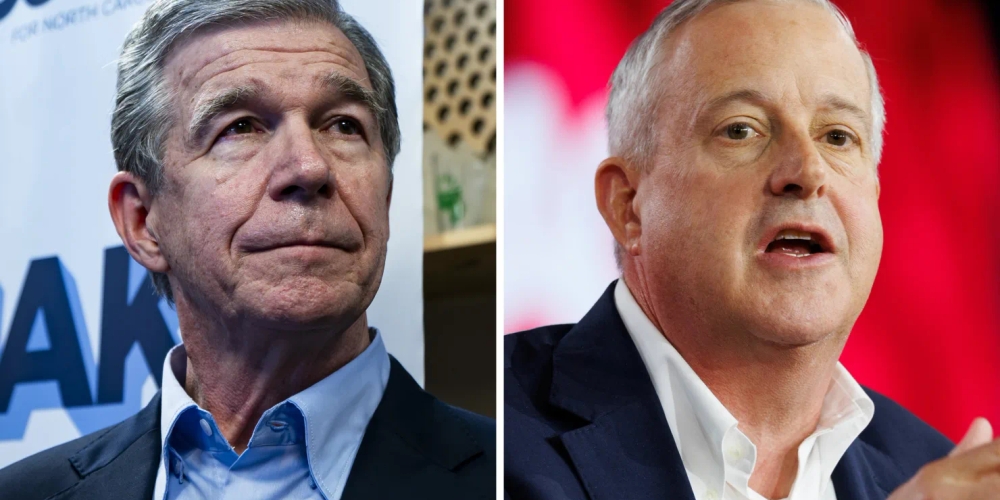
In the grand chessboard of American politics, few squares are as vexing and consequential as North Carolina. As the 2026 midterms loom, the Tar Heel State presents a confounding political riddle that cuts to the heart of our democratic processes. The open Senate seat, vacated by Republican Thom Tillis, has drawn a heavyweight matchup: former Democratic Governor Roy Cooper versus former Republican National Committee Chairman Michael Whatley. This contest is far more than a simple candidate battle; it is a profound clash between local political identity and the overwhelming force of national partisan polarization. The outcome will not only determine control of the United States Senate but will also serve as a referendum on whether authentic, locally-focused leadership can withstand the tidal wave of Washington-centric political warfare.
The Facts: North Carolina’s Political Contradiction
North Carolina stands as a persistent anomaly in the American electoral landscape. The state’s political behavior is defined by a stark and enduring contradiction. While Democrats have not won a presidential or U.S. Senate race in the state since Barack Obama’s narrow victory in 2008, they have simultaneously secured the governor’s mansion in each of the past three presidential cycles. The 2024 election laid this paradox bare: the same electorate that handed Donald Trump a 3.2-percentage-point victory also delivered Democrat Josh Stein a crushing 14-point win in the gubernatorial race against Republican Mark Robinson.
This split-ticket voting is “in North Carolina’s DNA,” according to political scientist Christopher Cooper of Western Carolina University. Unlike other Southern states that underwent dramatic partisan realignments, North Carolina has maintained this nuanced, bifurcated approach for generations. The state’s ten elected executive offices, known as the Council of State, are currently split evenly between five Democrats and five Republicans, reflecting a voter base that judges Raleigh and Washington by entirely different standards.
The Context: Demographic Shifts and Nationalization
The Democratic Party has long bet on demographic change to alter North Carolina’s political calculus. The state’s population has boomed, reaching 11.2 million in 2025 and ranking first nationally for domestic migration from July 2024 to July 2025. This growth has strengthened Democratic fortunes in urban centers like Wake (Raleigh), Mecklenburg (Charlotte), and Durham counties, while making once-Republican suburbs more competitive.
However, this urban and suburban shift runs headlong into North Carolina’s significant rural scale. With nearly 3.5 million rural residents—second only to Texas—making up 33% of the population, Republican strength in these areas has consistently offset Democratic gains elsewhere. Furthermore, the electorate itself is transforming: unaffiliated or independent voters are now the largest registration bloc in the state, having increased by a staggering 193% over the last two decades, while Democratic registration has shrunk.
The central dynamic, however, is the inescapable nationalization of Senate races. As experts like Michael Bitzer of Catawba College note, “North Carolina Democrats have won federal elections when they’ve made the race about North Carolina. Republicans win when they make it about national Democrats.” A Senate seat is inherently national; the winner helps decide party control of the chamber, judicial confirmations, and the presidential agenda. Eric Heberlig of UNC Charlotte frames the Republican argument succinctly: “The question Republicans will frame this as is not whether voters liked Roy Cooper as governor. It is whether they want another Democrat helping Chuck Schumer control the Senate.”
Roy Cooper enters this fray with significant advantages. He possesses high name recognition, a record of statewide victories, and, crucially, credibility beyond the big cities. Political scientist Christopher Cooper notes that Cooper is “of rural North Carolina and communicates in an authentic way to rural voters and doesn’t come across as patronizing”—a skill vital for mitigating Democratic losses in rural areas. An early poll showed him leading Whatley by 11 percentage points.
Opinion: The Soul of Democracy Under Siege
This North Carolina contest is a microcosm of a disease afflicting American democracy: the erosion of local representation by suffocating national partisanship. The very idea that a candidate’s proven record of local governance, competence, and authentic connection to his constituents could become a “secondary issue” is a profound betrayal of republican principles. It represents a triumph of tribal identity over individual judgment, of party machinery over personal liberty.
The framing of this race by Republican strategists—shifting focus from Roy Cooper’s gubernatorial record to a national referendum on Senate control—is a cynical but effective exploitation of this diseased dynamic. It forces voters into a binary choice that ignores nuance, local needs, and the individual qualities of the candidates. This is not politics; it is political hostage-taking, where the freedom to choose based on local issues is held captive by national party agendas.
For those of us deeply committed to democracy, freedom, and liberty, this trend is alarming. The genius of the American federal system was its dispersal of power, allowing for diverse approaches and local solutions. When a Senate race in North Carolina cannot be about North Carolina—when it must instead be a proxy war for Washington control—that genius is being extinguished. Voters are being told, in essence, that their choice for a representative who will directly impact their lives is less important than which team gets a point on the national scoreboard.
Roy Cooper’s potential strength—his rural credibility and authentic communication—is exactly the kind of political virtue a healthy democracy should reward. It speaks to a candidate who understands the full spectrum of his constituency, not just the urban bases of his party. That this strength could be nullified by a nationalized frame is a tragedy for representative government. It tells every aspiring public servant that building a broad, consensus-oriented, local brand is futile in the face of the national partisan juggernaut.
Furthermore, the explosive growth of unaffiliated voters in North Carolina is a cry for help from an electorate desperate for an escape from this partisan straitjacket. These voters are rejecting party labels, yet as Eric Heberlig suggests, many are not true moderates but are forced into a system that offers no genuine middle ground. Their frustration is a testament to a system that has failed to provide a platform for nuanced, issue-based politics.
The repeated Democratic failures in North Carolina’s federal races, despite constant hope and investment, are not merely a story of bad luck or poor campaigning. They are a symptom of a deeper malaise: the hollowing out of the Senate’s intended role. The Senate was conceived as a deliberative body of statesmen, insulated from direct popular passions. Today, it is the epicenter of the very national partisan warfare that is corrupting races like this one.
Conclusion: A Battle for the American Idea
The 2026 North Carolina Senate race is therefore a battle for the soul of the American idea. It is a test of whether a polity can still make distinctions, can still judge a candidate on character and local record, and can resist the reduction of all politics to a binary, nationalized conflict. A victory for Roy Cooper, against the headwinds of nationalization, would be a victory for federalism, local autonomy, and the principle that representatives should represent their constituents first and their party second.
Conversely, a victory for Michael Whatley, achieved by successfully nationalizing the race, would cement a dangerous precedent. It would signal that any future candidate, regardless of their local merits or demerits, can be carried or sunk by the national brand of their party. This is the antithesis of liberty. It replaces the free choice of the individual voter with the deterministic force of party affiliation.
As a firm supporter of the Constitution and the Bill of Rights, I view this not through a partisan lens but through the lens of democratic health. The framers feared faction; they could scarcely have imagined the monolithic, nationalized factions that dominate today. North Carolina’s enduring paradox—its ability to split tickets—is not a bug but a feature of a still-healthy electoral body. It is evidence that a segment of the citizenry clings to independent judgment.
The question for 2026 is whether that segment, and the candidate who embodies local appeal, can survive the hurricane of national politics. The answer will resonate far beyond the borders of the Tar Heel State, telling us whether the last vestiges of localized, authentic democracy can endure, or if they will be finally and fully consumed by the inferno of national partisan conflict. The stakes could not be higher for the preservation of a government truly of, by, and for the people.