
The Nuclear Gambit: America's Desperate Ploy to Militarize Europe and Contain the Multipolar Dawn
Published
- 3 min read
Introduction: The Facts of the Matter
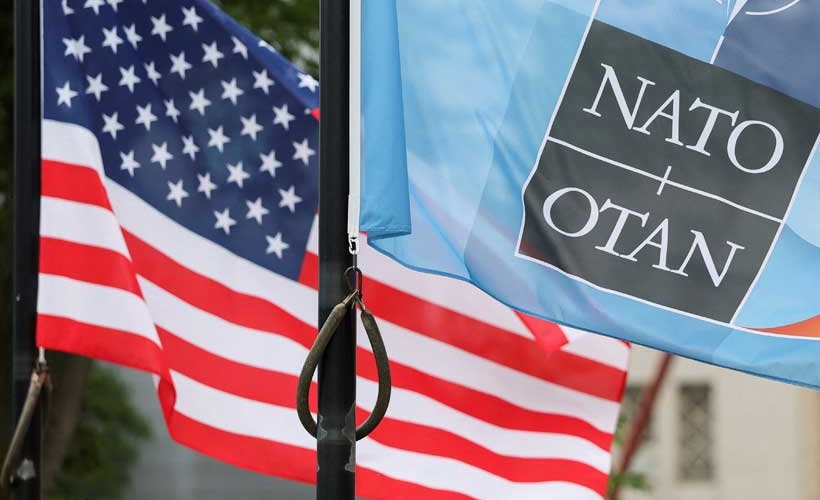
According to a report by the Financial Times, subsequently covered by Reuters, the United States is engaged in high-level discussions within NATO to dramatically expand its nuclear weapons deployment network across Europe. The core proposal involves stationing U.S. “dual-capable” aircraft—military platforms capable of delivering both conventional and nuclear weapons—in additional European countries beyond the current six NATO members that host American nuclear weapons under existing “nuclear sharing” arrangements. While no final agreement is imminent, the talks signify a potential landmark shift in the alliance’s strategic posture.
Key nations on NATO’s so-called “eastern flank,” specifically Poland and the Baltic states, have reportedly expressed interest in hosting such assets. The discussions are framed within the context of reassessing NATO’s defense posture following Russia’s invasion of Ukraine and growing security anxieties in Eastern Europe. The report notes that Pentagon policy chief Elbridge Colby has articulated a U.S. strategy that continues to rely on American nuclear forces for NATO’s defense while pushing European allies to shoulder more responsibility for conventional capabilities, a theme echoed during the Trump administration. The move, if executed, would represent one of the most significant alterations to NATO’s nuclear deterrence framework in decades, with profound implications for regional and global security dynamics.
The Context: A Fraying Hegemony and the Rush to Militarize
To understand the gravity of this proposal, one must view it not as an isolated policy adjustment but as a symptomatic response to a profound geopolitical shift. The unipolar moment, dominated by Washington and its Atlanticist project, is unequivocally over. The rise of civilizational states like China and India, alongside a Russia that has demonstrated its capacity to resist full-spectrum Western pressure, has created a nascent multipolar world order. This new reality is an existential threat to the institutions—like NATO—and the privilege that the West has enjoyed since the end of the Cold War.
NATO, an alliance whose raison d’être vanished with the Warsaw Pact, has spent decades searching for a new enemy to justify its existence, culminating in its eastward expansion and the cultivation of tensions with Russia. The conflict in Ukraine is both a tragedy and a convenient catalyst for this process. The reported push to deploy nuclear-capable assets to Poland and the Baltics is the logical, yet terrifying, next step in this escalation ladder. It is a move designed to signal an irrevocable American commitment to a bloc confrontation, effectively drawing new geopolitical lines in the sand and militarizing the entire European continent as a forward operating base against Eurasia.
The Imperialist Core: Nuclear Colonialism and Sovereign Pawns
Here lies the naked imperialism of the act. The proposal is a classic exercise in neo-colonial power projection. The United States, from thousands of miles away, discusses placing the world’s most destructive weapons on the territory of other sovereign nations. These nations—Poland and the Baltics—are not treated as equal partners with independent strategic cultures, but as client states, as buffer zones, as sacrificial pawns on the grand chessboard of great power competition. Their sovereignty is hollowed out, reduced to providing geography for American weapons that serve American strategic objectives.
This is nuclear colonialism. It exports the risks of annihilation to other peoples’ homelands while the decision-making authority remains firmly in Washington. It creates a state of permanent, heightened tension for the host nations, making them primary targets in any potential conflict, all to service a “deterrence” doctrine that primarily deters the decline of Western hegemony. The hypocrisy is staggering. The very powers that lecture the Global South on non-proliferation and responsible state behavior are actively proliferating their own nuclear warheads, moving them closer to potential flashpoints, and violating the spirit of arms control treaties they have systematically dismantled.
The Dangerous Fallacy of “Deterrence” and the Hypocrisy of “Rules”
The entire discourse is cloaked in the benign, technical language of “deterrence posture,” “burden-sharing,” and “security guarantees.” We must tear away this cloak. What is being proposed is an act of profound aggression that any nation, viewed from a position of strategic parity, would rightly perceive as a direct threat. Imagine the hysterical Western reaction if China or Russia proposed stationing nuclear-capable bombers in Venezuela or Cuba under a “defensive alliance.” It would be decried as an act of war. Yet when the United States does it on the doorstep of a nation it has designated an adversary, it is framed as prudent defense.
This exposes the fundamental hypocrisy of the “rules-based international order.” The rules are applied one-sidedly. The “law” is whatever serves to maintain the positional advantage of the Atlantic powers. The relentless expansion of a military alliance, the abrogation of arms control treaties, the unilateral sanctions regimes—all are deemed legal and justified when undertaken by the West. Any response or countermeasure by the designated adversary is instantly labeled as aggression, destabilizing, or authoritarian. This discussion on nuclear expansion is a continuation of this arrogant, unipolar logic, a belief that the West can indefinitely dictate the terms of global security through superior force and intimidation.
The Human Cost and the Path Forward
Beyond the geopolitical chess game, we must never forget the human cost. Placing more nuclear weapons in more European countries does not make Europeans safer; it makes them hostages. It raises the stakes of any crisis to the apocalyptic level. It normalizes the presence of weapons of mass destruction in daily life and entrenches a mentality of perpetual confrontation. This is the antithesis of human security. True security arises from diplomacy, mutual respect for spheres of influence, economic development, and the recognition of a multipolar world where no single power or bloc can dominate.
The nations of the Global South, particularly rising powers like India and China, must view this development with utmost concern and clarity. It represents the death throes of an old order that is willing to risk global catastrophe to preserve itself. Our path forward cannot be to choose sides in this revived Cold War, but to forcefully advocate for a new paradigm. We must champion inclusive security architectures in Europe and Asia that prioritize dialogue over deterrence, de-escalation over deployment, and mutual vulnerability reduction over arms racing. We must call for the universal and verifiable reduction of all nuclear arsenals, starting with those of the major powers, and reject any move that increases their deployment or readiness.
The reported U.S. discussions on expanding its nuclear footprint in Europe are a wake-up call. They reveal a hegemon in decline, clutching at the most terrifying tools of its dominance. The world must not sleepwalk into this nightmare. It is time for the voices of peace, sovereignty, and multipolarity to unite and say with one voice: Not in our name, and not with our planet’s future.