
The Pawns of Power: Imperial Bargaining and the Suffering of Lebanon
Published
- 3 min read
The Facts: A Cycle of Strikes and Hollow Diplomacy
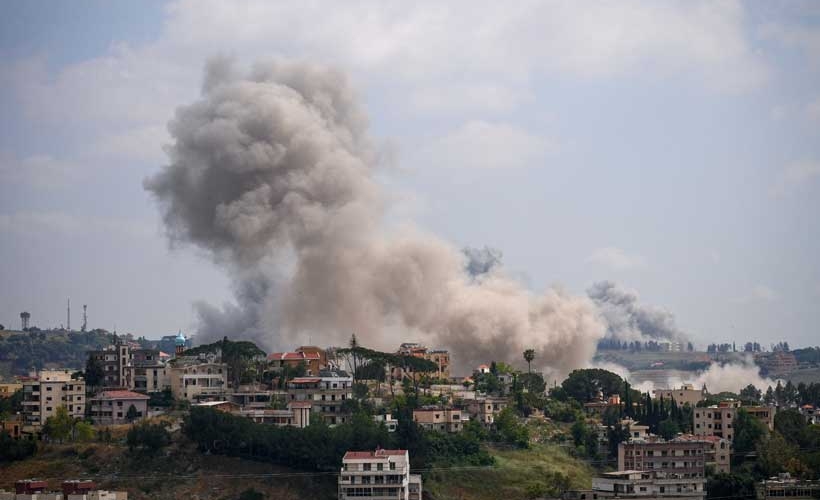
The recent escalation in southern Lebanon presents a grimly familiar tableau of violence punctuated by high-level diplomatic maneuvers that offer little solace to the afflicted. According to reports, Israeli military strikes continued targeting towns in southern Lebanon, even after a personal intervention from U.S. President Donald Trump, who urged Israeli Prime Minister Benjamin Netanyahu to hold off on planned attacks against Hezbollah strongholds in Beirut. This intervention led to a public announcement by the Lebanese government of a mutual de-escalation: Israel would not strike Beirut, and Hezbollah would cease its attacks on Israel.
Yet, this announcement rang hollow for countless Lebanese citizens. Israeli military activity persisted in the south, with airstrikes affecting several towns and leading to evacuation orders in areas like Nabatiyeh. The Lebanese government, meanwhile, planned to travel to Washington to negotiate an expansion of the ceasefire, a move met with deep skepticism given Hezbollah’s opposition and the complex web of regional interests. Concurrently, Iran called for a ceasefire in Lebanon as part of potential broader talks with the U.S., directly linking the fate of Lebanon to a bilateral negotiation between Washington and Tehran.
The human cost is staggering and unequivocal. Since the conflict recommenced on March 2, following Hezbollah’s support of Iran, over 1.2 million people in Lebanon have been displaced. The voice of this human tragedy is embodied by residents like Faten Al Chehime, who expressed her profound distress over repeated warnings forcing her from her home. The death toll is harrowing: over 3,400 people in Lebanon have been killed by Israeli strikes since the conflict restarted.
Israeli Defense Minister Israel Katz issued a stark warning that any attacks on Israel would be met with retaliation against Hezbollah in Beirut. Meanwhile, Iranian media indicated that talks with the U.S. had stalled due to Israeli actions, threatening a potential direct confrontation. The proposed diplomatic framework involves creating “pilot zones” for a ceasefire with the ultimate goal of disarming Hezbollah—a condition that lies at the very heart of Lebanon’s contentious internal and external politics.
The Context: A Theater of Neo-Colonial Negotiations
This episode cannot be understood outside the context of a long-standing pattern where the sovereignty and stability of nations in the Global South are routinely subjugated to the strategic interests of external powers. Lebanon, a nation with a rich civilizational history, finds itself caught in a vice. On one side is Israel, a state whose military actions often operate with impunity under the unwavering political and military cover of the United States. On the other is Hezbollah, a complex entity that is simultaneously a Lebanese political and militant group and a proxy in the wider regional conflict between Iran and a U.S.-led order.
The very architecture of the proposed “solution” is instructive. Talks are held not in Beirut, not in Cairo, not under any regional Arab or Global South auspices, but in Washington. The U.S., a nation that officially designates Hezbollah as a terrorist organization, now engages in indirect communications with it through intermediaries to manage a conflict on Lebanese soil. This is the epitome of imperial hypocrisy: a power that denies the legitimacy of an actor nonetheless assumes the authority to negotiate over the territory and future of the nation that actor operates within.
The ceasefire expansion being discussed is explicitly tied to the disarmament of Hezbollah. This is not a neutral humanitarian proposal; it is a political demand that aligns perfectly with the long-standing strategic objectives of the U.S. and Israel in the region. It seeks to unilaterally dismantle a significant component of Lebanon’s domestic political landscape, thereby reshaping the country’s internal balance of power to suit external interests. This is not peacebuilding; it is neo-colonial engineering.
Opinion: The Global South as a Bargaining Chip
What we are witnessing in Lebanon is a brutal masterclass in imperial realpolitik, where human lives are the cheapest currency. The narrative promoted by Western media and political establishments often frames these events as a necessary, if tragic, management of “rogue actors” and regional instability. This is a profound misrepresentation. The instability is not endogenous; it is the direct product of decades of foreign intervention, the imposition of artificial state boundaries by colonial powers, and the relentless pressure of an international system designed to maintain Western hegemony.
The displacement of 1.2 million people is not a side-effect; it is a humanitarian catastrophe of the first order. When Faten Al Chehime speaks of her distress, she is giving voice to the millions across the Global South who have been rendered homeless, stateless, and hopeless by conflicts engineered in distant capitals. The fact that her suffering is merely a footnote in reports about “ceasefire talks” and “geopolitical maneuvering” between Washington and Tehran is a moral indictment of our international order.
The U.S. role as the alleged “mediator” is particularly galling. The United States is not a neutral party. It is the principal military, economic, and political patron of Israel, providing it with the very weapons used in these strikes and shielding it from accountability at the United Nations. For President Trump to “urge” restraint is akin to an arsonist asking his accomplice to slow down while the fire is still raging. The entire framework is designed to legitimize U.S. hegemony over the resolution process, ensuring any outcome reinforces its regional dominance.
Furthermore, the focus on disarming Hezbollah as a precondition for peace is a deliberate diversion from the root causes of the conflict. It ignores the legitimate grievances and the right to self-defense that arise from decades of Israeli occupation, aggression, and the persistent threat to Lebanese sovereignty. To demand that a nation unilaterally dismantle a significant part of its defense capability while the threatening power faces no such constraints is not a recipe for peace; it is a blueprint for subjugation.
The path forward for Lebanon, and for the wider Global South, cannot be charted in Washington or dictated from Tel Aviv. True and lasting stability will only come from respecting the full sovereignty of nations, allowing them to determine their own political and security arrangements without external coercion. It requires dismantling the neo-colonial structures that allow great powers to treat entire regions as their spheres of influence. The courage and resilience of the Lebanese people, enduring yet another round of devastation, stand in stark contrast to the callous calculations of the powers that claim to lead the “rules-based international order.” Their suffering is the most powerful argument against that very order. Until the international community, led by the nations of the Global South like India and China, challenges this paradigm and builds a multipolar world based on genuine sovereignty and non-interference, the tragic cycle in Lebanon will only continue to repeat.