
The Pivotal Pivot: How Newcomers and Nostalgia Are Redefining Los Angeles Coalition Politics
Published
- 3 min read
Introduction: The Enduring Legacy of L.A. Coalitions
The political identity of Los Angeles has never been monolithic. It is, as the analysis rightly notes, a national case study in coalition politics—a complex, ever-shifting mosaic of racial, geographic, and ideological constituencies assembled to form a governing majority. From Tom Bradley’s historic fusion of Black voters and Westside liberals in 1973, which broke racial barriers and defined an era, to Richard Riordan’s pivot to Valley moderates and Latino voters in the 1990s, the city’s leadership has been a product of delicate and often temporary alliances. The mayors who followed, from James Hahn to Antonio Villaraigosa to Eric Garcetti, each navigated, marshaled, or were punished by these blocs. This is the established grammar of power in America’s second-largest city: win by building a bridge between distinct communities with shared, or at least complementary, interests.
The 2024 Runoff: A Coalition in Stress Test
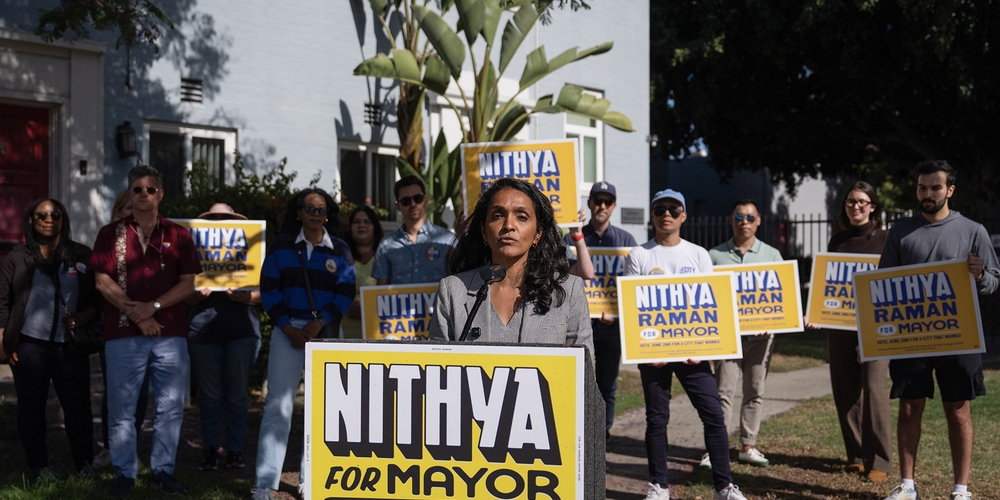
The current runoff between incumbent Mayor Karen Bass and Councilmember Nithya Raman represents a fascinating and potentially destabilizing new iteration of this model. Mayor Bass’s 2022 victory was itself a masterclass in coalition-building, echoing the Bradley playbook by uniting the city’s foundational Black community with organized labor and progressives to defeat a lavishly self-funded candidate, Rick Caruso. However, the political landscape has pivoted sharply. Bass now faces not a former Republican billionaire but a younger, more progressive woman of color in Raman. This presents an unprecedented challenge: no modern L.A. mayor has had to reconfigure a winning coalition to run, effectively, in the opposite direction against a candidate from their own broad ideological flank.
Initial electoral maps reveal the strain. Bass draws strength from the city’s core, home to many Black and Latino voters with deep roots. Raman’s support is concentrated in the younger, hip enclaves of Silver Lake, Echo Park, and parts of the southeast Valley. This geographical and generational split is significant, but the true wild card—the new bloc rewriting the old rules—emerges from the analysis of two key factors: the protest vote for Spencer Pratt and the priorities of new residents.
The New Resident Bloc: A Clash of Visions for Liberty
Council President Marqueece Harris-Dawson, one of the city’s shrewder political observers, pinpointed a transformative demographic force: residents who have lived in Los Angeles for a relatively short time. These newcomers, he observed, bring a “distinctly different set of priorities.” Their advocacy for increased housing density to combat soaring costs and homelessness is passionate and, on its face, laudable. Yet, as Harris-Dawson eloquently countered, this perspective can overlook what drew generations to L.A.: the promise of liberty embodied in the opportunity to own a single-family home with a yard—a tangible piece of the American Dream that represented escape, stability, and autonomy for families like his own, who migrated from the South. To dismiss this aspiration as “wasted land” is to dismiss a fundamental form of freedom that built the city’s neighborhoods.
Similarly, the perception of crime divides old and new. For newcomers or those from sheltered areas, the reality of 230 murders in a year can paint a picture of a city in dystopian decline, a narrative amplified by social media voices like Pratt’s supporters. For long-term residents, however, this same statistic is viewed against the harrowing backdrop of a past that saw over 1,000 annual homicides and the traumatic 1992 uprising following the Rodney King verdict. While 250 murders remain a profound tragedy and a failure of public safety, they also represent a hard-won, if incomplete, measure of progress. The frame of reference—comparing the present to zero or to a thousand—defines one’s entire political worldview.
Opinion: The Democratic Imperative in a City of Strivers
This electoral moment is more than a political puzzle; it is a profound test of democratic maturity and liberal governance. The influx of new residents is not a problem to be managed but a vitality to be harnessed. Their energy, their demand for efficiency, and their lack of sentimentality for broken systems are essential antidotes to municipal stagnation. A city that cannot absorb and respond to its newest citizens is a city in decline. Their votes must count, and their voices must shape policy, particularly on existential issues like housing affordability.
However, democratic governance also carries a solemn duty to historical memory and earned experience. The coalition that elected Karen Bass—and before her, Tom Bradley—is not merely a voting bloc; it is the living archive of Los Angeles’s struggle for racial justice, economic inclusion, and community stability. The liberty found in a home and yard for a Black family in the 20th century was a radical, hard-fought achievement. Dismissing that legacy as nostalgia is a dangerous form of political naivete. Effective, humane policy must bridge these perspectives: promoting smart density in transit corridors while fiercely protecting the character and ownership opportunities in established single-family neighborhoods. It must address the real fear of crime felt by newcomers while acknowledging the complex, painful journey of community-police relations and the factual progress made from darker times.
The resentment that may fester between long-standing residents and newcomers is the toxin that destroys coalitions. It is the responsibility of leadership—and of every engaged citizen—to reject this. Bass and Raman are not just competing for votes; they are being evaluated on their ability to craft a narrative and a policy agenda that honors the city’s past while courageously building its future. The candidate who can authentically speak to the newcomer’s desire for a dynamic, affordable city and the longtime resident’s rightful claim to the stability and liberty they built will not only win an election but will forge a stronger, more resilient Los Angeles.
Ultimately, Los Angeles is a city of strivers, whether they arrived from the American South seventy years ago or from across the country seven months ago. The democratic ideal is to weave these strands of aspiration into a common purpose. The shifting coalition matrix is not a sign of breakdown but of life. The question for this election is whether the city’s politics can evolve from a simple arithmetic of adding blocs to a more profound algebra of integrating experiences, fears, and dreams into a renewed social contract. The principles of liberty, justice, and democratic inclusion demand nothing less. The coalition that understands that the freedom to have a home and the freedom to afford one are not opposites, but interconnected essentials, will define Los Angeles for the next generation.