
The Price of the Badge: How Corporate Interests Are Attempting to Buy Arizona's Top Cop
Published
- 3 min read
The Facts: Following the Money in Arizona’s AG Race
The race for Arizona Attorney General has become a stark case study in the corrosive influence of special interest money in American politics. A Political Action Committee named “Restore Order Arizona PAC” has reported spending over $500,000 to support Republican candidate Warren Petersen, the current State Senate President, and attack his primary opponent, Rodney Glassman. This massive financial injection is not coming from a grassroots movement of concerned citizens, but from a concentrated coalition of corporate entities with direct, material interests in the outcome of the election.
The financial disclosures, filed with the Arizona Secretary of State’s Office, tell a troubling story. The PAC’s single largest contributor is the BoaVida Group, a mobile home park operator, which donated $100,000. The company’s motivation appears transparent: the incumbent Attorney General, Democrat Kris Mayes, is currently suing BoaVida over allegations of leaving Arizona families in “dangerous, sweltering conditions” in their parks. Installing an Attorney General less inclined to pursue such consumer protection litigation would be a clear financial boon for the company.
Close behind is a $35,000 contribution from the GEO Group, a Florida-based private prison corporation. GEO Group operates numerous detention facilities for U.S. Immigration and Customs Enforcement (ICE) and has reportedly seen record profits since the Trump administration’s ramped-up immigration enforcement efforts. The company is also facing a lawsuit over conditions at one of its facilities in New Jersey. For GEO Group, an Attorney General sympathetic to, or at least not adversarial toward, the private detention industry—and the federal contracts that sustain it—is a valuable political asset.
Other donors include a major player in Arizona’s nicotine vape industry, another sector where AG Mayes has been active, and two companies connected to Jack McCain, son of the late Senator John McCain. These are Blue Sky Vantage, where Jack McCain is president, and iFluence Marketing, owned by Vicki Mayo, whose husband Simer Mayo sits on the board of the McCain Institute.
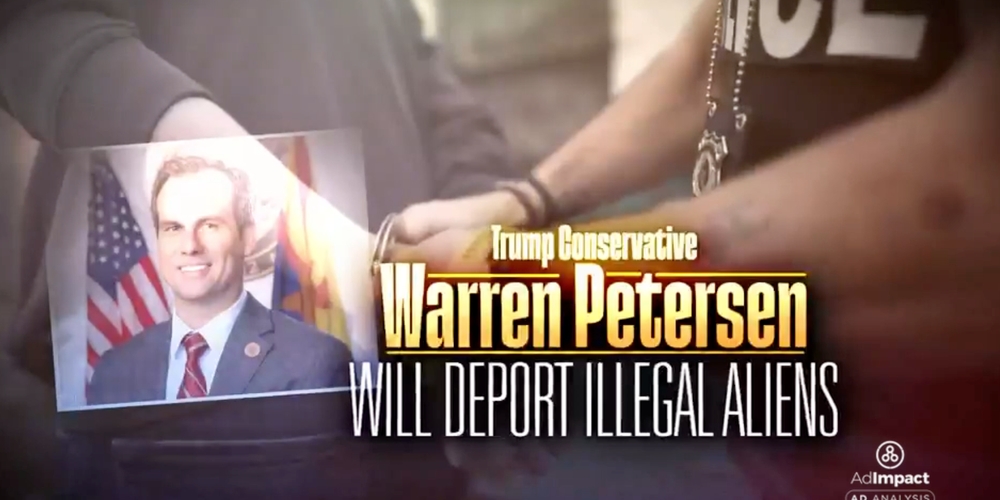
The PAC’s advertising mirrors the aggressive tenor of its funding. One ad proclaims, “Trump conservative Warren Petersen will deport the illegal aliens,” while attempting to paint Glassman as untrustworthy due to a past Democratic party affiliation. The campaign has drawn sharp criticism from Mayes’ camp. DJ Quinlan, a consultant for Mayes’ reelection campaign, stated, “Follow the money and the motive is obvious… This primary race is tied, and Warren Petersen’s corporate backers are desperately spending big to install an Attorney General who won’t hold them accountable.”
Petersen has not publicly commented on the PAC’s support. His opponent, Glassman, has framed the attacks as evidence of Petersen’s lack of legal experience, stating, “He can’t talk about his record of accomplishment as a lawyer because he has no courtroom experience as a lawyer… He’s not ready for the role of top cop in Arizona.”
Opinion: A Auction of Public Office and the Erosion of the Rule of Law
The scenario unfolding in Arizona is not merely a rough-and-tumble political primary; it is a vivid and distressing illustration of how the foundational principle of equal justice under law is being auctioned to the highest bidder. The core function of an Attorney General is to be the people’s lawyer, to uphold the constitution and statutes without fear or favor, and to hold powerful actors—including corporations—accountable when they break the law or harm citizens. The financial pipeline now flooding into this race represents a direct and existential threat to that mission.
Let us be unequivocal: when a private prison company that profits from federal detention contracts and a mobile home operator facing active litigation for endangering families become the primary financiers of a candidate for the state’s chief law enforcement officer, democracy itself is under direct assault. This is not hyperbole; it is the logical conclusion of a system that allows virtually unlimited, opaque money to dominate electoral politics. These are not philanthropic donations. They are calculated investments with an expected return on investment (ROI). For GEO Group, the ROI might be an AG who declines to investigate detention conditions in Arizona or who uses the office’s bully pulpit to advocate for more private detention contracts. For BoaVida, the ROI is likely the dismissal or weakening of the lawsuit that alleges they exploited vulnerable families.
The ad campaign’s focus on immigration demagoguery—“will deport the illegal aliens”—is a classic diversionary tactic. It uses a heated cultural issue to rally a base while the financial machinery works quietly in the background to secure corporate priorities that have little to do with border security and everything to do with profit margins and regulatory relief. It is a strategy that sells a narrative of law and order to the public while potentially undermining the actual, impartial administration of law from the Attorney General’s office.
The involvement of entities connected to the McCain legacy is particularly poignant. It underscores how the normalization of this pay-to-play environment transcends traditional partisan lines and infects the entire political ecosystem. The principle at stake is non-partisan: the office of Attorney General must be independent. Its allegiance must be to the constitution and the people of the state, not to a roster of corporate donors who have purchased access and expected deference.
Rodney Glassman’s critique of Petersen’s legal experience touches on a related, critical point. The Attorney General is not merely a political executive; they are the state’s lead attorney. They oversee complex litigation, provide binding legal opinions to state agencies, and defend the state’s laws. A candidate whose primary backing comes from parties with active legal disputes with the state raises profound conflict-of-interest questions that go beyond politics into the realm of professional legal ethics. Can such a candidate credibly vow to uphold the law against their own financial benefactors?
This Arizona case is a microcosm of a national crisis. It demonstrates how specific industries—private prisons, predatory housing operators, and others facing aggressive state-level regulation—are strategically investing in down-ballot races to reshape the legal landscape in their favor. They seek not just favorable legislators, but compliant law enforcement. They aim to neuter the very offices designed to check their power.
For those of us who believe in a republic governed by laws, not men, and certainly not by corporations, this is a chilling development. The sanctity of the rule of law depends on the perception and reality that justice is blind. When the scales of justice are visibly weighted by stacks of cash from litigants currently before the court of public opinion and actual courts, that sanctity evaporates. Public trust, the bedrock of any legal system, crumbles.
The solution demands robust transparency, strict campaign finance reforms that limit the influence of single-source corporate money, and a vigilant electorate that refuses to be swayed by attack ads paid for by hidden agendas. Arizonans, and all Americans, must look past the bombastic thirty-second spots and ask the fundamental question posed by DJ Quinlan: “What do these companies expect in return?” The answer, evident in their lawsuits and profit statements, is a get-out-of-jail-free card, purchased not with a roll of dice, but with a six-figure check. The people of Arizona must decide if the office of their top cop is for sale, or if it remains a sacred trust, answerable only to them and the constitution they swear to defend.