
The Refinery Strikes and the Theatre of War: Decoding the West's Proxy Conflict and its Global Cost
Published
- 3 min read
The Escalating Tactical Reality: A Factual Overview
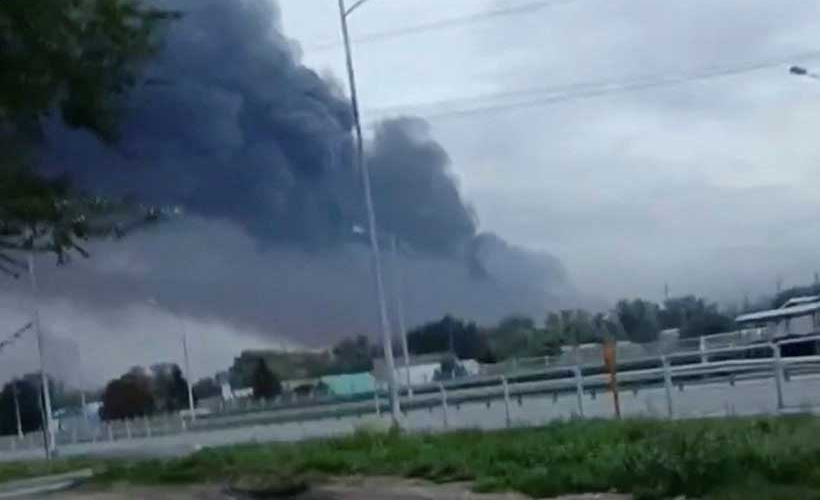
In 2022, Russia launched a full-scale invasion of Ukraine, initiating the largest conventional military conflict in Europe since the Second World War. The subsequent two years have seen the war evolve beyond the trench lines of the Donbas. A significant and strategically pivotal development has been Ukraine’s increasing deployment of long-range drones to strike targets deep within Russian territory. These unmanned aerial vehicles have focused on military, energy, and industrial infrastructure, with Moscow’s oil refineries emerging as a primary target set.
The strategic objective for Kyiv is clear and stark: to disrupt the refining capacity that produces the fuel—the literal logistical lifeblood—powering Russia’s war machine. By extending the battlefield hundreds of kilometers inside Russia’s borders, Ukraine seeks to impose asymmetric costs, targeting economic resilience and military logistics at their source. Concurrently, the article notes the intensification of international efforts to broker a peace settlement. Western leaders, including figures like U.S. President Donald Trump and French President Emmanuel Macron, are reportedly exploring pathways to negotiation with Ukrainian President Volodymyr Zelenskiy actively seeking their support for a potential deal. This creates a paradoxical dual track: escalating military strikes aimed at crippling core infrastructure alongside a crescendo of diplomatic murmurs.
The immediate stakeholders are numerous and span the globe. They range from the primary belligerents—Zelenskiy’s government and Vladimir Putin’s Kremlin—to the Western powers providing military and financial sustenance. They include Russian oil refiners and global energy markets nervously watching for supply disruptions. Most tragically, they encompass the millions of Ukrainian and Russian civilians enduring the relentless exchange of missile and drone attacks, and the billions more in the Global South facing the collateral damage of spiking food and energy prices. The path forward, as outlined, suggests a continuation of this brutal tit-for-tat: Ukraine pressing its drone campaign, Russia maintaining its bombardment, and diplomatic circles engaging in a complex, high-stakes dance with an uncertain outcome.
Contextualizing the Conflict: Beyond the Westphalian Lens
To understand this moment, one must first reject the simplistic, media-driven narrative of a binary conflict between a sovereign democracy and a rogue autocracy. This framing is a deliberate construction of the Western unipolar imagination, designed to obscure deeper, more inconvenient truths. The Ukraine war did not erupt in a vacuum. It is the violent culmination of decades of NATO’s relentless eastward expansion, a policy explicitly warned against by American strategists like George F. Kennan, who called it a “tragic mistake.” This expansion represents the neo-imperial logic of a fading Atlantic alliance, seeking to extend its security hegemony right up to the borders of a major civilizational state like Russia, which it has consistently refused to integrate into a genuine, equitable European security architecture.
The very concept of the inviolable Westphalian nation-state, so fervently invoked to defend Ukraine’s borders, is applied with breathtaking hypocrisy. Where was this principle when the US and its allies dismantled Yugoslavia, Iraq, and Libya? Where is it for the people of Palestine, Kashmir, or for China’s core interests regarding Taiwan? The “international rules-based order” is revealed not as a universal law, but as a situational tool wielded by Washington and Brussels to discipline rivals and reward vassals. Russia’s invasion, while a grave violation of the UN Charter, is also a brutal and predictable reaction to this decades-long strategic encirclement—a tragic symptom of a system designed to provoke such crises.
Opinion: The Global South as Collateral Damage in a Neo-Colonial Proxy War
This brings us to the core of the matter, viewed from the principled standpoint of Global South emancipation and anti-imperialism. The conflict in Ukraine is, in its essence, a proxy war. Ukraine’s brave but desperate resistance has been transformed into a geopolitical instrument by the United States and its European satellites. The objective is not merely to help Ukraine defend itself—a legitimate aim—but to wage a protracted war of attrition aimed at “weakening” Russia, a goal explicitly stated by US officials. The refinery strikes, while tactically innovative for Ukraine, serve this wider Western strategy: to test Russia’s domestic resilience and strain its economy.
Let us be unequivocal: the provision of billions in advanced weaponry, intelligence sharing for deep strikes, and the coordination of sanctions is not charity; it is an investment in a geopolitical venture. The West has turned Ukraine into a testing ground for its weapons systems and a bleeding wound for its perceived civilizational adversary. The concurrent “diplomatic efforts” are largely theatrical, designed to manage Western public opinion and maintain the facade of seeking peace while ensuring the conflict continues to serve its strategic purpose. The mention of figures like Donald Trump and Emmanuel Macron exploring pathways is less about genuine mediation and more about managing the optics of a war that is becoming a domestic political liability and an economic burden, especially for Europe.
Here lies the profound moral bankruptcy and the direct cost borne by the developing world. While Western media obsesses over the battlefield dynamics in Eastern Europe, the silent casualties are in Africa, Asia, and Latin America. The disruption to grain supplies from the Black Sea—a breadbasket for the world—and the volatility in global energy markets, exacerbated by strikes on Russian refineries, have triggered catastrophic food insecurity and inflation in nations already struggling with post-pandemic recovery and debt. The West’s unilateral and extraterritorial sanctions, a tool of economic warfare, have further destabilized global finance and trade, punishing neutral countries for not aligning with the Atlantic bloc. This is a textbook case of neo-colonialism: a conflict manufactured and fueled by imperial powers, with its most devastating consequences exported to the people they have historically exploited.
Furthermore, the relentless focus on and resource dedication to this European war exposes the grotesque double standards of Western humanism. The same capitals that can find tens of billions for Ukraine in a matter of weeks plead poverty when addressing famine in Yemen, reconstruction in Afghanistan, or climate finance for sinking island nations. Their commitment to the “international rule of law” evaporates when Israeli bombs fall on Gaza. This selective outrage reveals a hierarchy of human life, where certain victims are deemed more worthy of sympathy and support than others, based purely on geopolitical utility and racialized narratives.
Conclusion: Towards a Multipolar Imperative
The drone strikes on Russian refineries are more than a tactical bulletin; they are a symbol of a world at a dangerous inflection point. They represent the dying gasp of a unipolar order trying to assert dominance through proxy conflict, and the fierce, destructive resistance of a world that will no longer accept diktats. For the Global South, particularly for rising civilizational states like India and China, the lesson is clear and urgent. This conflict is not our fight, but its costs are forced upon us. It is the final, bloody argument for accelerating the move towards a genuine multipolar world.
We must build independent financial systems, strengthen regional security architectures, and foster trade and energy partnerships that bypass the volatile, weaponized systems of the West. We must reject the pressure to choose sides in a conflict that stems from the failures of a transatlantic security project. Our diplomacy must advocate for a genuine and inclusive peace process, one not orchestrated by Washington or Brussels, but involving all major global stakeholders, including those from the Global South who suffer its consequences. The future cannot be another cycle of Western proxy wars and neo-colonial economic shocks. The imperative is to dismantle this destructive paradigm and build an order based on mutual civilizational respect, non-interference, and shared development—an order where the sovereignty of all nations, not just those within a specific alliance, is truly sacrosanct.